
February 2026
All forty-one of us have now safely returned from Ukraine having delivered twenty-three pickup trucks, a minibus and over £150,000 of aid to our contacts in Lviv, Kyiv, Poltava and Dnipro. Thanks to the huge generosity of you our supporters we have over our eleven trips to date to Ukraine raised just under £1,800,000. This has enabled us to deliver a total of 108 pickup trucks, an ambulance, two minibuses and an ATV together with specialist medical equipment to various hospitals and large volumes of medical and humanitarian aid. Our next convoy leaves mid-June 2026 and if you are interested in joining us do please contact me.
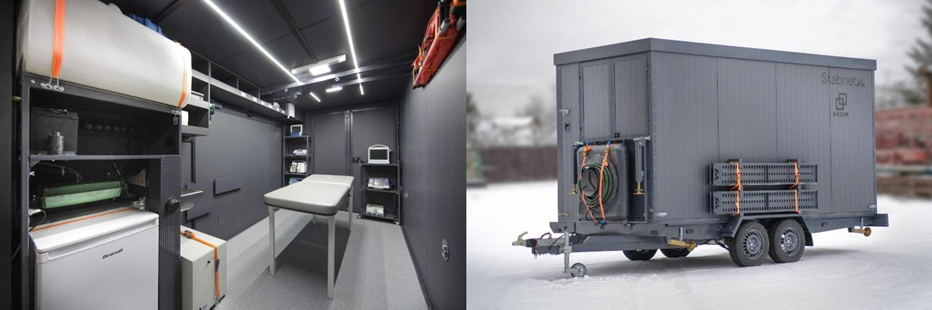
In June, as well as delivering trucks and aid, we will supply at a cost of 45,000 Euros one truly lifesaving fully equipped mobile ‘stabilisation container’ shown here which has already been funded by your donations. Thank you again for your generosity and support. Slava Ukraini!
Paul Parsons paul@convoy4ukraine.com
The Drivers
Nicholas Morse, Tim Morse, Michael Lee, Guy Sutton, Jonathan Baines , David Woodd, Paul Turner, Peter Gaskell, Philippe Lefevre, Monty Stuart-Monteith, Jim Yyoung, Michael Shipster, Paul Nevin, Storm Smith, Ian Wilson Young, Paris Back, Nigel Back, Paul Higham, Terry Gillett, Charlie Hastie Andrew Hudson, Matthew Atkin, Charles Prickett, Lois Prickett, Nick Taylor, Dominic Enderby, Anthony White, Thomas Buckle, Will Lewis , Rupert Douglas-Pennant, Richard Gladdle, Chris Moss, Gabrielle Liddy, Edward Allen, Andrew Post, Mary Aylmer, Hugh Ralli, Oleh Nayda, Archie Hainsworth, Nick Jacobs, Paul Parsons
Day 0 Prologue 12th February Towcester, Northamptonshire, UK
As the convoy team gathers, the fourth anniversary of the full-scale Russian invasion of Ukraine is looming. What an astonishing and awe-inspiring achievement by the Ukrainian people to have stood up to the might, ferocity and savagery of the world’s third superpower for four long summers and four bleak winters, and for Ukraine still to stand free and proud.
As we make our way that afternoon to Paul Parsons’ barns, where the vehicles are waiting, I think about the terrible price the Ukrainians are paying for their (and our) freedom as they endure the worst winter of the war. We know why they need the medical, humanitarian and rehabilitation equipment that we are going to be taking to Ukraine.
In recent months Ukraine has been pushed off the front pages and when we started raising funds for the Convoy we feared donor fatigue and wondered how hard it would be to persuade friends to give to Ukraine. But, astonishingly, our friends and colleagues are still digging deep into their pockets to support the work of Convoy4Ukraine. For this trip more than 1,500 supporters have donated more than £433,500 If you are one of those who has donated, huge thanks on our behalf and on behalf of the Ukrainian people.
This is the eleventh and largest convoy of aid to Ukraine that has been organised by Paul Parsons and Ant White. On the eve of our departure there are 22 vehicles and 41 drivers gathered as the dusk fell in Northamptonshire. A 23rd truck has already reached Ukraine. The trucks have been serviced and fitted with winter tyres ready for the journey, and they have been packed with aid. (There’s a full list of the equipment we bought in the appendix to this report.) We had no doubt that these tough vehicles would be up to the challenges they might face once in Ukraine. As for the drivers, maybe not so much?
I discovered that the 41 of us covered the full gamut, from experienced and eminently suitable for a trip like this, to rather the opposite. I am very much at the unqualified end of the spectrum. I am a recently retired barrister. I always anticipated a lot of travel in retirement. I just didn’t think it would be like this. Fortunately, my wife and co-driver Mary is better suited to this sort of thing: she’s a mechanical engineer and she drove a lorry load of aid to Poland in the 1990s.
I think all the newcomers feel apprehensive as we arrive. Nerves have been jangled a bit by messages about Air Raid Alert apps and Faraday pouches. But the veterans, reassuringly, seem calm. Talking to those veterans I realise why. Lots are ex-services, a couple are involved in racing driving, several are motorcyclists. One has flown a microlight from Bangalore to England. Another was with the Northern Alliance as they captured Kabul from the Taliban. I catch a moment with Mary: “Surrounded by all these alpha males, I’m feeling a bit beta”. “Maybe we’re the gamma bit of this convoy”.
Thursday’s task is easy, though. Testing out the trucks on the local roads. Ours is a sturdy, rugged Mitsubishi L200 with 120,000 miles on the clock, but it has been expertly serviced by Colin the dedicated mechanic and it drives and handles well. In the back is prosthetic equipment and a generator potent enough to power a mobile hospital.
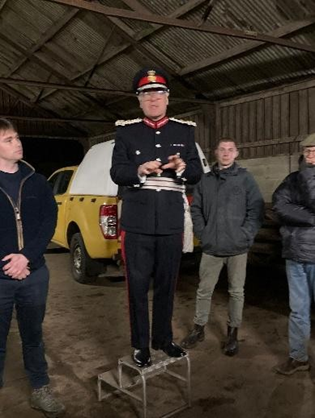
After the test drive, the send-off. Speeches by Ukrainians temporarily living locally and by the Lord Lieutenant of Northamptonshire in full uniform, before retiring to bed to sleep fitfully and to worry about what was ahead.
Day 1 Rain 13th February
Start Towcester, Northamptonshire, finish Dortmund, Germany.
Distance: 733 km
Countries: Five
Time on the road: 8½ hours
Time spent at borders: 4½ hours
Fuel stops: One
Wrong turnings: Two: Calais (but that was French Customs’ fault) and Antwerp
An early start for the first day of the long drive to Ukraine. Breakfast at 5.15 am, departure
at 6.00 am ready to slog our way to the tunnel terminal
where the convoy regroups and by chance we meet a
Welsh government-backed convoy going to Ukraine too.
But crossing borders isn’t easy in a convoy of 22. As the
cheery security check man who flags us down for an
inspection says “Aren’t there a lot of you this time? And on
the busiest day of the year so far.” So, queues for security,
queues for passports and queues for the train. (But fellow
driver Paris from Norfolk takes the opportunity to recruit
another driver who she meets on the train). And then we
discover that the French customs authorities were not
playing ball: we are told to report to an office in Calais
after unloading.
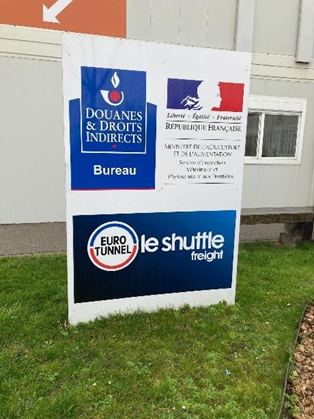
Unfortunately opinions differ as to where this customs office actually is and in spite of expert remote shepherding over WhatsApp from Paul, Archie and Oleh, rather a lot of us miss the crucial turning and find ourselves scattered around the sodden Pas de Calais trying to navigate back to the office, which turns out to be hidden in a desolate freight terminal. Once reunited, we admire from a distance as Paul charms, cajoles and wrestles with the Douane bureaucracy before emerging
triumphantly with duplicate copies of a stamped manifest for every vehicle and its contents. Back on the road for an hour before a fuel stop and regroup just into Belgium. But after all the delays at and around the Shuttle it’s now late afternoon, and as we press on into Belgium we are also pressing on into Antwerp’s Friday rush hour.
Day 2 Fog (and rain and snow) 14th February
Start Dortmund, Germany, finish Gliwice, Poland.
Distance: 921 km
Countries: Two
Time on the road: 9 hours
Fuel stops: Three
Wrong turnings: Just a trifling scenic detour near Kassel
7.00 am breakfast, then trucks refuelled in time to set off at 8.00. It’s Valentine’s Day, but not as we know it. I try to make the best of it and ask what could be more romantic than an early start, a long drive and a rich variety of German and Polish motorway service areas? Capped off with provincial Polish food in a Silesian coal mining town. Perhaps I
will have to up my game next year.
Up into the wooded hills south of the Harz mountains, but also into cloud and fog shrouding what might have been fantastic views. Then down into the plains of Saxony and back into the rain, passing Leipzig, Colditz (“can’t we stop to go around the Castle?” “no, we’re literally on a mission”) and Dresden – just a glimpse in the distance of Florence on the Elbe, the jewel box of a city destroyed in the Allied firebombing raid of February 1945, and painstakingly reconstructed from Bellotto’s paintings. No time to see it on this trip, though.
Just after Dresden we cross the Polish frontier into the land of the unpronounceable ł and of excellent motorway service areas. We trundle for hours past the forests and across the vast wintry expanses of southern Poland. At some point the rain has turned to snow, and we arrive in Gliwice through snowfall in time to see the sights before dinner. Happily,
Gliwice turns out to be handsome and filled with mediaeval and baroque churches and Art Nouveau architecture. We lower the tone of the Valentine’s Day themed lobby of our Austro-Hungarian hotel for a while, and then head off for an architecture tour. We end by falling into a restaurant on the mediaeval Old Town Square. The rest of the clientele, loved
up Polish couples eating a deux, look a bit surprised to see we are choosing to celebrate our Valentine’s with 34 friends. The younger members of the convoy have found somewhere cooler to drink and dine and to celebrate Lois’ 20th birthday.
Some of the convoy are not so lucky. Archie and Oleh continue to work mechanical magic and resuscitate a ‘failing’ truck.
Day 3: Snow 15th February
Start: Gliwice, Poland, finish Lviv, Ukraine.
Distance: 432 km
Countries: Two
Time on the road: 8 hours
Time spent at borders: 2 hours
Fuel stops: One
Wrong turnings: None until the outskirts of Lviv
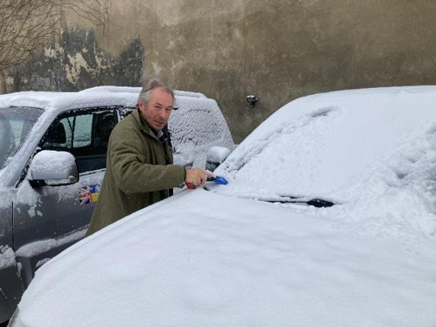
We wake to deep snow. Swift breakfast at 7.00 am and then time to scrape the snow off the vehicles. There are scrapers waiting for us, stuck into the snow on each bonnet – Archie and Oleh’s work as guardian angels is clearly a 24 hour operation.
I notice that the language of the WhatsApp messages is
getting more military as the border approaches: “don’t fill up: just muster. We get a pre-border briefing. Tight convoy now, and at the border we will switch to one Ukrainian
E-Sim per vehicle with other phones in a Faraday pouch and turned off. Then we’re given a short master class on convoy driving and a refresher on getting our loads through
Polish customs.
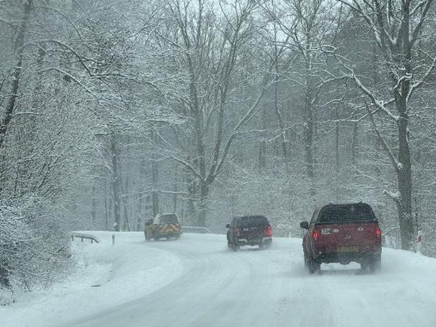
The convoy twists through dense, snowcovered forests and across icy steppe. The whole set-up could not be more cinematic: we all think of Cold War spy films and meetings at borders. Finally, the border post is in sight and
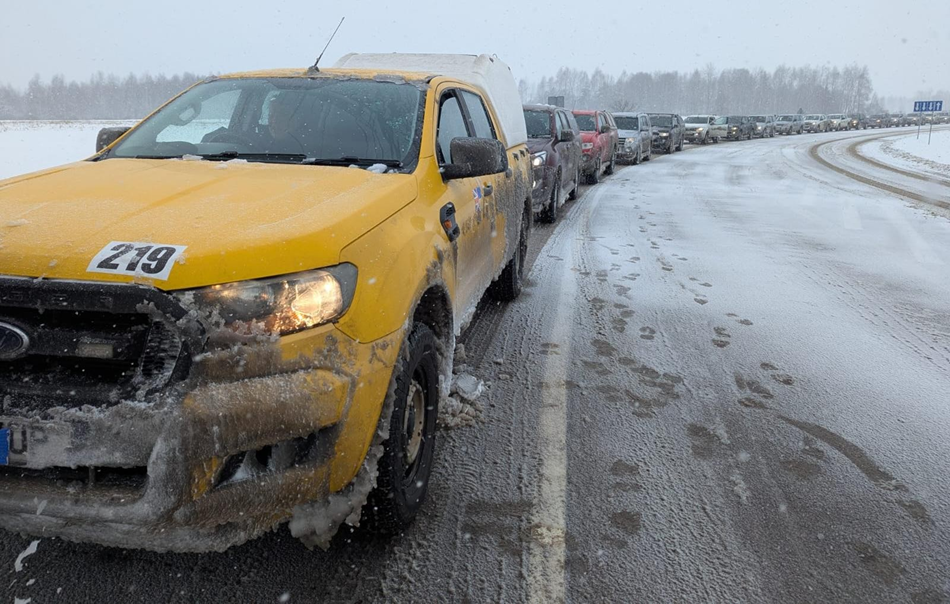
the line of 22 vehicles draws up in single file along the road. We are hugely fortunate that a visiting German border official takes charge and efficiently organises our arrival.
The magic of documents stamped by French customs
works. It is bitingly cold as we get out of the trucks to start to tackle the multiple hurdles of an old-style border. First task is cleaning the snow and ice off the number plates. Next is Polish Customs, which involves smashing the ice that has formed on the prow of the truck so we can open the bonnet to show the VIN. Then Polish passport control,
complete with registration for EU biometrics – but will my fingerprints be the same when it’s not many degrees below freezing? Next stage is to clean the ice that has reformed
during the last two checks off the numberplates so the camera can read them and open the barrier to Ukraine.
Ukraine’s formalities are quicker, but we still have time to read the Armed Forces of Ukraine’s border guard mission statement which includes treating us with ‘aimiability’ and, to be fair, they do, whilst Mary passes around candied pecans.
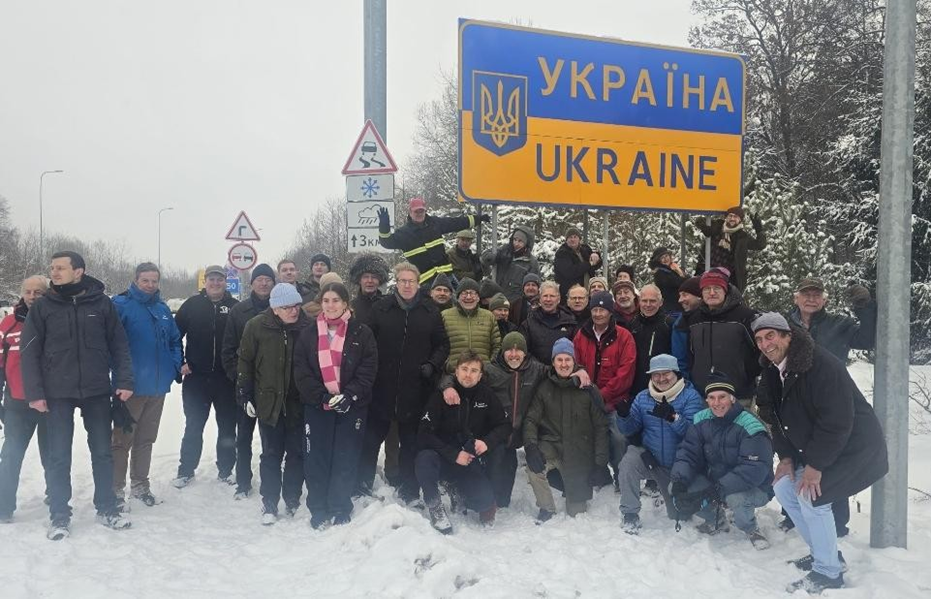
At last, all 22 vehicles and their drivers have been cleared; we are allowed out of the border compound and into Ukraine. We gather, excited and proud, for a group photo in front of the signboard marking the Ukrainian border. Then it’s a tight convoy through little villages, each with a magnificent onion-domed church in a different colour, and each with a graveyard with a fresh grave or two marked with National and Brigade flags, those of fallen soldiers. Village noticeboards are also covered with photographs honouring the dead or missing. As the convoy joins a main road the Ukrainian drivers hang back to let us pull onto the road as one unit.
By the time we’re into the suburbs of Lviv, convoy discipline has rather fallen apart and half a dozen trucks find themselves lost and in need of rescue by Oleh, our rearguard.
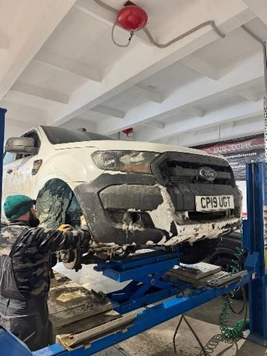
So it’s late by the time we laggards arrive at our secure parking, a trolley bus depot where Ihor, an old friend of the team and former mountain guide but now a wounded veteran, will guard them and their cargo. Central Lviv is disconcertingly normal: the shops, bars and restaurants are open (it is pre curfew) and there are lots of people out and about. Our hotel is stylish, and our dinner is a celebration of Lviv’s Austro-Hungarian heritage at the Vienna Coffee House complete with musicians playing waltzes and patriotic songs (the musicians an offering to us from the owners in thanks for our help to their country). Behind the scenes volunteer Ukrainian mechanics work to iron out a few niggles so that we are good to go in the morning.
Day 4 The point of it all 16th February In Lviv.
Hurried breakfast as ever, then minibuses to the trucks, to start our packed schedule of meetings with groups we support and handover of trucks and aid.
We’re on our way to the first appointment at 9am, when the entire city comes to a halt. Every pedestrian and car stops, every driver gets out, and all stand in silence for one minute as the daily act of solidarity with the armed forces of Ukraine and remembrance for all the victims of the war.
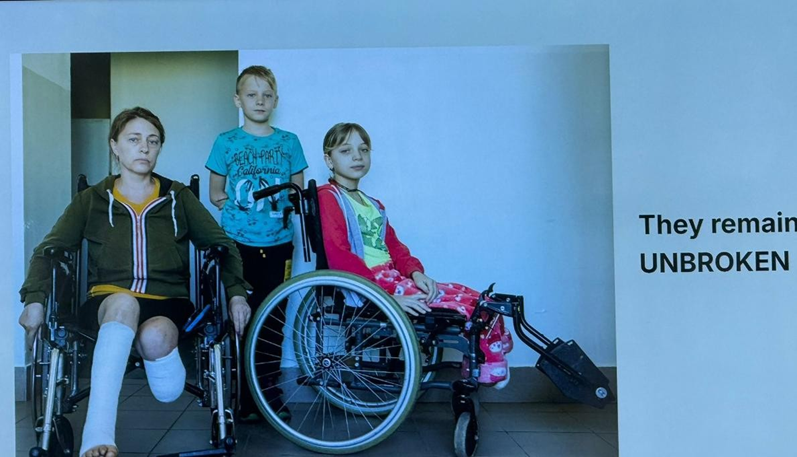
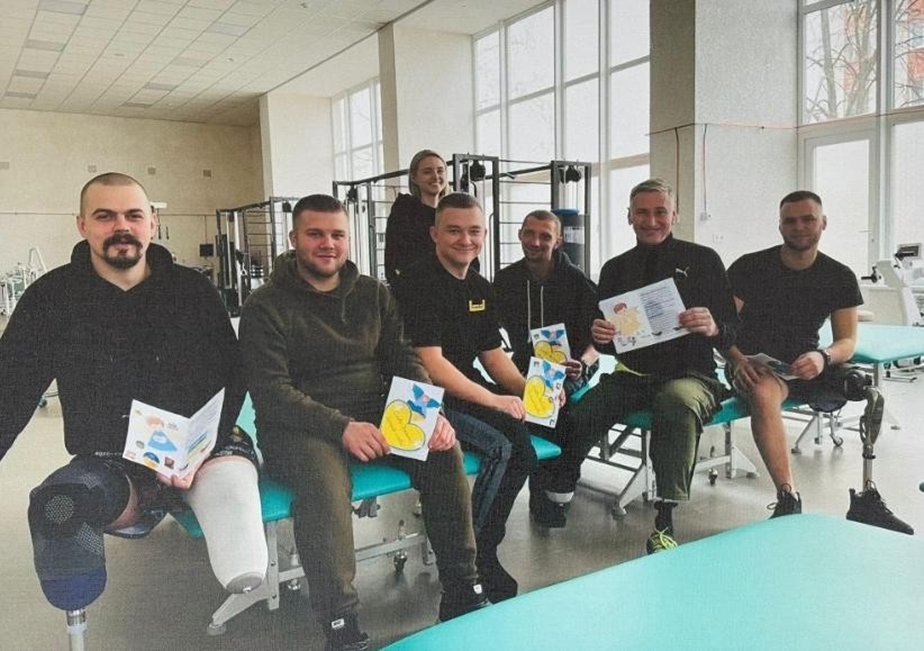
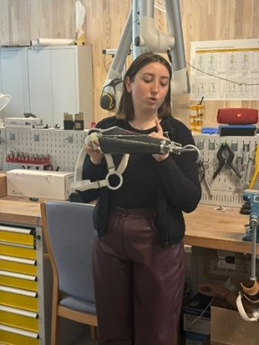
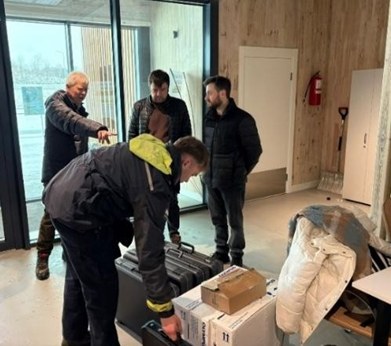
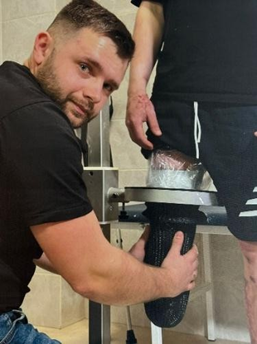
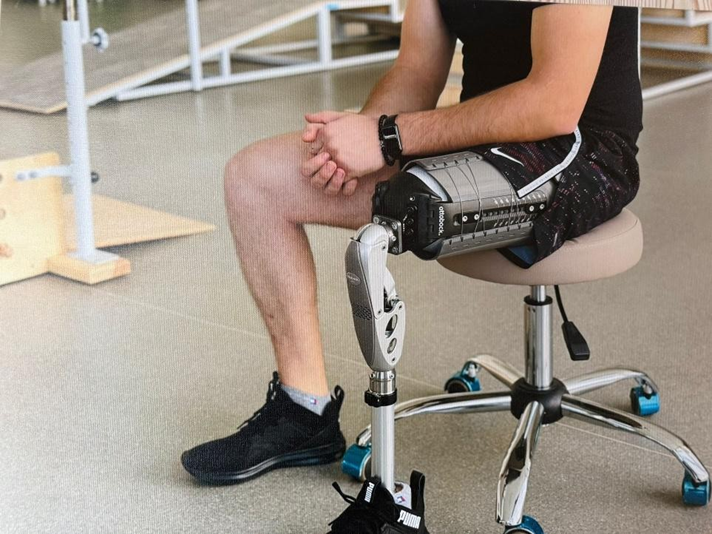
The need is vast. We are told that there are 250,000 patients in Ukraine in need of rehabilitation. We learn, too, that 30% of those fitted with prosthetics at the centre go back to fighting on the frontline.
We meet two of the surgeons who operate on the patients and hand over the equipment that they requested on the last visit both bought and generously donated: colonoscopes and gastroscopes, because many of the patients have gastro-intestinal injuries, and specialist skin grafting equipment. Unbroken hospital cares for the normal peacetime population of Lviv oblast but also the huge additional number of the internally displaced who have sought refuge in western Ukraine.
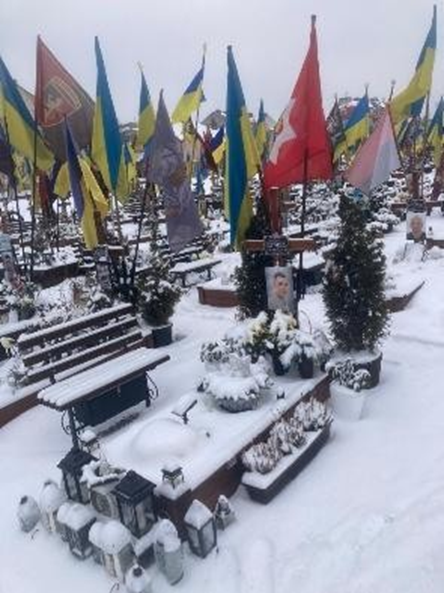
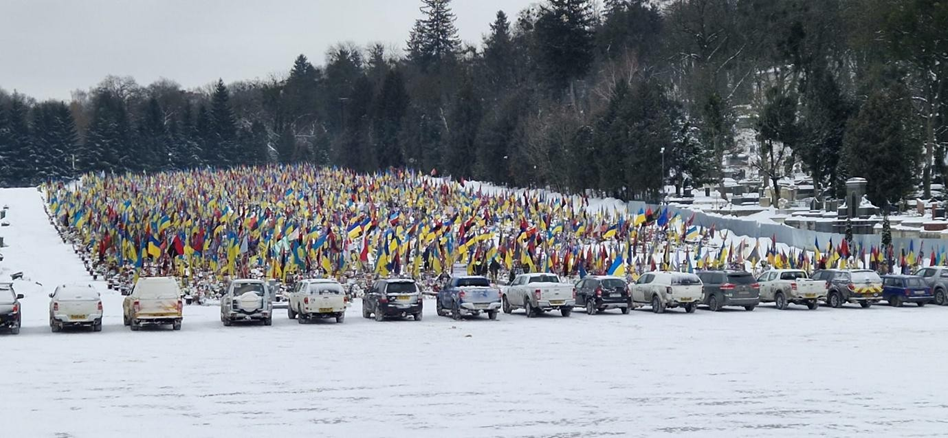
The next stop is the Field of Mars, the military cemetery for soldiers from Lviv from 2022 until the end of last year when it reached full capacity and the cemetry was closed. There are over one thousand graves, row upon row upon row. There’s always a photo of the fallen soldier and flags; often there are small mementos, flowers and candles and a little seat beside the grave; here and there across the vast cemetery a mother or wife is sweeping the snow off the grave. We wander along the lines of the dead looking at the photos. So many are so young – volunteers of 18. So many are so old – men in their sixties who had also been serving on the front line. There are men and women, young and old, some who look like soldiers, many who look like the teachers, clerks, farmers or whatever they were. There are tears in the eyes of every driver I pass. A new cemetery has been opened close by which in turn is filling. This scene is replicated in towns and villages across Ukraine.
On to Rizdva Presviatoyi Bohorodytsi Church where we meet the priests Frs Orest and Vasyl. All the vehicles are blessed by Fr Orest (as are we) and four are handed over to be driven by volunteers to distant parts of the country where the need is greatest.
We also meet Tetiana and Toma from the NGO ‘Ukraine Mother’ who provide support and equipment to the internally displaced, to those in need because of killing and maiming by the russians and to men and women serving their country. Tetiana and Toma are old friends, indefatigable in their voluntary work now undertaken without the help of their husbands who are serving.
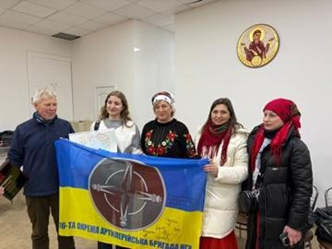
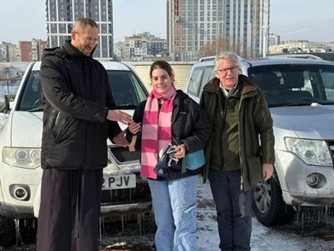
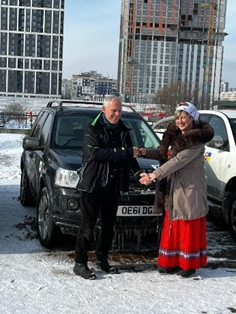
We hand over a huge amount of equipment: generators, power banks, tourniquets, stretchers and so much else that has been requested. The gratitude and warmth of Tetiana and her team cannot be overstated. We feel humbled.
The beautiful icons in the church remain unfinished as the icon painter Sviatoslav whom we meet later is serving in the army.
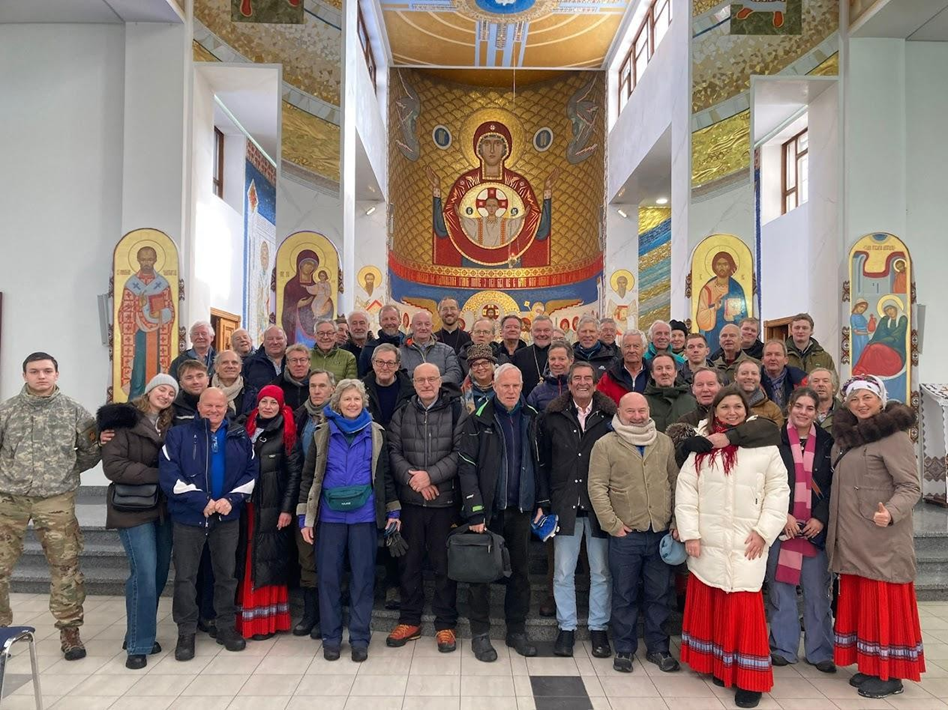
Then to the City Hall to hear from Oleksandr from Unbroken and Andrii, the charismatic deputy mayor responsible for veterans’ affairs. The challenge involved in reintegrating veterans is vast. It is even worse for former prisoners of war who have been tortured by the russians.
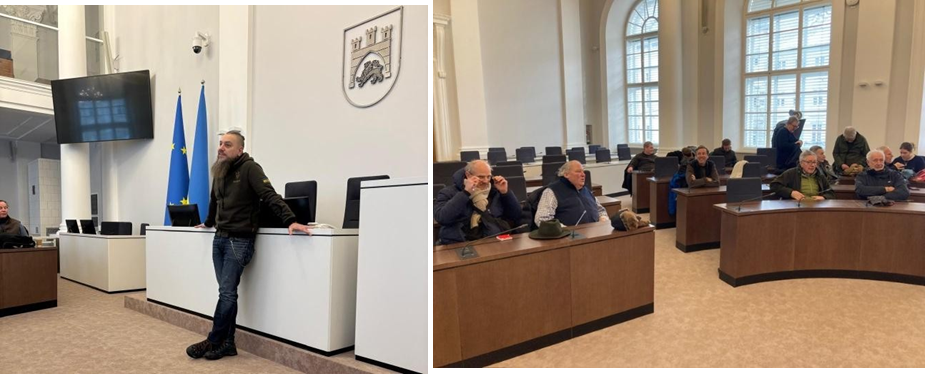
Back at the hotel we hear from Adriana, a Professor of Medicine and head of the Lviv Volunteer Medical Battalion about the lifesaving first aid kits and medical backpacks they supply. We have brought them tourniquets, bandages and chest seals. Adriana is keen to tell us what else they needed by way of supplies, but keener still to get out the message about the threat that Ukraine and the West face: “the sooner the world realises how dangerous russia is, the better”.
Finally Olha and Oleksii from two rehabilitation NGOs, Nomad Live and Angar who provide therapy and activities for psychologically/psychiatrically injured veterans; we handed over equipment including canoes for use by amputees as part of their rehabilitation. They too were keener to get out Ukraine’s message than anything else: their aim is to “be resilient and remaining standing longer than russia”.
Everyone from each of the organisations C4U supports presses on to us their gratitude for what we had done, and for what all of our donors had done.
We’re emotionally shattered by the end of the day, but there are more emotions to come. 18 of us are going back to Poland from Lviv. The other 22 are pressing on east to deliver the rest of the aid and trucks. Jim Young will be writing the report on the second leg. We say farewell over dinner and wish the intrepid 22 the best of luck. Strangers four days ago are now comrades and friends.
Day 5 Coda 17th February
Lviv to Warsaw
Mary and I have decided to see a bit more of Lviv before heading to the border, so we are looking forward to a lie-in for a change. But the Russian Armed Forces have other ideas. Shortly after 6 am the air attack alarm sounds on our phones and throughout the hotel. Russia has launched 400 drones and 29 missiles against all parts of Ukraine, including Lviv. We scurry to the shelter, thoroughly aware that our shelter is a comfortable former wine cellar with electricity and heating. All over Ukraine families are stumbling through the dark to concrete basements, quite likely unheated. It’s -8° outside.
As we explore the city later, we realise how superficial the air of normality is. A convoy of vans full of wounded soldiers blares through the traffic. There’s a vast triple funeral at the Garison Church for three more men that Lviv has lost.
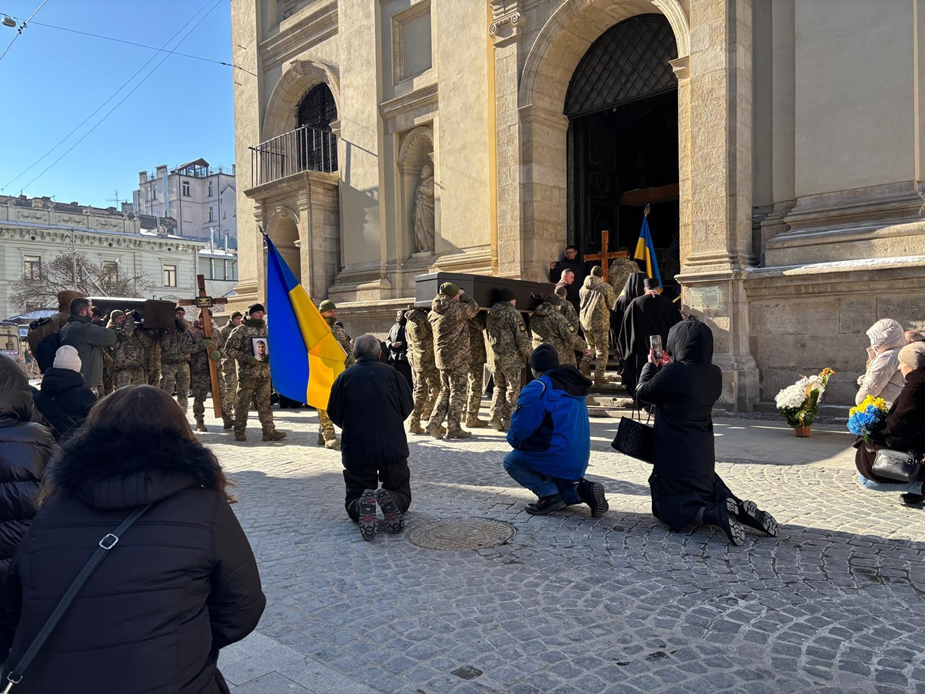
We count our blessings, and head for a city that’s at peace.
Conclusion
This has been an intense, and intensely moving, journey. We feel relieved to have done some good. We feel fortunate to have seen and heard what we have. We feel humbled by the fortitude and grace of the Ukrainian people. We feel grateful to all our co-drivers for their company and companionship and to Paul, Ant, Archie and Oleh for running the convoy so well. We thank all our generous donors.
We hope that in time Ukraine’s bravery will be rewarded by a just peace.
ANDREW POST
17th February
Our hotel was beautiful, the city of Lviv, entrancing. In fact, you could almost forget you were in a country at war. That is, until 6:09 a.m., when the air raid siren sounded on my phone and throughout the hotel. I walked quickly down five flights of stairs to the hotel’s basement bomb shelter, where I joined about ten fellow convoy drivers and a group of French businessmen and their Ukrainian escort. We made the best of it. Within half an hour, all my British colleagues had gone back upstairs and about their business, leaving the Frenchmen, the Ukrainian and me still waiting for the “all clear.” As the 7:30 deadline for our departure approached, I finally lost patience and went back upstairs only to find all my fellow travellers finishing their breakfasts. I ran up to my room finished dressing and packing and nearly missed the mini-bus back to the vehicles: lesson learned.
Our mission in Lviv having been fulfilled, the company split this morning according to plan, with 19 of the original drivers heading westward, going home and the rest of us, numbering 22, proceeding to central and eastern Ukraine. Five Ukrainians were brought in to supply the deficit of drivers to Poltava. We knew that the further east we went, the closer we were to hot zones. In his briefing that morning, Paul Parsons crystallized that perception by announcing that only one driver per vehicle should have an operating phone and we would generally avoid forming a cohesive convoy, all to reduce our digital signature for the russians to track and target.
We left Lviv heading toward Kyiv, a journey of about 600 km (370 miles). We passed through vast farmland areas and the signage indicated that most were owned by large, corporate farms. We saw what we believe was winter wheat emerging. We hit the Kyiv suburbs just before 5 p.m. The roads were in good shape. We began to see bomb damage in residential buildings, most of which had already been repaired.
It began getting dark, and everything on the roads that was wet began to freeze. We crossed the Dnipro River, which is massive. The snow and freezing rain were falling, it was dark, and our GPS stopped working. The snow built up on the roads. It was well below freezing. Then the windshield was icing up. We were struggling to see and were feeling quite lost, but the GPS resumed, and we made it to our hotel.
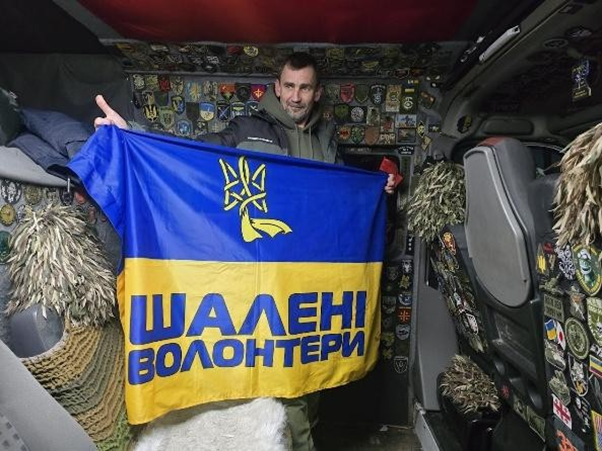
We made our first delivery right away, a battery backup
unit for a medical team and other equipment. It went to a
couple of Ukrainians named Andrii and Oleh, who had
driven from the East to which they were returning in their
own well-decorated van. Then, we had a dinner where a
small “orchestra” performed during dinner. This band
travels all along the front lines to entertain civilians and
soldiers – important for morale where conditions and life are tough. Tonight, they entertained us. What a privilege!
The moment that knocked me out, though, came when they replicated the daily nationwide moment of silence that we had experienced for the first time the day before
on a city street in Lviv. A chill ran down my spine as the drummer tapped out the slow cadence—tap, tap, tap, tap, tap, tap, tap, tap … thud—and it was over. Point made. With
the help of Yaroslav, a longtime friend of the organization, we delivered a mini-bus to replace one that had been blown up in a drone attack.
We gave a vehicle to Helena and Vitali, who were taking it to an organization they are involved with nearer the occupied territories in the East. In return, they gave us cheesecake and flags.
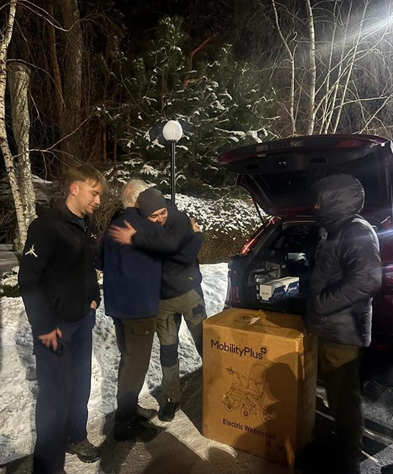
We delivered to an old friend Serhii, himself convalescing after injury, an electric wheelchair for use by a veteran well known to our organization from previous trips who had recently had three limbs amputated.
We returned to the hotel to sleep. In the wee hours of the morning, there was an air raid siren, but no one paid attention – including me.
Wednesday, 18th February
At 7:40 a.m., we began our journey to Poltava, a distance of about 210 miles. We made a fuel stop. Every petrol station had a convenience store, and we were always an oddity as we descended upon the locals. But these petrol stops gave us an opportunity to take the temperature. We meet an
Azov Brigade soldier on his return from visiting the Bundeswehr – his impressions of their readiness were not reassuring. At one such stop one of our number called out, “Who can speak Ukrainian? Nodding to a local who was sitting near him, he said, “I think he’s not too happy about us being here.” I speak a little bit of russian, so I went over and introduced myself to the man in that language.
“Who are you guys?” “Well, I’m an American, and there are two of us in this group, but the rest are British.”
“Why are you here?” he asked, a little suspiciously. “We’re here to deliver aid,”
“Aid for whom?” he asked, a little more suspiciously. “Why, for Ukrainians, of course!”
The man’s grizzled face split into a grin, and his eyes widened, and he said “Good – thank you!”
Our first destination, Poltava, where we would hand over three vehicles with equipment and supplies to medics. They joined us for lunch and conversation. One had been in the Seychelles when the war broke out and returned. He was 40, and his companion was 44. Both were named Volodymir. They talked about the high morale. One said he believed the russians would last only “one year more, no longer.” What would winning mean to them? “All our territories are rolled back, including Crimea, to the 1991 lines,” Volodymir said. “Reparations. Punishment for war crimes. Security guarantees.”
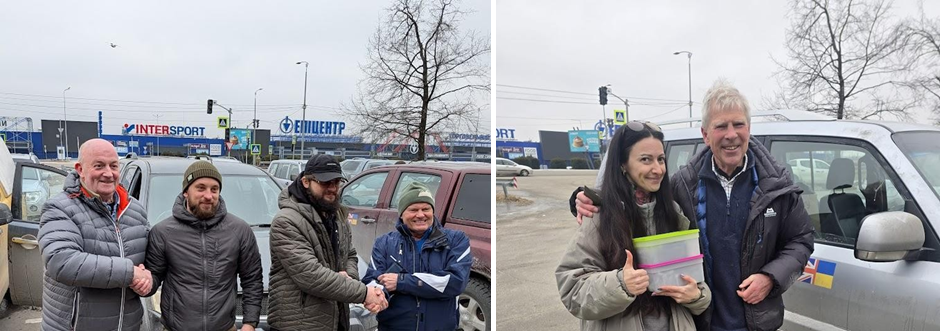
Anastasia, also a medic also came for lunch and a vehicle. Mikola, whom the convoy had met previously but could not come this day, sent a cake his wife had baked in thanks. The degree of affection with which these Ukrainian heroes greeted our organization’s leaders and its veteran members was truly remarkable, and this happened everywhere we went. As one Ukrainian wrote to Paul after our visit: “I understand how much effort it takes to organize such a team. What you are doing is a great mission, and we deeply appreciate it.”
After lunch, we left Poltava, trying to get to Dnipro, which is a relatively short distance: approximately 150 km. Our GPS dropped out because of air raids, and we got lost in the Ukrainian countryside. We eventually found our way to quite a traffic jam in Dnipro.
At dinner, we were joined by. Father Nicolai, a chaplain and a group of graduate student volunteers from the Ukrainian Students League, which undertakes humanitarian work in and around Dnipro. Zarya, 24, spoke at dinner: “You deliver to us not only trucks but inspiration, the greatest sign of humanity.” She acknowledged that there are doubts in the West about how Ukraine will maintain a democracy after the war. “I am sorry, guys, but this is our first time, and what we are going to do with it we don’t know,” she said with a helpless gesture to amusement of her audience. “The war started for us in 2014. We are a large country with a variety of views. We are really pretty exhausted, and we are sad about everything, but we will never be ashamed. We want to be heroes. We are just young Ukrainians who are trying to save our country. This is our work because this is our hope.” Applause replaced the laughter.
After dinner, we went to the dorm. The streets and sidewalks were sheets of ice. We parked our trucks on the street near the dorm. We arrived at our overnight barracks, where there was no electricity – but there was running water. As the temperature dropped, I added layers of clothing and socks. Eventually I achieved warmth and got a pretty good night’s sleep.
Thursday, 1Gth February
We started the morning with air raid sirens, to which no one appeared to pay attention. In only a few days, we had become accustomed to them, and you could easily see why Ukrainians looked as if normal life carried on. And for a little while, we had electricity.
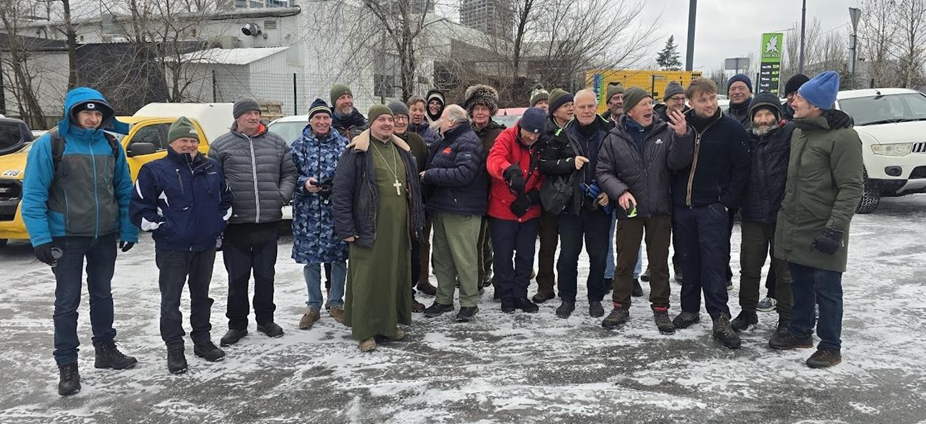
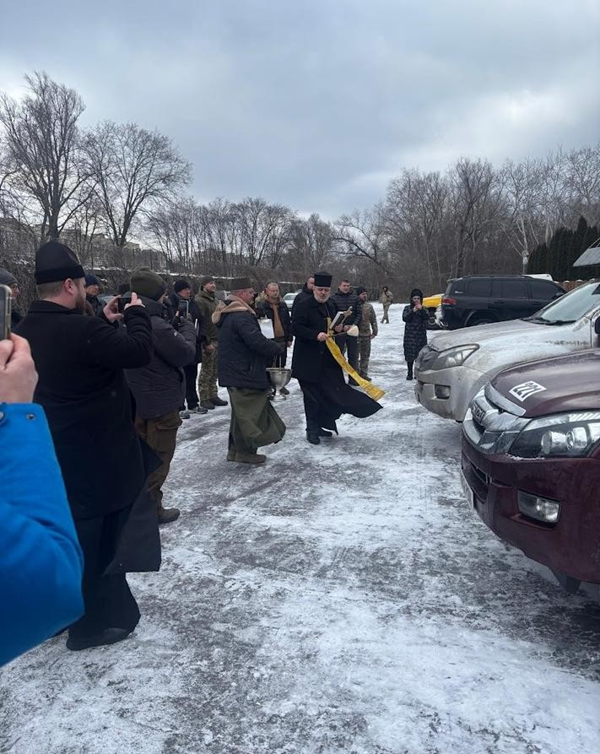
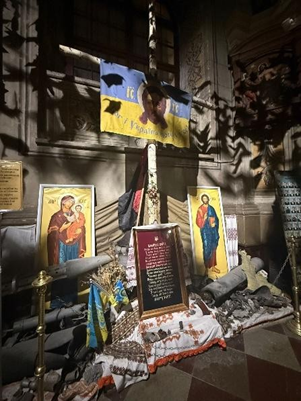
There were 12 vehicles left at that point, so we all piled in and drove to our rendez-vous, a beautiful wooden church. When we arrived, another military funeral was being conducted. We watched as soldiers carried a coffin into the chapel. We waited.
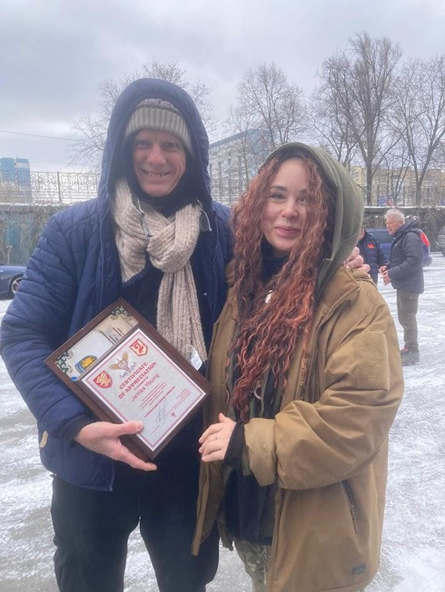
Afterwards, we joined the Ukrainians who would soon take ownership of our remaining vehicles and the equipment and supplies they carried. Once again, we witnessed the deep affection and respect that Paul and his field leadership team – Anthony, Archie, and Oleh experienced wherever they went in Ukraine. At every stop, they were showered with plaques, certificates, and mementos. Newbies, too, were warmly welcomed to join this club of constant friends.
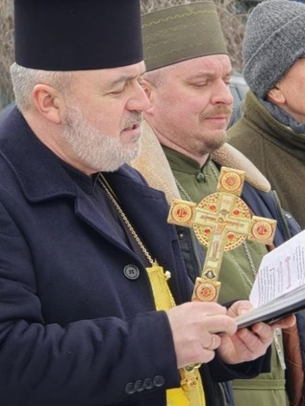
In the chapel, Father Vitaly conducted a service and blessed all of us and our missions. The priest giving the remaining vehicles a second blessing, this one Orthodox, of their own.
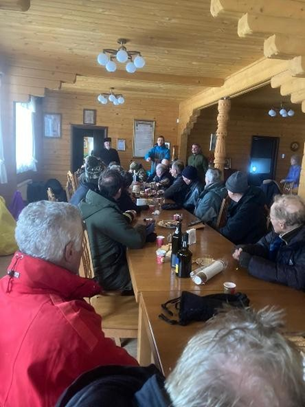
We gathered in the Sunday school hall for tea. Father Vitaly blessed us all and announced a blessing on Paul from the archbishop of this district for four years of faithful services to the Ukrainian cause.
Among the Ukrainians who stood out to me were another Volodymir, who left a successful business in Minnesota immediately after the full-scale invasion began, to join the struggle against Russian aggression, as did Anya, a Polish-born Belgian who came to Ukraine to work as a medic some years earlier.
Tears came to my eyes when I came across a medic named Svitlana and explained how her words, as quoted in a report on this organization’s September mission, had provided the last push to bring me to Ukraine all the way from America, and how I believed that my sharing of those words with many other Americans in my fundraising literature and speeches had generated a great deal of support for the Ukrainian cause. In the end, we both had tears in our eyes and smiles on our faces.
Svetlana with me
Wrapping Up: Thursday and Friday, 1Gth and 20th February
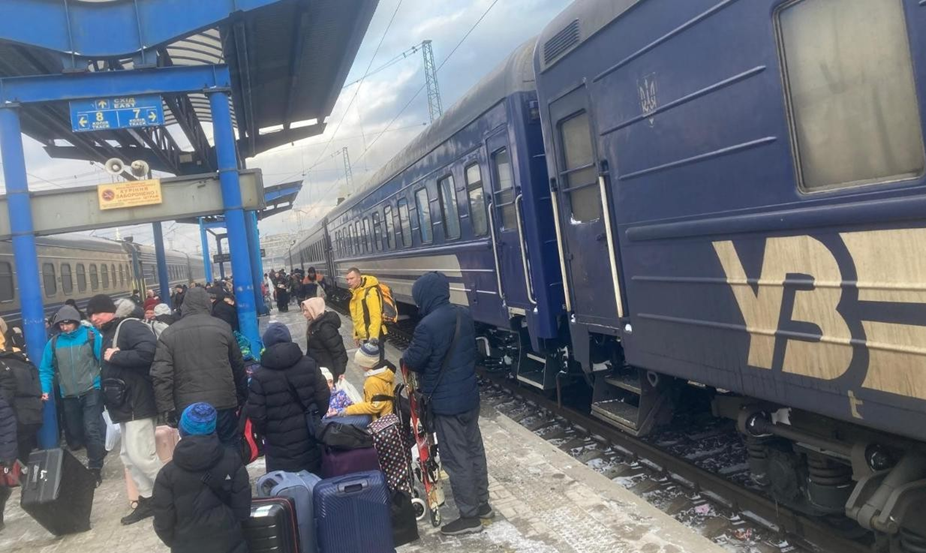
And, all of a sudden, we were done! We had to catch rides to the Dnipro train station with the new owners of the vehicles some of us had driven for the full 10 days and 3,600 km (2,400 miles) of this trip. We took a sleeper train from Dnipro to Lviv where the train arrived precisely on time. Our group began to disperse. Most of us continued on the same train to the Polish border, stopped there and then caught another train to Krakow.
Personal Observations
I came away from this trip with a respect for the courage, resilience and resourcefulness of Ukrainians that I had not fully understood from reading about it. They face their problems with clear eyes, and they find solutions. I also believe that the Ukrainians are gaining strength at the same time that the russians are losing strength, and now is the time for the West to apply maximum pressure on russia. Unfortunately, in the absence of a political miracle, the burden for applying such pressure will fall on Europe.
As the reader has perhaps noticed by now, I am an American. I live in a rural part of the southern state of South Carolina. Part of the urgency I felt in coming to Ukraine arose from my government’s failure to support Ukraine in its struggle against russian aggression. On this trip, I found myself saying over and over again that not all Americans support the current administration’s position. I will fight for that political miracle at home, but I can offer no hope that things will change in my country anytime soon. So, it is up to individual Americans to make a stand on their own—simply to do something. Based on my experience during this trip, I will urge other Americans to do likewise; I have seen in the eyes of Ukrainians that it does make a difference to see one of us because, as Svitlana wrote to Paul, “It’s not just a visit, it’s the feeling of a shoulder beside us.”
JIM YOUNG
APPENDIX
| Product | Quantity | Price |
| Olympus colonoscope CF-Q260DL | 4 | £26,000.00 |
| Olympus gastroscope GIF-XQ260 | 1 | £8,000.00 |
| ZIMER Dermatomes (Surgical instrument) | 2 | £9,200.00 |
| Blades Original | 500 | £650.00 |
| Blades Compatible | 200 | £350.00 |
| Canoes (NOMAD rehabilitation) | 5 | £5,101.68 |
| Power banks 30000mAh | 60 | £1,376.40 |
| Power banks 60000mAh | 3 | £92.97 |
| Könner C Söhnen KS 5500iEG Fuel Inverter generator | 3 | £3,567.00 |
| EcoFlow DELTA 2 Portable Power Station | 29 | £13,771.20 |
| EcoFlow GLACIER Classic Portable Fridge | 1 | £639.00 |
| Generators 3.5kw | 2 | £569.98 |
| Power banks 50000mAh | 10 | £329.22 |
| Sleeping bags | 4 | £239.60 |
| Vehicle tools | 4 | £375.80 |
| Ecoflow Delta 2 Max (3 Max) | 10 | £11,690.00 |
| Generators 2.3kw | 14 | £4,353.86 |
| Generators 3.3kw | 13 | £5,068.95 |
| EcoFlow DELTA Pro 3 Portable Power Station | 2 | £4,048.00 |
| Ecoflow River 2 Max | 14 | £3,706.00 |
| Vented Chest Seals | 1105 | £9,624.55 |
| Celox Gauze | 240 | £5,253.60 |
| Burn Gels | 200 | £290.00 |
| Tourniquets CAT | 1135 | £24,348.30 |
| Israli Bandages (Emergency Bandage 6”) | 190 | £1,060.20 |
| Israli Bandages (Emergency Bandage 4”) | 300 | £1,347.00 |
| SAM Junctional Tourniquets | 2 | £570.95 |
| Generator Könner C Söhnen KS 3100iG S | 2 | £1,358.00 |
| Abdominal Aortic Junctional Tourniquets | 5 | £1,898.25 |
| Soft Stretchers | 30 | £938.89 |
| Ecoflow Jackery Explorer 2000 | 1 | £899.00 |
| Ecoflow Jackery Explorer 3000 v2 | 1 | £1,599.00 |
| Diesel Heaters | 20 | £1,295.80 |
| Disel Adapters | 20 | £579.80 |
| EcoFlow DELTA 3 1500 | 3 | £1,647.00 |
| UK to EU plug adapters (5 pack) | 18 | £161.82 |
| EU to UK plug adapters (6 pack) | 46 | £735.27 |
| Jackery SolarSaga 200W Solar Panel | 1 | £399.00 |
| Jackery DC Extension Cable for Solar Panel | 1 | £32.99 |
| Snugpak Special Forces Complete System | 8 | £2,526.75 |
| Electric Winches | 2 | £899.90 |
| Electric wheelchair with accessories | 1 | £1,104.98 |
| SUM: | £157,700.71 |