Our News

Northamptonshire Convoy #12 Report: June 2026

 All thirty-two of us have now safely returned from Ukraine having delivered: twenty pickup trucks (eighteen driven and two transported); over £107,000 of aid fully detailed at the end of this report; and two Stabnet Units (more on which below) to our contacts in Lviv, Poltava, Kharkiv and Barvinkove. Thanks to your huge generosity, we raised £343,802 for our June trip and have, over our twelve trips to date to Ukraine, raised in total over £2,100,000. This has enabled us to deliver 128 pickup trucks, an ambulance, two minibuses and an ATV together with specialist medical equipment to various hospitals and large volumes of medical and humanitarian aid and the two mobile operating theatres. Following our return to the UK, we received this message from one of our aid recipients, Svetlana who is a medic, which I thought worth reproducing in full:

“Thank you for these words.

Honestly, they mean no less to us than the vehicles, generators, or any other aid you bring.

Because war does not only exhaust the body. It exhausts faith. And sometimes, more than anything else, a person needs to know that somewhere far away there are people who genuinely care.

You come to a country where air raid sirens are part of daily life, where people have learned to plan their days between alerts, where every meeting could unexpectedly become the last. Yet each time, you choose to return.

And that is what we remember most. Not the vehicles. Not the boxes. Not the supplies. The people.

Those who could have stayed at home in warmth and safety yet chose to stand beside us.

There are thousands of kilometers between us, different languages, different flags flying above our homes. But for a long time now, we have shared the same cause. Freedom.

And the responsibility to defend it.

You wrote that you return home with a feeling that there is still unfinished work.

You know, most Ukrainians have lived with that same feeling for many years.

Perhaps that is why we understand each other so well.

Please pass on our deepest gratitude to your entire team.

Every driver. Every donor. Every volunteer who raises funds, repairs vehicles, loads supplies, and gives their time, energy, and heart to this cause.

They may never hear the explosions. But every day they help us withstand them.

To many of us, you are no longer simply partners or volunteers.

You have become part of the extended family that this war has created.

And when Ukrainians say, “Please tell them thank you,” believe me, those words carry far more than simple politeness.

They carry lives. Saved crews. Another day of resistance. Another chance for someone to make it home alive.

Take care of yourselves. And know that here in Ukraine, you will always have friends waiting for you.

With great respect, gratitude, and friendship, Svitlana and all of our Wild Pack

War has a strange way of creating families where, only yesterday, there were strangers.

And we are grateful that you have become part of ours. “

Our next convoy leaves October 2026 and if you are interested in joining us, do please contact me. Thank you again for your generosity and support. Slava Ukraini! 

Paul Parsons paul@convoy4ukraine.com 
The Drivers

John Foster, David Preston, Michael Middleton, Dick Bradford, Toby Chambers, Jacob Jenkins, Guy Fearon, Suzanna Stuart Monteith, Michael Baines, Squeeze Baines, Jonjo Wood, Matthew Horwood, Andrew Brash, Joe Brash, Charles Prickett, Fred Prickett, Tom Hughes, Andy Harrison, Charlie Pelling, Iain Willis, John Sinclair, Jeremey Owen, Charlie Hastie, Paolo Roncarati, Lisa Hainsworth, Andrew Cunningham, Nick Hoareau, Niall MacNaughton, Oleh Naida, Archie Hainsworth, Ant White, Paul Parsons

To Lviv

The success of this project depends upon two essential elements. First the volunteer drivers, some of whom are natural fund raisers and others to whom it does not come naturally. Secondly, those who are willing to put their trust in the charity and generously give their money to bring much needed aid to the brave people of Ukraine in their struggle against arguably the worst dictator since Hitler. This has been the twelfth Convoy4Ukraine organised and led by Paul Parsons and his outstanding team and, once again, the continuing generosity of donors has enabled them to return from the mission in the certain knowledge that they have helped to save Ukrainian lives and to aid the recovery of those who have suffered life changing damage to their physical and mental health caused by this cruel war.

Friday 12 June – Formation

 We began to gather at Southfields near Towcester in the mid-afternoon and met by Archie, Paul’s trusted young lieutenant nursing a recently injured arm, who would guide and occasionally chivvy us on our journey and Paul whose welcome was warm and reassuring. Archie gave us our vehicle keys, all the paperwork necessary to get our vehicle into the EU and across the Poland / Ukraine border and off we went to find our previously loaded pickups lined up and waiting for us. Our Ford Ranger was not in the first flush of youth but it was comfortable and a test drive gave us confidence that it was up to the task ahead. By the time we returned most of the drivers had gathered. Some rather dazed looking newbies like us and other seasoned team members renewing friendships. While we were refreshed with Rosé or Peroni beer, Paul introduced us to his home team, Ukrainian and British, and those who were to shepherd us to Ukraine. We were told all we needed to know about how the convoy would operate and the all-important system of dropping pins on Google Maps to help us to complete each step of the drive. In amongst plenty of bravado and banter Solomonia gave us a moving reminder of how important it is to Ukrainians to feel that the peoples of the free world are actively supporting them in their struggle against evil and oppression. I would have loved our generous donors to have heard her express her thanks.
It emerged that one experienced member of the team, who would be driving alone, was so keen that he had arrived at 6.00am on the previous day to find a deserted field from which he deduced that the convoy had already departed without telling him. Fortunately, there was no-one there to hear his reaction but his good humour was restored when he discovered the truth.

There was time for more wine and beer and more introductions and then we dispersed to the homes of those who would kindly host us for the night with the reminder that wheels would roll at 6.00 am the following morning whether we were ready or not.

Saturday 13 June – Towcester to Dortmund

 I am sure that some slept well but I suspect that, for the first timers the anticipation of a long drive made sleep fitful – so it was a relief to start bang on 6.00am in a long convoy, armed with a pin on the Eurotunnel terminal at Folkestone. Rather disconcertingly the convoy split at the first roundabout outside Towcester and we found ourselves on our own but, with a delightfully clear M25 round the west side of London, the whole group completed the 164 miles comfortably in time to regroup for a cup of coffee and for Paul’s diplomatic skills to get us through French customs without requiring a detailed inspection of our vehicles in Calais which might have involved a delay of two or more hours. We drove on to the 10.20am shuttle on schedule without incident except for one nameless driver still in the manual gearbox familiarisation stage, who narrowly missed ramming the train which might have somewhat delayed dinner in Dortmund…
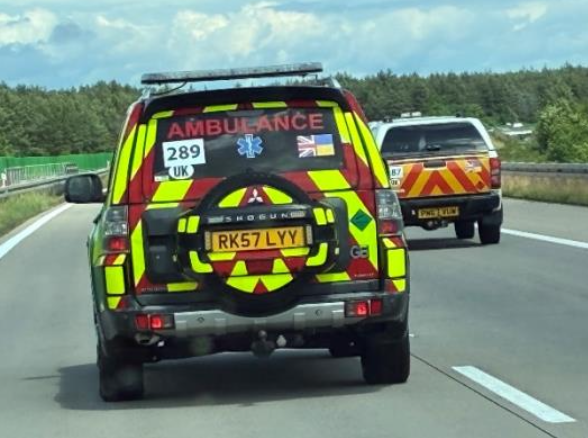
Once in the EU we travelled at a steady 80mph which our pickup managed comfortably. A WhatsApp message from Ant White, our highly efficient organiser of food and accommodation, brought some cheer by offering the choice of veal, salmon or chicken and wine or beer . My co-driver mistakenly thought this was for a gourmet continental lunch and responsibly declined the beer or wine. He should have been so lucky! At the next fuel stop in Belgium there was barely time to buy a bag of crisps but time for a warning from our leader (who spoke from bitter experience) to make sure that we filled with the correct fuel. And then we were on the road again.

The next 235 miles was through the flat and unexciting low countries studded with wind farms and leading to seemingly endless German industrial areas and the great rivers of the Rhine and Ruhr. At this stage of the journey one driver admitted to his companion a rather untimely phobia of bridges. We never learnt the effect that this phobia might have caused but they survived it… We all made it to our first Travelodge type hotel in Dortmund by 6.00pm with Archie and Oleh bringing up the rear for rescue and breakdowns. A quick drink to compare notes on the day led to dinner in a nearby restaurant and gave us more opportunities to get to know our travelling companions. I found a relatively early bed very welcome but some of the younger element had other ideas.

Sunday 14 June – Dortmund to Gliwice

The hotel gave us an excellent breakfast and after checking our oil and coolant levels and refueling we hit the road at 07.50 – ten minutes before schedule. The weather was grey and reasonably cool. This stage of the journey was much more scenic, still with forests of wind turbines (some enormous) but more hills and valleys and the occasional grand schloss in the distance. A number of us had served in the British Army of the Rhine during cold war years and this part of Germany brought back memories of our youth. On we went with the occasional warning from Paul reminding us that it was not a race and not to exceed 80mph. We never understood how he always seemed to arrive at our destinations first without breaking his own rule! The autobahns were in excellent condition and after Kassel we passed through the Meissner Kaufunger Wald, a vast forest, and on through Lower Saxony, south of the Harz mountains, to cross the former inner German border and what used to form the ‘Iron Curtain’. Travelling with a farmer I received regular mostly favourable assessments of the quality of German crops of rye, maize, wheat and potatoes. For this stage of the journey we formed mini convoys and it was sometimes a relief to tuck in behind another pickup.

After another flying fuel stop at Sangershausen, we passed a sign to Colditz crossing the Elbe at Dresden and the Spree at Bautzen near to the Czech border with its impressive church spire and onwards to the Polish border through large pine forests indicating poor land for agriculture. Once in Poland we stopped to refuel again at Kraśnik Dolny 409 miles after leaving Dortmund and I celebrated by having a slightly dodgy looking Polish sausage for lunch. Suddenly language and place names became unfamiliar and resulted in me making an inadvertent visit to the ladies’ lavatory to the consternation of some of the occupants. 

Now firmly in Poland we passed big fields of arable in rolling country moving on to flatter land with potato fields between Wroclaw and Opole. High seats were positioned at woodland edges, presumably for shooting wild boar in the crops.

Our rapid progress looked too good to be true and it was – when Google told us that the A4 between us and our destination was closed due to an accident. After debating whether to risk the chance that it might not have opened again soon, we decided to leave the beaten track and followed a rather winding minor road through some quite scenic country and rather poor villages. Others took different routes and some sat it out. We lost about 30 minutes but all trucks were in Gliwice by about 6.00pm and we just had time to check into our hotel before going to a restaurant for a very splendid Polish dinner organised by our gourmet-in-chief, Ant.

Monday 15 June – Gliwice to Lviv

We gathered in the car park at 07.30 and were relieved to find that our Ford had lost no oil or coolant on the previous day. Archie and Oleh had to top up coolant and oil and make some running repairs to some other vehicles and, after issuing a group bollocking about the hazards of failing to replace coolant caps, we were off at 7.50am moving through pine and birch forest and poor scrubland to skirt round Kraków passing a beautiful hill top church. Crossing the river Wizla we were warned to take care for elk on the road and indeed a crossing elk resulted in a close shave for one of our number.
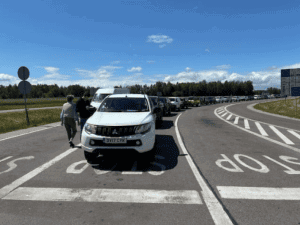
Our final filling station before reaching Ukraine was at Krzemienica and we were warned on pain of death not to leave there before we were given permission. Here we were briefed on the process of leaving Poland and entering Ukraine and the need to be ultra-cooperative with border guards through the tortuous process in order to avoid even longer delays.
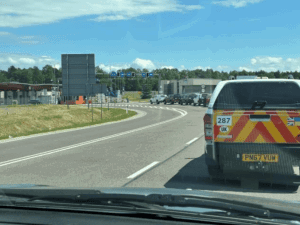
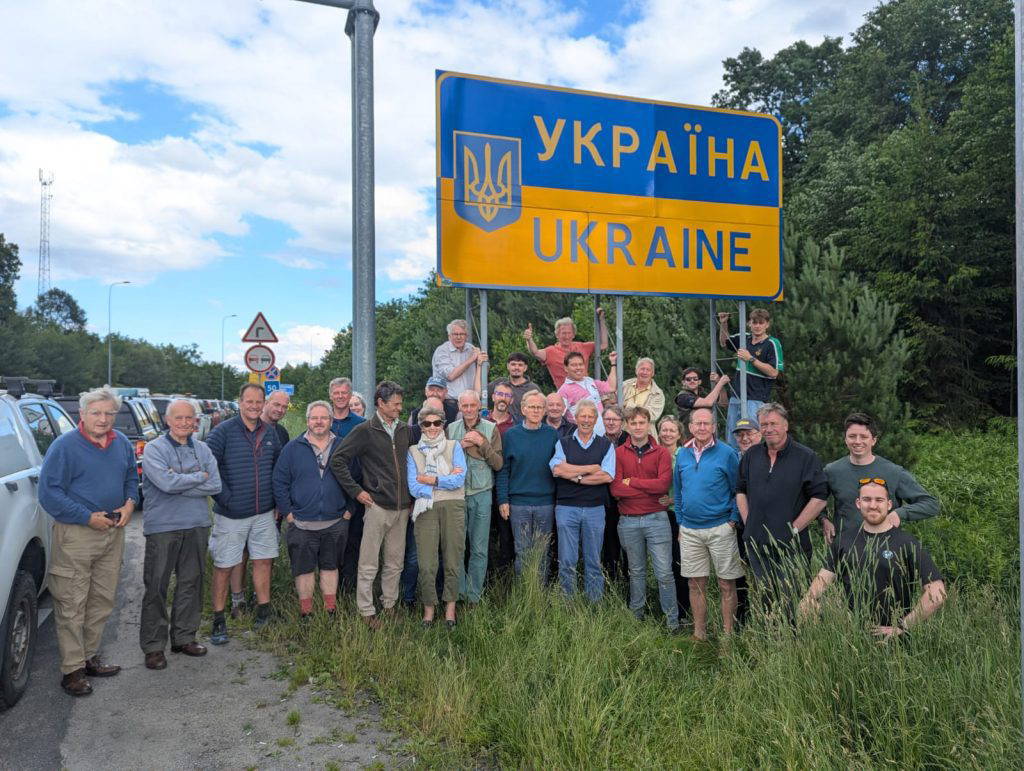
From this point we kept a tighter convoy at a slower pace on more minor and sometimes winding roads, passing through beech, birch and pine forest and poor strip farming including some crops that were difficult to identify. Loose dogs had to be avoided and stork nests on top of telegraph pole were a frequent feature. We reached the Polish border post at 1.00 pm. The process could have been worse, and we were all through by 4.00 pm and after a group photograph under the Ukraine sign we were on our way to Lviv, passing through small villages Ukrainian flags flying in cemeteries marking the graves of soldiers, forests and all kinds of subsistence farming. The outskirts of Lviv consisted of small factories and Soviet-style blocks of workers’ flats. We parked up in a secure yard outside the city centre and were taken by bus to the Leopolis hotel in the centre reaching it at 7.15pm. 

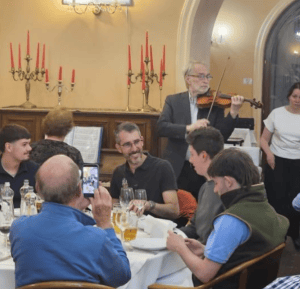
 Dinner was laid on by Ant in a nearby restaurant for 7.45pm. Having sat on my bottom for three days with no exercise I had no appetite for food and opted out of dinner to explore the streets of Lviv. I was subsequently told that I had missed the best dinner yet and also some outstanding Ukrainian live music. I regretted this but enjoyed the only opportunity to explore the city centre on a lovely sunny evening. My initial impression was surprise that this did not feel like a city at war but soon the generators on every street, the small number of fighting age men except those in uniform and men on crutches with prosthetic limbs told a different story. A further reminder was the arrival of a flagged military funeral cortege arriving from the front.
Lviv is a grand and beautiful city full of impressive baroque architecture including the Church of St Andrew in the Bernardine Monastery, a UNESCO world heritage site damaged by an Iranian built Shahed drone in March this year. I think we were all moved by the atmosphere of calm and reflection in the Saints Peter and Paul Garrison Church, completed in 1638 which was close to our hotel.

Tuesday 16 June – Lviv

This was the day in which we were to learn more about the effects of the war on those who are fighting and the extraordinary initiatives taken by those who are helping them to recover. It also helped us to see where some of the aid we had brought was to be used. After breakfast and coffee, if we were lucky (produced individually and painfully slowly by the barista) we were bussed back to our trucks.

 En route to our first visit, we stopped and got out of our vehicles at 9.00am to stand in silence together with the whole city for the daily one minute pause to remember those who have given their lives for the freedom of their compatriots.

  Our first visit was to the Unbroken Prosthetic and Orthotic Centre, one element of the Unbroken Charitable Foundation, which was founded by two veterans to help those who have been injured by the war by giving them the best professional medical care available to enable them to return to a full life. This centre was donated by the German Federal Government and the service is continuing to grow. We were taken round by Yulia who showed us how modern prosthetic limbs are made and fitted and the modern robotic equipment given by South Korea. 200 patients are currently undergoing treatment. Many of the staff are women who have lost relations. 25 year old Oksana, who teaches patients to use prosthetic limbs told us that she was an art restorer until she lost her brother in the war and she felt she ‘must do more’.
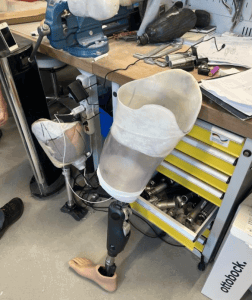
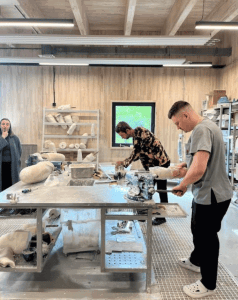

The organisation recognises that veterans undergoing treatment, many of whom are not from Lviv, need the close support of their families and are building social housing to fulfil this need. Convoy4Ukraine has supplied Unbroken with endoscopes, gastroscopes, colonoscopes, laryngoscopes and duodenoscopes and keeps in close touch to identify and source further needs. Oksana lightened the atmosphere by telling us the two most common questions she is asked by patients on what they will be able to do with their prosthetic hands: “Will I be able to use my trigger finger?’ and, holding up her middle finger, “Will I be able to do this at the Russians?”. Restoration of veterans’ physical and mental health is going to continue long after the war has ended and Unbroken will play a major part.

After another rather hairy drive through Lviv we reached the Lviv Centre for Services to Combatants. Since 2016 this organisation has delivered legal advice, psychological support, career advice and training to over 62,000 mentally and physically damaged veterans (compare this number to the 22,000 regular British Army troops in combat roles) and their families. The centre also encourages businesses to employ veterans. The staff, most of whom are women are invariably from veterans’ families. Convoy4Ukraine continues to offer and provide the Centre with aid.

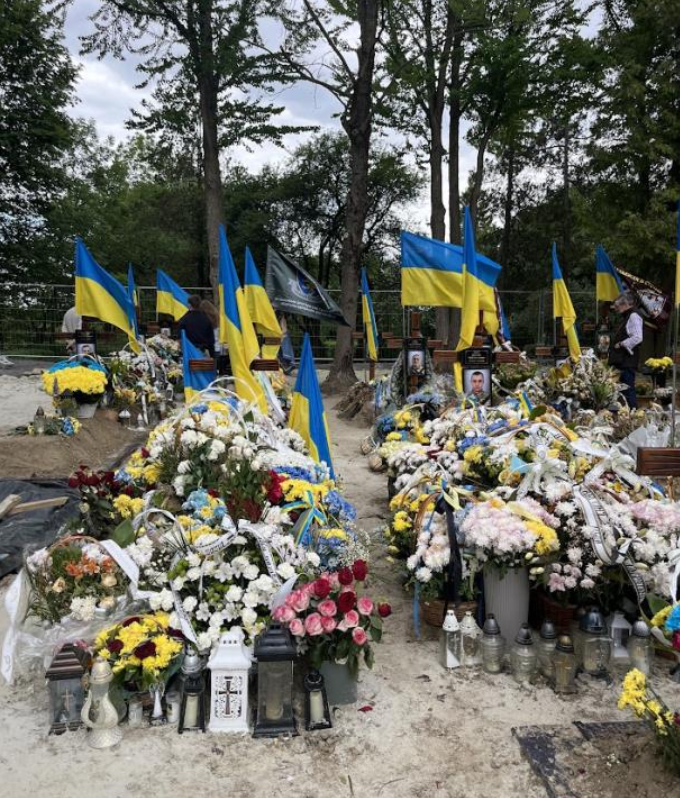
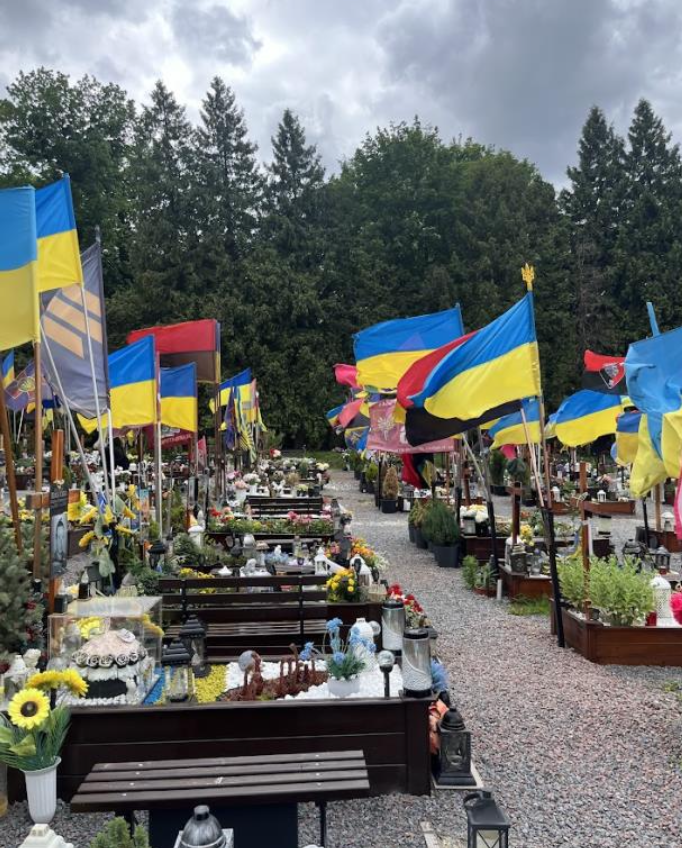
 The largest military cemetery in Lviv, The Field of Mars where thousands of graves of men and women, combatants and medics of all ages fluttering with Ukrainian, nationalist and unit flags brought home to us the terrible human cost of the war. As mothers, fathers, husbands, wives, children and loved ones quietly came to the graves with fresh flowers it was impossible to not to feel moved by emotions of grief and anger.  The Field of Mars has now reached capacity and has been replaced by a new cemetery called The Hill of Glory where we saw graves of those who had fallen in the previous two weeks. We were also acutely aware that cemeteries like this can be found throughout Ukraine. After the war the temporary grave surrounds will be replaced by permanent stone crosses. 

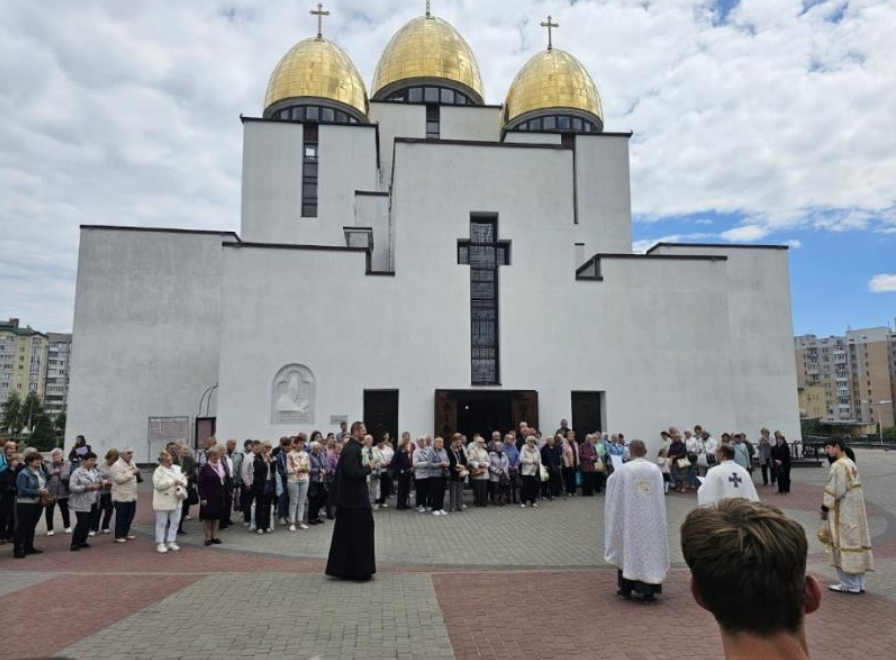
From there we moved to the impressive Church of The Nativity of The Blessed Virgin, built in 2008 following the collapse of the Soviet Union and dedicated to Pope John Paul II. After a mass, in front of a large part of the congregation, Fathers Orest and Vasil blessed the pickups and sprinkled them with holy water – not forgetting to give the drivers a good sprinkling too. 

 We were then entertained to lunch with a speech of thanks to Convoy4Ukraine by Father Vasil followed by a ceremony akin to school prize giving acknowledging the valiant work by Paul and his team of ‘permanent staff’.  Amongst other presentations was a huge loaf of bread baked by ‘Mothers of Lviv’ who came in national dress. After lunch we handed over three vehicles and aid.
Back to the hotel by 5.00pm and we were already late for a talk by Alexei on Nomad Live, an organisation supported by Convoy4Ukraine which helps released prisoners of war with ‘peer to peer’ support to overcome the effect of their experiences and to reintegrate with society. It is easy for us to forget the long term trauma caused by war and this talk was a valuable eye-opener. 

 This talk was followed an on-screen presentation by Adriana Haydux on the invaluable role of the Lviv Volunteer Medical Battalion which reminded us that Ukraine is suffering not only its 5th, but also its 12th and 112th anniversaries of Russian invasions. Instant, correctly administered first aid saves lives that might otherwise be lost. The battalion supplies troops with advanced individual first aid kits, tactical medical backpacks and trains combat medics to a very high standard. It also provides first aid equipment and training for civilians living close to the front line. We were shown how to apply a tourniquet and provided with individual first aid kits.
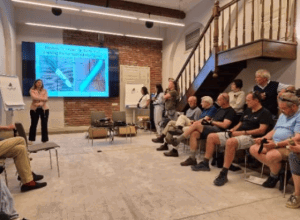
It was a long but unforgettable day and the whole team had dinner together for the final time before the following day when some would return home and others take the remaining vehicles further east.

Dick Bradford.

Beyond Lviv

Wednesday 17 June – Lviv to Poltava

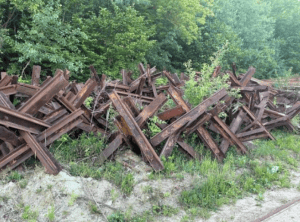
06.15. An early start and the normal bun fight to get breakfast in the Leopolis Hotel before we had to board the minibus and return to our vehicles, which had overnighted in an abandoned tram station. We noted  the tank traps made from old tram rails piled up on the waste ground in front of the 4x4s. War time recycling at its best. It was going to be a long day on the road – approximately 900km, Lviv to Poltava via Kyiv. 
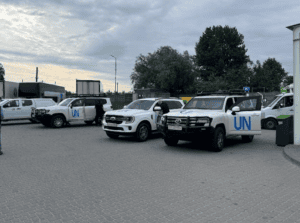
We eased our way out of the city making our first stop at one of the ubiquitous OKKO service stations to refuel. Here, by coincidence, we met up with three UN Toyota Land Cruisers. They were crewed by a multi-national, mine clearing team heading for Kyiv. A former British Army Royal Engineer was part of their team. Nice to see fellow Brits on the road east, but we rather envied their high-spec vehicles with their armoured glass and doors. 
We knew we had a lot of miles to cover so everyone had their foot down and missives were issued on the WhatsApp telling us to adhere to the speed limit and avoid trashing the engines of our old work horses. Truck 293 was belching black smoke periodically but we were informed it was less to do with excessive acceleration and more it lacked a DPF particle filter, whatever that is. You learn something new every day. Just east of Zhytomyr we stopped again to gather the convoy and refuel. We were about two thirds of the way to Kyiv on the E40. This was the arterial road that would take us most of the way to Poltava. It comprised dual carriageway, mixed in with two-way traffic and reminded me of the A303. Our drive throughout was punctuated by a stream of near suicidal Ukrainian drivers weaving in and out of traffic.

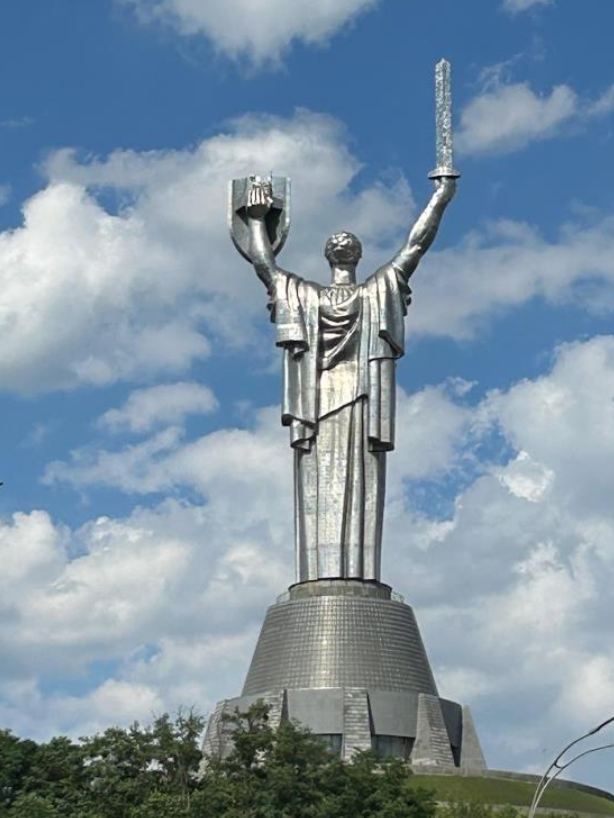
 Nick my co-driver and I cut through Kyiv and had to utilise some London driving , i.e. aggressive and selfish, in order to get where wanted to and as a consequence of a series of last-minute changes of direction and lane. We stopped off briefly by the Dnipro River and grabbed a quick photo of the river with the statue of Mother Ukraine and the Kyiv skyline in the background. 
 On we pushed, following the signs for Kharkiv to the next stop, a WOG service station just east of Kyiv where we were meeting Oleg, the CEO of Stabnet from whom we had commissioned two Stabnet Units that had been manufactured in Kharkiv. These were Stabnets 64 and 65 of a hoped for production of 300 for which further funding was awaited .

Nick managed to drag a rare smile out of the service station staff while we were there. Most of us had been confused by what the system was for refueling. Pay first? Fill up first? Now we knew -fill up, pump number , fuel type-diesel, amount of fuel, type of payment – card. Nick then went on repeating it in his somewhat debatable grasp of Ukrainian. 
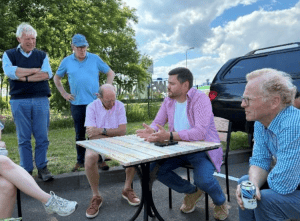
Andrew Brash’s white Ford Ranger was now leaking oil badly and there was some concern about whether it would make it to Poltava. Archie and Oleh were on the case. On towards Poltava past vast, beautifully groomed fields of wheat and potatoes, bathed in the soft early evening light. Bizarrely you rarely saw a heard of cows and never any sheep. 

Whilst trying to relieve the boredom of the endless miles, Nick and I decided to check out the reviews of the Hotel Aristokrat in Poltava on Booking.com. This was to be our hotel for the night. It opened up with…

Please review any travel advisories provided by your government to make an informed decision about your stay in this area, which may be considered conflict affected.” 

This proved remarkably prescient given what followed in the early hours of the morning. 

Booking.com reviewers had given the hotel an 8.5 rating and the status of Very Good, but there were few overseas reviewers! However, Victoria from Belgium gave it a 5.0 as the staff had locked her out of the hotel in January which we felt were reasonable grounds for a poor review.

Finally, we reached Poltava about 20.00 and after parking the vehicles in a pretty tight underground parking spot doubling up as the hotel air raid shelter, immediately began the handover of vehicles. 
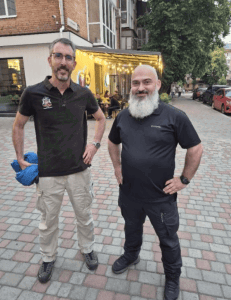
  We met Michael, Archil and Alex. Archil was Georgian, a former maths teacher and sported an excellent ZZ Top style beard. He and his Georgian colleague had been in Ukraine since early 2023. We handed over some medical supplies to them and one vehicle to Sasha, JonJo doing the handover honours. Dimitrov and Alex who were heading towards Zaporizia and Lozza also picked up a vehicle. We handed over an ambulance to Misha a medic whose wife produced a  cake for our dinner. 

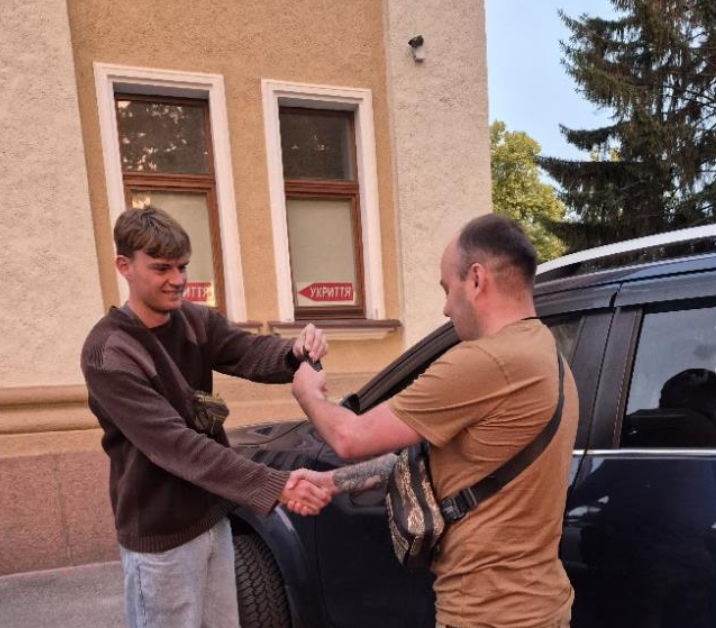
Michael and Squeeze Bains’ handover was briefly interrupted at around 21.00 by an air raid warning with the phone app telling us to go to the nearest shelter and reminding us that our “over-confidence was our weakness.” None of the locals took any notice so we followed suit and carried on. As the warning ended, some teenagers who had been mooching around in the courtyard in front of the hotel headed past us. One long-haired, scruffy youngster wandered up and asked, in good English, who we were and why we were in Poltava. We explained and he thanked us for helping Ukraine and then sauntered off to join his friends. We were rather touched by his words. We then headed in for a belated dinner. 
 

Thursday 18 June – Poltava to Barvinkove

01.20. I was awakened abruptly by a loud explosion followed by some more distant crumps and accompanied by the air raid siren. I had to decide – bed or shelter? Bed won, but sleep followed slowly as the adrenaline that had fired through my system took time to fade. An hour later, the air raid warning wails me awake again, but this time no explosions and sleep follows more quickly. I awake more gently at around 06.30 to a beautiful sunny morning, slightly fuzzy headed from the interrupted sleep and the rather potent beers sunk at dinner the previous evening. It transpired that an electrical substation had been hit, or so the hotel receptionist informed one of our party and the Kyiv Post confirmed Poltava had been hit by six ballistic missiles.

I glance at my hotel receipt and imagine it to be a Soviet travel document, all in Cyrillic script with its official looking blue stamp. Your brain behaves in peculiar ways sometimes.

My colleague Charlie Pelling calls to say Iain, his co-driver, is feeling better after his previous day’s stomach upset and informs me that he and Iain managed to sleep through the explosions. How is that possible? Perhaps the white wine at dinner was a better anesthetic than my beer. England have beaten Croatia.

I climb out onto my room’s balcony and life in Poltava goes on. The buses are running and people are going about their business. A feature we have noted in all the cities we have passed through. The country may be at war but life goes on.

 Breakfast and refuel. On the way to the next pin our GPS goes down and we get complete nonsense on the satnav, at one point telling us to take a left turn into a field and then we are informed we are in Lima in Peru! We are not sure who is spoofing the GPS, but it is very effective. We revert to our rather large-scale, paper map. We eventually get to the pin drop where we are due to RV with the Stabnets and are rather puzzled there is no sign of them as we wend our way up a dusty track with four other vehicles. We hang around for half an hour and then Charlie Hastie decides to go for coffee at a nearby service station and by chance discovers the Stabnet and crew we are looking for are about 400m away on the opposite side of the road. We all gather and the second Stabnet arrives. We get a chance to look inside the two units we had named Nightingale and Lister. These are fantastic mini hospitals that we know save lives and this technical information explains why.
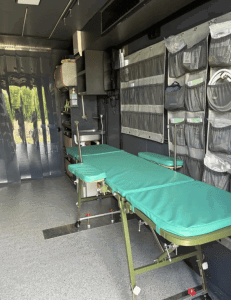
The stabilization container is 2.5 meters wide by 6 meters long and weighs only 2.4 tons. It is specially designed for stabilization of injured soldiers and is the only mobile structure able of caring for the wounded directly at the front line. It offers mobility (thanks to the light weight); discretion (the compact size allows it to be hidden as close as possible to the contact zone besides, advanced thermal acoustic insulation has been developed to avoid enemy detection; and autonomy (the container can function independently thanks to supply of equipment on board (inverter generator, water tank, bacterial decontamination system and washing system).
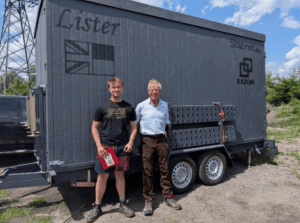
The medical equipment each unit carries includes: an operating table; a multiparameter heart monitor; infrared coagulator; manual /automatic defibrillator; secretion aspiration system; portable ultrasound scanner; oxygen concentrator; intensive care ventilator; blood bags refrigerator; hot-air sterilizer.

We then make a short drive to drop off the next vehicles. It is off the E40 on some waste ground edged with trees. We park up in the shade and under cover and meet up with some old friends Svitlana the larger-than-life medic and Yura, both of whom I had met in an abandoned house east of Sumy the previous February and her team of medics. 
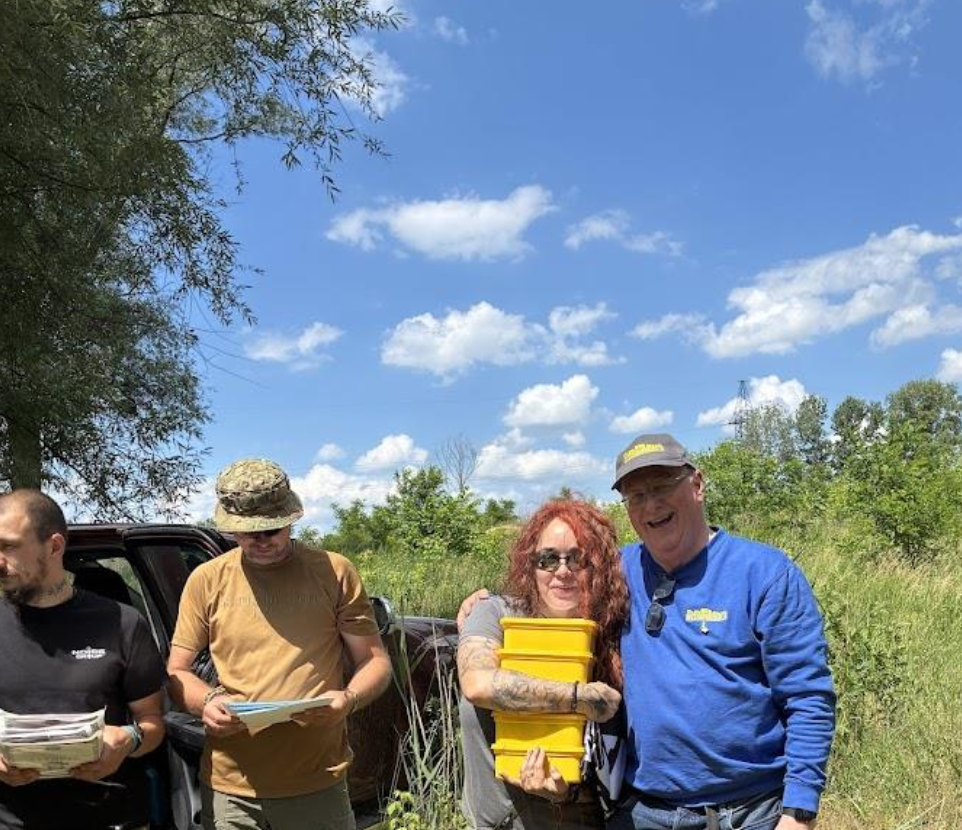
 They had moved south to Kharkiv Oblast in May 2025. Vlodamir a young tough looking Ukrainian/ American had come from the US to assist leaving his wife in the US to run their business. We hand over the designated vehicles and collect more certificates of appreciation. Paul, Anthony and Archie’s hauls will probably cost them an extra baggage charge on the flight home. The engraved 0.50 shell case, key ring may also cause a few problems when we pass through airport security. We say good-bye to old friends and to some new ones. 

  To the last pin north of Izium. We have intermittent GPS and note drone nets now shroud most of the roads. This is all liberated territory with omnipresent signs of damage caused prior to and during the Ukrainian counteroffensive.

There is also increased military traffic on the roads. We get to the final pin which is in the town square in Barvinkove. Billboards depicting pictures of local deceased soldiers line the park. 
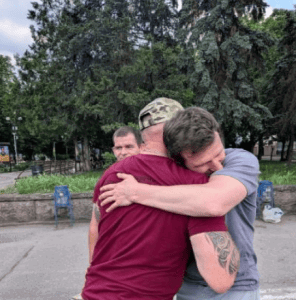
 Here we meet Serhii, a great bear of a man and his colleagues, including Rita a young psychologist. We never quite worked out how she applied her skills. 
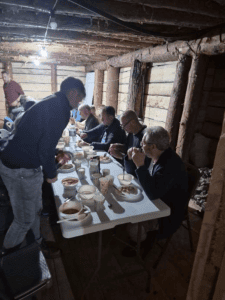
They are incredibly generous with gifts and their words. We leave the square, now bereft of vehicles and all board an old, yellow, school bus made by Leyland (worrying) which takes us to a camp, which is to be our base for the night. Ihor, our host, gives us a guided tour of the facility . There is a wonderful smell of freshly sawn wood and we are all impressed by the quality of the camp’s construction. 

A delicious borscht and a mix of salmon, pork, potatoes, and salad. The night is spent in an underground dorm that resembles a prison of war camp with its wooden bunk beds. Sleep follows for some, although our leader Paul, a light sleeper, eventually gives up trying to sleep through the snoring and opts for a sofa in the dining hall. 

Friday 19 June – Barvinkove to Lviv

Breakfast is cup of coffee and a piece of last night’s cake. We are on our way to Kharkiv station by 08.15. We are back on the school bus again, which unfortunately and to the driver’s irritation, is limited to 75 kph. It is a slow journey, under endless drone nets and alleviated briefly when Ihor stopped to buy us a mountain of strawberries from a babushka at the roadside. They are delicious. Two and half hours later we arrive at Kharkiv station, a wonderful Soviet style building that opens out onto a wide square. 

 We grab a quick bite and board the train, only to be told to get off again as there is an air raid warning. We reboard five minutes later. It is four hours to Kyiv and I am struck again by how normal everything feels, particularly as we are only 20 miles or so from the Russian border. A group of school children join us in the carriage, seemingly on a school trip to the capital.
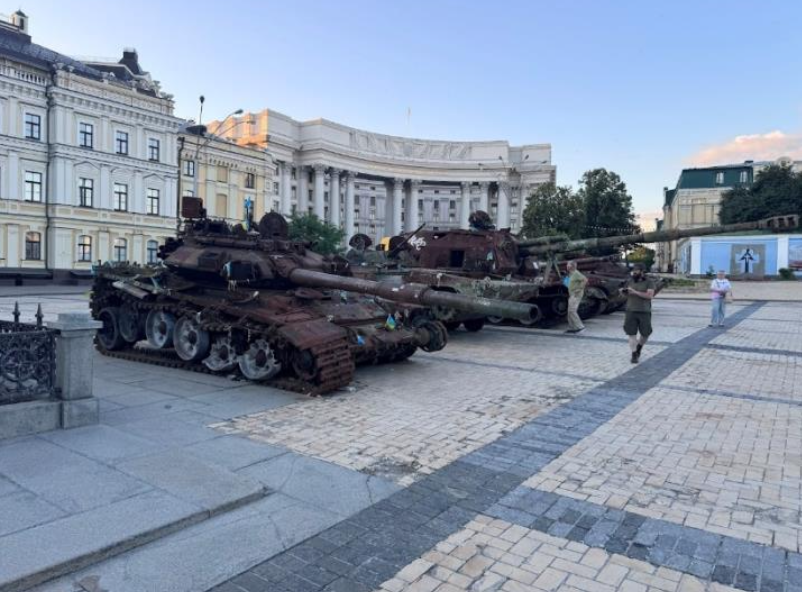
 

On arrival in Kyiv, precisely on time, Yaroslav, an old friend of Paul’s, meets us and we board a minibus for a quick tour of some of Kyiv’s sights. We have an eclectic dinner of modern and traditional Ukrainian food, washed down with a rather nice red – Odessa Black. After dinner we continue the whistle stop tour taking in a few more sights. St Michael’s church with its wall of remembrance, thousands of faces of those who have lost their lives since 2014. As always, very sobering. The hulks of burnt-out Russian vehicles sit in the square in front of the church and are a grim reminder of the cost of war to everyone. There is then a headlong dash to Kyiv station to catch our sleeper west to Lviv. A little bit of confusion, as the 22.17 is not listed initially, but it eventually appears and we head to Platform 6 and hopefully a decent night’s sleep. The two berth cabins are comfortable and we bed down for the night, having persuaded Iain not to crack open the bottle of whisky he was carrying. 

Saturday 20 June – Lviv to Poland

We wake and receive our tea from the carriage guard, somewhat frustrated as she had also been trying to fix both loos, which had packed up overnight. We arrive in Lviv just before 07.00 again on time. Here we say goodbye to Paul, Oleh and Archie who are staying on in Lviv and the remainder of us board a minibus to the border crossing point some 13 km east of Przemysl. I note the road signs encouraging enlistment in the army. We are then stopped by a Ukrainian guard at a check-point short of the border post. He checks our passports and questions Toby if he is in the army given his military-looking gear. Perhaps checking for draft dodgers and deserters? We speed through Ukrainian passport control only to see a rather long queue to get through to the Polish side. Anthony White took the initiative and confirmed we could go through the EU lane. We move past waiting families, hot and bothered by their long wait in the strong morning sun. We edge between two women who are having a very intense argument about what we surmise is one’s attempt at queue-jumping. We make slow passage through Polish border control and then head for the taxis waiting on the main road. I had travelled with three friends who I had served with in the 4th Royal Tank Regiment decades before and we enjoyed a very nice afternoon and evening in Krakow Old Town, with Iain’s wife Clare joining us later.

In summary, it was a fantastic week being part of what is essentially a road trip with a serious element and common purpose to provide needed aid and trucks, but which also provided the full range of emotions; sadness at seeing the waste of life that accompanies war; the frisson of excitement that accompanies a bit of danger and lots of laughs. We met some wonderful people, the tough, resilient and determined Ukrainians and our fellow travelers.

A huge thank-you to all those who made it possible, Paul, Oleh, Anthony and Archie along with Tisha and the UK team and of course to all those that donated so generously to fund the 12th convoy and make it happen. Best of luck to convoy 13 in October 2026. 

Niall MacNaughton

Product 

Quantity

Price

OMRON M1 Blood Pressure Monitor

10

£196.50

EcoFlow DELTA 2 Portable Power Station

25

£10,895.00

Sleeping bags

25

£1,593.50

Generators 3.5kw

2

£440.00

Generators 2.3kw

8

£2,487.92

Power banks

45

£955.80

Generators 3.3kw

19

£7,855.96

Tourniquets CAT

1550

£33,288.25

Ecoflow Delta 2 Max

8

£7,147.00

Power banks 60000mAh

15

£471.60

Power banks 50000mAh

10

£369.90

Emergency bandages 6″

345

£1,894.80

Emergency bandages 4″

30

£167.40

Rescue eye shields

100

£537.13

EcoFlow DELTA 3 Max Plus / DELTA 3 Max Plus Smart Extra Battery

3

£6,594.00

EcoFlow DELTA 3 Max

3

£3,242.00

Vented Chest Seals

1110

£10,489.50

XShear Trauma Shears

165

£5,443.35

Celox Gauze

290

£7,972.10

Haemostatic Dressing

100

£899.00

Burn gels 

80

£175.20

Hyundai 3.3kW Petrol Open Frame Inverter Generator

4

£1,199.96

Plug converters 

59

£829.84

Poly – EncorePro 520 QD headset

2

£192.00

Diesel generator KS 9200HDES-1/3 ATSR 

1

£1,444.00

Foam mattresses

20

£405.79

Storage Cases

3

£339.98


SUM:

£107,527.48

Northamptonshire Convoy Update: June 2026

The Northamptonshire convoys are led by Paul Parsons with the help of Anthony White, Oleh Naida, and Archie Hainsworth. From small beginnings in November 2022, we have received huge support so that by the end of June 2026 we will have:

  • Driven 12 aid convoys to Ukraine;
  • Raised over £2,100,000 all of which spent on aid and vehicles;
  • Delivered 128 pickup trucks, an ambulance, two minibuses and an ATV;
  • Assisted many medical teams and a number of hospitals in Lviv;
  • Commission two mobile fully equipped Stabnet stabilisation containers.


Stopping at Dortmund on night one and Gliwice on night two, we arrive in Lviv on our third day. On day four in Lviv we meet our numerous friends and contacts and hand over some of the vehicles and aid to them. On day five the team splits, with some returning home via Poland and the rest driving on to deliver trucks and aid directly to their end users elsewhere across Ukraine. This stage takes a further two nights before returning to Lviv by train.

We ask our drivers to raise £9,000 and to pay their own travel costs.

Our next convoy leaves for Ukraine in October 2026. To join this, please contact Paul Parsons at paul@convoy4ukraine.com.

Northamptonshire Convoy: June 2026

Irish Convoy #11 Report: April 2026

The Irish team has recently returned from a successful convoy, during which they delivered 2 ambulances, 8 4×4’s and an ALP (Ariel Ladder Platform) fire engine that can be used for high-rise rescues and aerial firefighting. On their six-day journey, they travelled from Ireland through the Netherlands, Germany and Poland before spending some time in Ukraine.

Here is the convoy story, as told by leader Michael Hughes: 

DAY 1 – Rendezvous at Stockhouse; in the words of ABBA, ‘my, my, here we go again’.

A fine sunny morning finds us ferrying vehicles into Stockhouse to secure the car park for further arrivals. Inside, Sambos and food are being prepared for our volunteers and guests. 

Soon other volunteers start arriving with their vehicles and spaces are quickly filled. Then the star of the show, the ALP (aerial ladder platform) , an impressive behemoth of a machine, arrives, driven by Ken and Jim. Soon, it’s joined by two ambulances driven by Paddy, Justin, Robbie & Connor. Along with our minibus provided by Darran, our crewvan provided by Vika and 8 great 4×4’s provided by Stockhouse, McNallys, Damien & Paddy, Ger, Kiaran & Paul, Fergal & Brian, Keir and David. These are to be driven by Muireadhach, Manus, Jim, Gerry, Orla, Carmel and myself. Overall, there’s a great crew of many veterans and several new guys. The support we all got from friends, family and genuine folk makes this all possible, with generous help from local folk as well as from people as far away as Minneapolis.

We finish the final prep in the carpark, with the team and supporters meeting and exchanging stories. There’s then a few speeches outside from Senator Linda Nelson Murray, Joe Clancy and Kiaran Tansey from ESPWA, and myself. We all convey our continued support for Ukraine. Father John then blesses all the vehicles and aid before we start our engines and get ready to depart, again.

The convoy rolls out of the carpark, led by the ALP and 2 ambulances. 2 km out at Laracor cross, Mother Hen standing on the verge waves off the vehicles, and a little further on all the lads in McNally’s garage are standing out waving too.

After snaking through Summerhill, it’s on to Kilcock and down onto the first of many motorways we will travel on over the next few days. Heavy traffic at the end of the M50 slows us for a while, but then it’s open roads down through picturesque Wicklow to our first stop at Whitford House Hotel, where we get our usual quality meal before refueling and making our way down to the ferry port.

In quick time, we embark the ferry and settle in for our customary drinks and craic before setting sail. There are a few bumps for an hour or so and then calm waters. The banter is good and the night passes fast, with the last of the lads hitting the sack at 4am. Day 1 is over, and everyone knows it’s the calm before the storm. Challenges lie ahead but we have the confidence to know we can meet them head on.

DAY 2 – Evacuate Dunkirk, the Irish are coming!

Upon checking in on the ferry, I get a massive surprise when I discover that our main contact in DFDS Finbar has generously upgraded me to a deluxe cabin. Loads of room and a TV to boot, I’m delighted. When going on a ‘cruise’, all comforts are welcome.

Early in the morning the first tannoy calls us for breakfast so several of us meet there. There’s calm seas and sunshine, but a wind out on deck that would almost lift you off your feet. Despite all the comforts, we get no real rest on board, but that’s life. 9 pm comes, and we are asked to vacate the cabins for the remaining 1.5 hours. The lads produce a deck of cards and 25’s is the game of choice; I haven’t played this in years but it’s like riding a bike, it all comes back. 

The call goes up to disembark, and in no time we are driving off the ferry. It’s then ‘pedal to the metal’ up the motorways out of France, across Belgium via Antwerp and Brussels, and across into Holland. We arrive at 2.45am and have a quick beer before retiring for the remainder of the night. The rooms are first class, and the bed is so welcome and comfy that I sleep through the alarm. The plan for tomorrow is for the ALP and two ambulances to leave early at 8.15am to get ahead of us, so our mechanic crew remain behind them as long as possible. We know diesel prices are very high in Holland and Germany so we’ve brought 20 litre drums from Ireland to level the playing field; it’s ironic to think that our Irish diesel at €2.08/ltr is considered ‘cheap’.

Our convoy rolls into Sevenum, with the final few arriving at 3am. That 3.5 hours is the litmus test of our vehicles, and they all pass. A breakdown on a Saturday night, or indeed Sunday, would mean leaving a vehicle behind, because spares wouldn’t be available anywhere.

Spirits are high among the group and everyone is looking forward to tomorrow, as it is a long drive. Bring it on!

DAY 3 – DFB on the Autobahn

We have a very short sleep before breakfast at 8am. The volunteers from the Dublin Fire Brigade (DFB) are to depart at 8.15am to get ahead of the rest. Soon, everybody is on the road. There’s beautiful sunshine again, just like there was back in Ireland. Muireadhach and Manus are diverted to Düsseldorf airport in the bus to swap out with Darran who is flying in as they are flying home. We schedule our first stop 3 hours out for us all to meet again.

One hour from the stop, we get word that one 4×4 has taken a wrong turn and has driven south to Bonn. This means that Jeep is on its own now, because it’s too far away and we can’t wait so long. As it turns out, it has to drive even further south to Frankfurt before picking up a road to Dresden where we are headed. A long day for us, but a longer day for them.

As it turns out, we have luck on our side and get all the way across Germany to Dresden without any problems. We arrive around 5.30pm at the same hotel we have used previously, and again it is also full of police that obviously use it as their hotel of choice. Once checked in, we meet in the lobby and head into town on a bus to ‘L’Osteria’ restaurant for some good Italian style food. A class meal and a nice drop of wine too.

A lot of craic is had, and the slagging is hilarious at the best of times. When we pass our fire engine and two ambulances on the motorway and see them driving with determination towards Ukraine there’s a lump of pride in our throats. Our convoy includes a bus, a crew cab van and many quality 4x4s, but no doubt the jewel in the crown of this trip is the ALP fire engine. It’s going to do incredible work and is destined to save so many lives. Its final destination is already confirmed, and even though we’re bringing it nearly 300km into Ukraine, it will still have another 1000km to travel. The Mayor himself had volunteered to drive it south, but when the fire service of that city saw the quality and size of it, they dispersed a crew to get it. The crew will liaise with Conor from DFB who will train them to operate it on the spot.

Many of the other vehicles are also designated for special purposes. We have had some very impressive convoys to date, some larger and some smaller, but this one is extra special, bringing our total number of vehicles delivered to 140.

Back at the hotel, we go for a quick visit to the Shamrock Irish pub. Some of the crew stay out a bit longer; it’s no bother as we are going to be departing a little later the next morning to liaise with the arrival of another 3 team members at Wrocław airport. A good night’s sleep is guaranteed as the Ramada was a class hotel.

DAY 4 – Blowouts and the run for home!

We’re up early on Monday morning, getting all the vehicles topped up and checked for oil, and soon we’re on the road again.

We file out through Dresden and we’re soon on the Autobahn again heading for Poland.

Suddenly, a message goes up that Keir has broken down. I then spot him way over on the hard shoulder waving for assistance. Because Paddy and Damien are in front of me, it’s already too late for them to stop. Sean and Bernard are right behind me, and I fear they too will overshoot the runway, but eagle eyes spot Keir and Sean throws out the anchor and stops. Sean, Keir and Bernard are equal to the task; a blowout has the car sitting low on the road. Like a Grand Prix pit crew, the lads have that SUV jacked up and the spare on it in a jiffy. Meanwhile, Carmel is identifying somewhere to get a spare at short notice, and is successful in locating a place where Sean finds a suitable tyre. This is the level of organisation we have honed and perfected with each progressive convoy. There’s no such thing as problems, only solutions. 

We pull into a prearranged service station to collect our 3 new arrivals who have made their way there from the airport. On we go to the next stop, where we have a longer break to allow everyone to catch up. It’s 4 more hours to Rzeszow; although it’s not the finish line, consider the bulk of our work done when we get there. This is because we now have the EU crossed and no matter what happens all the vehicles will make it to Ukraine. 

After we fuel up and get fed we go on the road to the next pitstop. In a short while we reach it; the weather hasn’t changed one bit since leaving Ireland, and it’s beautiful sunshine all the way.

It’s then confirmed that Sasha has flown into Rzeszów to meet us for a short spell before catching an onward flight. Sasha and Vika are instrumental in the success of our convoys, so it is welcome news to meet her along the way.

Soon I’m rolling into our destination in Rzeszów and there is Sasha framed in the entrance, pint in hand and another on order for me. Back slaps, handshakes and vehicles rolling in over the line, with pints for all provided by Sasha. Then in rolls the ALP and Sasha rushes out to greet it. When it turns around and appears outside the window of the bar he is on top of it waving back at us. 

We have a couple of pints and freshen up, and in short time we head into town to the Galway Bay Irish pub for a good dry aged steak. Sasha says his goodbyes and heads off to catch a flight to Dublin. We have a brilliant meal with wine, beer, and another impromptu sing song. Great craic is had by all. We have an early night, because we have an early start to the border and beyond. 

DAY 5 – You can go, but you leave the ‘engine’….

Another early start, with arrangements in place to meet our Ukrainian partners at the border at 9.30am. This means we need to get breakfast quickly, and get on the road to our staging point for the last fill of fuel before heading for the border. There’s a quick briefing in the car park to inform everyone new of what the plan is and remind everyone to stick together. Caution is highly recommended; where we are going, the chances of anything happening are slim, but not non-existent. Two places we have visited on recent convoys have been hit recently, an oil storage facility in Brody and a world heritage church in Lviv.

We fuel up all our vehicles, and Fergal distributes tri-colour flags to each vehicle. It serves us well and unites us in pride to display these flags, so we can show who we are and where we’re from. The flags display Irish solidarity with Ukraine; of course, we experienced a similar period in our own history. 

All the vehicles line up in order. From this point onwards we are ONE convoy, all together. Nobody gets left behind.

We snake out onto the motorway and head for the border for another 1 hour and 10 minutes, travelling at a low speed to keep us together.

Soon, we leave the motorway and drive through Przemyśl (also known as little Rome). This is the last town in Poland we drive through before the border crossing. Przemyśl itself was hit by a rogue Russian drone when we were delivering our second convoy. 

Eventually we roll up to the border and drive up one of the empty lanes to the front.

Vika, Roksolana and Katya are there waiting for us; it’s wonderful to meet again. There’s hugs, backslapping, photos, handshakes, and smiles all around. Now comes the serious part. Vita, Roksolana and Katya explain the importance of letting us through quickly to the Polish border guard. At first she isn’t buying it, and is instead inclined to send us back to the end of the long line. But the group is nothing if not resilient and determined, and they wear her down using every argument in the book. Soon, we are allowed through to be processed. A German convoy of 9 vehicles can’t understand how we manage it. “It’s the Flag,” I tell them with a wry grin. 

Soon we are all getting checked by Polish customs. Then we get word that the ALP fire engine is separated and has been diverted through ‘freight’. Alarm bells start to ring. We are all processed and sent on through to the Ukrainian customs and passport control, entirely separated from the ALP. Only through experience and good luck does Roksolana stay with Ken and Jim. This is to prove critical as the saga unfolds

We move out of the crossing point to a prearranged fuel station a couple of kilometres out of town. Firstly, we get word that the ALP is getting through, then that it isn’t, then that it is too heavy and inspectors have to come and examine it.  The next word we get is that the Poles are considering fining us €3500for wasting their time. Vika is liaising frantically with Roksolana for updates, I am liaising with Ken and Jim at the same time, and conflicting reports are filtering through. 

The day is ticking by, there is still a 300km long drive ahead of us and a ‘rush hour’ in Lviv to pass.

Things are looking bad, and Justin and I are considering making calls to contacts in the government back home to get help.

Roksolana is working her magic, Ken and Jim are arguing our position, time is ticking, then we are told they are going to be let through. Then we hear nothing for a while, until we look around and there is the ALP driving onto the service station forecourt. Cheers erupt; we have our ALP through and we are a convoy again. 

We drive on in one long line, leaving the bizarre border experience behind us. We don’t have a care in the world now because we are guaranteed ALL of our vehicles and aid have made it. We roll through the beautiful Ukraine countryside, observing the simple traditions that most of Ireland unfortunately let die in the 80’s.

As I drive, me and Vika have a great conversation. There are beautiful castles up on hills to our right, vast fields seemingly without end, and potato crops in their drills. We are driving up front just ahead of one of the ambulances so we have to pull in on occasion to see if the rest of the convoy is still there. 

Excitement is building as we get closer to Brody; we know our reception committee is waiting for us, and we also know that we have something worth waiting for. Led by the ALP, this is one of the most impressive convoys to roll into town.

Soon we are coming up to the town of Brody. As we turn a corner we see the blue lights of the ALP and the ambulances on. There they are driving straight through the middle of the town, horns blowing, tri-colours flying, locals stopping on the sidewalk to observe, smiling and waving. 

Our final destination is just out of town a bit; down some country lanes into the woods and beside the lakes. It’s a beautiful oasis of a resort, courtesy of our hosts.

Now the star of the show is asked to perform one final time. The ALP is driven forward to park in an appropriate place so our DFB expert can instruct the Odessa fire brigade crew on operating procedures. Vika acts as translator as Conor explains the functions. 

Soon the massive arm and cradle of the ALP unfolds after the ‘jacks’ lift all 26 tonnes off the ground. Both firemen go up as it extends 100ft up into the darkening sky. When they come down the Mayor and I go up. The mayor, who is no stranger to precarious situations when he visits the front, has no hesitation and just jumps in, videoing the landscape from this new angle.

Soon we are back on ‘terra firma’ and we transfer the vehicles to our Ukrainian partners. We take photos of every vehicle and hand the keys over; it’s a poignant moment for us because the bond we’ve formed with the vehicles we drove across Europe is now severed. These vehicles have new missions now; some won’t survive long, and others will have longer lives. It’s a lottery. Ironically, as I observe this, I receive a message from Warren (another volunteer) with a picture of a vehicle from a previous convoy that he’s just spotted driving through Kiev. The tri-colours are still on the doors; I’m delighted to see it.

We are now invited into the reception. There are two long tables in the log-cabin themed ballroom, laden with food. We sit down and the festivities begin. There’s food, drink, speeches, awards, and laughter; it’s a cocktail of joy.

We give and receive gifts, and are happy to present special recognition awards from our Ministry of Defense to 6 of the people in the room. One of these is Tim the paramedic; he spends most of his time dealing with horrific injuries. We are genuinely in awe of him; he’s a young man that has seen too much but carries on regardless, a true hero.

Toasts are proposed. Vitaly is doing his usual thing, refilling the toast glasses with vodka quicker than we can drink them. Wine and beer flows. We send a special message to Muireadhach and Manus as they can’t be there. Eventually, tiredness gets me and I head up to my room, but the party continues into the night. I am asleep before my head hits the pillow. Job done.

DAY 6 – Life in Ukraine, the new reality!

I wake up early with a ‘happy hangover’, and decide to go out for an early walk before breakfast to see the resort in the early morning sunshine. I have a quick walkaround admiring the log cabins, swimming pool and sauna; it’s definitely a place to come back and visit in peacetime, a sentiment shared by many in our group.

I make my way back in for breakfast, with many of our team already tucking in. The celebrity of the morning is the owner’s dog, standing on 3 paws at the door of the restaurant. We are told he has had a recent operation on his 4th paw to fix an injury, and he knows exactly how to milk the sympathy vote, hassling us all for a nibble as we leave.

Soon, we are loaded onto a bus. We are going on a short tour of a couple of sites we’ve in Brody and then we’ll do likewise in Lviv. Our first stop is at ‘City Hall’ municipal building, where the Mayor invites us into his office. On entering, we notice the letter from our Minister of Defence proudly framed on the wall, among a large array of other presentations. Jim Howley walks straight across the room to sit in the Mayor’s chair; The mayor is delighted to oblige, not that he had a choice.

Through the lovely translator, the Mayor then addresses us all, updating us on the current situation. He describes the recent hit by Russia on the local oil storage tanks and the devastation it has caused, such as the loss of one fire engine and the greater losses of local men and women. He follows with the strong belief that it will pass and Ukraine will emerge victorious. I have no doubt they will. We have seen the highs and the lows on previous convoys, and felt the sense of loss and gravity of what is happening. This time, the overriding feeling is optimistic, which is great, but there’s still a job to do and pain to be endured.

After a few photos, we all file back out into the sunshine. We notice on the bus ride that just 50m away is the ‘Alley of the Heroes’, a memorial to all the locals killed in the war. We walk down to it; there’s no need for a tour guide here, it tells its own story. There’s very little talk here, except for an odd question.

Someone asks Roksolana if she knows any of the people, and she identifies the closest one as her uncle. She explains that he was a professional serving abroad in the armed forces. When the war started, he rushed home to help repel the initial invasion, and lost his life doing so. You can hear a pin drop, until a deafening noise in the sky catches our attention. I’m told it’s an F16 bomber jet flying around overhead. This is considered normal. 

This is why I do this. It is not outside the realms of possibility that this war will find us, with Putin’s ‘all in’ determination to continue and threats to widen the war into Europe. If Putin is to be stopped in his tracks, we are depending on Ukraine to do it, and given the correct support they are fit to do so, as shown over the last four years. This defense is bought and paid for by the blood of these heroes we are now looking at in the morning sunshine.

A sobering experience.

We all get back on the bus to drive across town to the local hospital. There, we are met by the Doctor in charge, who shows us the new, almost-completed wing. We have a hand in this. Vika and the Sunflower Network, Damien Meaney and the Beacon Hospital, and Kiaran and Joe from ESPWA have their fingerprints everywhere on it. Furthermore, one of the ambulances we have brought and the hospital beds in it are for this very hospital.

Afterwards, we depart and head for Lviv, arriving shortly after 1pm at Vika’s favourite restaurant. The Mayor and his team provide a spread without equal. It’s amazing; on entering the restaurant, we observe a massive fish aquarium as a centrepiece, filled with trout swimming around in a circle. Later, we are served trout upstairs. It’s a beautiful meal, and we relax, laughing and chatting.

We ask the mayor if we can visit the ‘Mars Field’ graveyard again and he happily obliges.

The first thing that happens when you walk into the graveyard is that you lose the will to talk. Silent observation becomes automatic; we look at the graves and at each other with an unspoken understanding of the sadness here. This is underlined by an anger that this has happened and is still happening, for no good reason other than a depraved man’s madness. The wanton waste of these young lives, all denied the futures they envisioned for themselves, is shocking.

We observe a mother tearfully tending her son’s grave, and we touch her on her shoulder to say that we understand her pain. A father explains through our translator that his son was a fine athlete with a bright future.

As we finish our walk around, the Mayor calls us over to say farewell. However, our conversation is interrupted by another funeral procession of fallen Ukrainians being driven to their new place of rest. This is the everyday reality in Ukraine today. It’s unbelievable unless you see and feel it.

We get on our bus and travel through town. I sit up front to converse with Andrij the driver in German. He is an impromptu tour guide, and I tell those around me what he says. To our right is the children’s playground that was hit by a missile, and a little further on is the park also hit by drones. As we drive through the centre, we see a church that was hit three weeks ago in the middle distance. We also see the square where a lady street cleaner famously continued cleaning after a drone exploded close to her.

Like I said, this is reality in Ukraine now, and it’s a reality that gets far worse the closer you get to the frontlines. As we had sat in the petrol station yesterday waiting for news of the ALP at the border, Katya had shown us a video of a drone exploding against the building next to hers in Kyiv.

For everyday Ukrainians, death can fall from the sky any minute. It’ll be a great day for Ukraine and for us when this ends.

We drive on, leaving Lviv behind us, and head for the border. This time, we can look out of the window at life in Ukraine and observe its beauty.

After a while we arrive at the border. I am shocked wordless when the border guard recognises me from the way in and engages in joyful conversation about our convoy. Yesterday, she had been very different; what a difference a day makes! 

Soon, we’re back on the bus for the 3 hour journey to Lublin, where we will spend the night before flying home in the morning.

In the morning, we head out to the airport to catch our flight home. Soon we’re on board and in the air, and champagne is introduced, thanks to Darran. We have a bit of craic before dozing off, and before we know it we’re landing in Dublin. There’s goodbyes all around and the team head off in different directions to return to our reality. It’s straight to work for us, straight to the pub for one last hurrah for others, and straight home to family for the rest.

This convoy has been a resounding success, and everyone returns home safe. Thank you for coming on the journey with us.

Seneca Bowers, interviewed by Linda Marijosiute

L: What’s your name and what do you do?

S: My name is Seneca Bowers and I am a medical interpreter for a non-profit. I go to appointments with people and help the Spanish-speaking immigrants in my community with finding the assets that they need to survive.

L: Could you tell me about your journey into Convoy for Ukraine? What prompted you to join and what kind of goal are you seeking to achieve here?

S: There’s a family that moved really close to my house from Ukraine after the full scale invasion, and they’ve been a huge inspiration for me ever since I met them. I met them initially because I was going to teach them English, but then they became my best friends. I go over to their house almost every week and their kids are like my nephews and we’re just really, really close. Their work ethic has been so inspiring to me, and just seeing how they’ve adapted and how they want to serve others where I live. I felt like I wanted to do something to be able to support them, because Ukraine’s lost a lot of media attention in the US and I wanted to help make people aware of it.

L: Why did you choose Convoy for Ukraine specifically?

S: I was just looking for a way to get involved and as soon as I found Convoy for Ukraine everything felt right and fit into place. They have everything so well prepared and answered any concerns that I had about going to another country or going along by myself without knowing people. They made everything feel very safe and like you were able to be empowered to do something more important with a group of people that also cared.

L: This is your first convoy. What would you say was the biggest surprise so far? What didn’t you expect?

S: I think the camaraderie between everyone. It’s a group of people who all have the same passion and they want to make a difference in the same area. However, they’re also able to have fun and we’re able to form relationships because we care so passionately about the same things.

L: What would you say has been the highlight of the trip?

S: I think there’s been a lot of anticipation building throughout the week and we all know that our purpose is something that’s so important and so serious and everyone takes it very seriously. I think we’re able to have fun but then when the serious moments happen you have these friends around you that care about the same thing. You’re all experiencing those moments of grief and camaraderie and empowerment together and it feels so powerful when you’re with those other people that you’ve met along the way.

L: What is your first impression of Ukraine? How do you feel being here?

S: It’s beautiful. The people have been lovely, the churches are gorgeous. That was definitely my first impression. So much of it seems like normal life is carrying on in so many ways and then you see little reminders of these aspects that remind you that there is a war going on and that everyone around you is affected. I think it’s something so serious when every single person that you’re looking at around you has been affected in some way.

L: What is one thing that you would say to a future volunteer or someone who’s thinking of joining Convoy for Ukraine but is not sure yet?

S: Just sign up. You’ll absolutely not regret it. They’ll take care of all of the important things so that you can just come along, and anything you have to offer is useful. You don’t have to think that you’re useful because you will find a way to be useful.

L: Thank you so much.

February 2026 Convoy4Ukraine Trip To Lviv And Kyiv

On the 16th of February, the Cambridge Convoy 4 Ukraine team embarked on their 22nd successful week-long convoy, where 41 volunteers delivered 21 aid-filled vehicles to Kyiv. Volunteer Guy Brandon has kindly written a piece about his experience and his reflections post-convoy.

Firstly, overall impressions. Ukraine is a beautiful country. At times and in some places you wouldn’t know it’s a country at war at all. Lviv could have been any other European city – until there’s a terrorist attack that killed a policewoman (one of the medics travelling with our group treated her partner and saved his life), or an air raid alert at 4am that sends you down to the shelter in the hotel basement. Life goes on with cafes and restaurants open, just like it did in Europe in the 1940s.

But there are signs of it everywhere. War has become part of the fabric of life. Part of the culture, even the fashion. That’s before you see the most obvious signs of it, like soldiers on the streets, dragons’ teeth scattered around, bomb-damaged buildings, or memorials like the one in the centre of Kyiv. Or the parts of the country that were captured and later liberated, where the evidence is clearest.

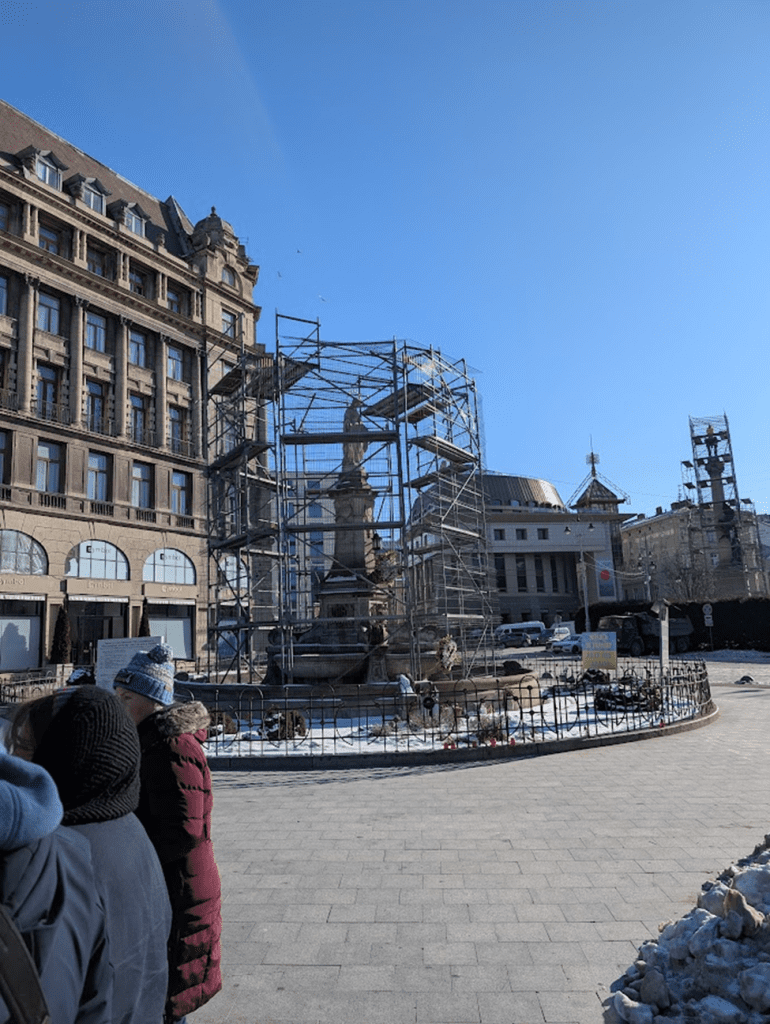
Protection around key statues in Lviv.

At 9am, much of the country stops for a minute’s silence. Loudspeakers announce the event in advance. Cars stop in the streets and everyone stands quietly. Then life goes back to “normal”. It’s worth saying that I never felt unsafe in the country, and I don’t believe we were ever at risk. Of course, we weren’t complacent, and we weren’t anywhere near the front line.

We were a group of around 40, driving seven Mercedes Sprinter ambulances, 13 4x4s, and a truck carrying a large generator. The vehicles were full of medical aid, including tourniquets and dressings, and over 20 smaller generators.

This was a trip of two halves. The first half was simply a long drive: Monday to Thursday, starting from various parts of the UK and ending on the border between Poland and Ukraine. It was relatively uneventful. The weather was good for the time of year, with little snow or ice – something that would have complicated the drive and made it far more dangerous.

The biggest glitch was one of the ambulances developing a major fault (a diesel injector blew out on the autobahn in Germany). It was almost catastrophic but the two specialist ambulance mechanics travelling with us did an incredible job with minimal resources and had it back on the road the next day. The drivers then did a 600-mile journey and were able to catch up with the rest of the group.

On Thursday evening we linked up with the team from Aequitas, our partner charity in Kyiv, who distribute the aid and vehicles to organisations on the ground. It’s run by a UK doctor who has been out in Ukraine since the beginning of the full-scale invasion in February 2022, with the help of a small team of Ukrainians and international volunteers.

Thanks to their work in the background, crossing the border was faster and easier than anyone had expected. Polish bureaucracy can be extensive, and it can take hours or even days sometimes. We were through in a little over an hour.

Our first stop was the Phoenix Centre, a home for internally-displaced people a little way from Lviv. Most of Convoy4Ukraine’s aid and vehicles are bound for Kyiv and further east, but we act as a delivery service to Phoenix for items donated to them from the UK. We were welcomed with a bowl of borsch and other Ukrainian food – very welcome when there’s still snow on the ground. A couple of hours later we said goodbye to some of the group, who were returning home, and left for Lviv, a journey of around an hour.

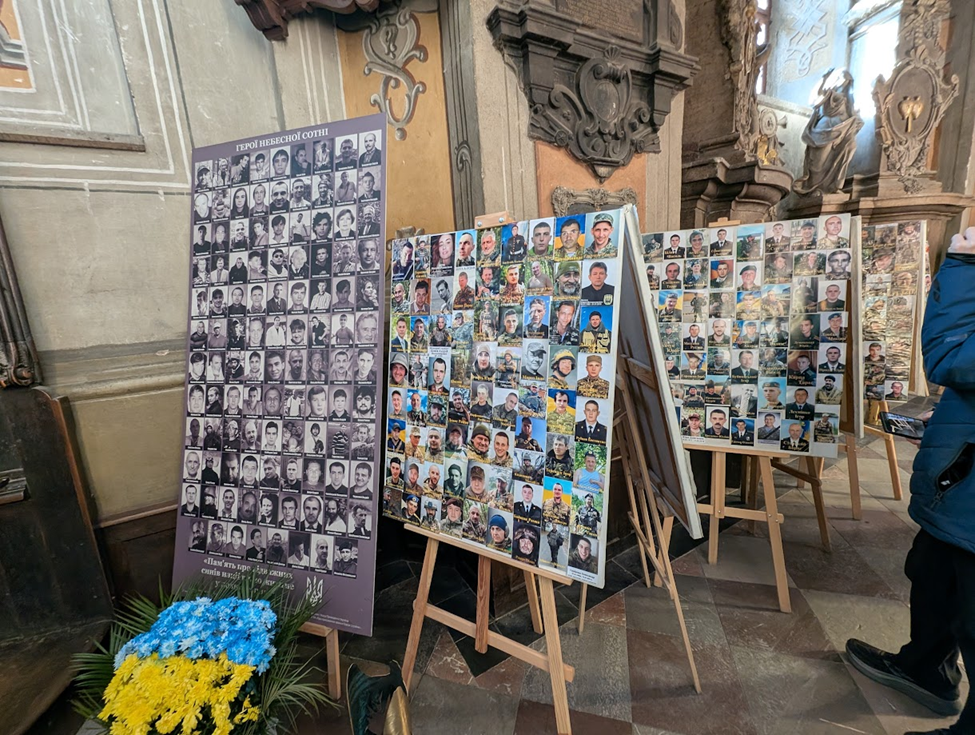
We stayed in Lviv for two nights, recovering after the long drive to Ukraine before our final leg to Kyiv, and seeing some of the city on a walking tour. Again, the war was often unnoticed but never far away: scaffolding and nets around monuments to protect them from missiles and drones; hundreds of pictures of fallen soldiers in the church; a military funeral; an underground restaurant designed like a bunker, where you could take potshots at Putin with a BB-rifle in between eating borsch and pirogi; shops with clothes themed around war, resistance, and independence. The tryzub, Ukraine’s national symbol, is everywhere.

Memorials to soldiers from regiments in Lviv in the Saints Peter and Paul Garrison Church.

We formally handed over our vehicles that afternoon. While some of us would still be driving, they’d belong to Aequitas from that point onwards.

Shortly after midnight on Saturday, there was the first of three terrorist attacks targeting the police. A 23-year-old officer died. Her partner was treated in the lobby of our hotel by one of our medics and taken straight to hospital. He is expected to recover, though it will take weeks. Two more attacks occurred the next day in Dnipro and Mikolaiv. An air raid alert woke some of us at 4am and we went down to the bunker under the hotel.

There’s plenty of notice of attacks, and the alerts don’t necessarily mean a strike is imminent, only that there are missiles in the air heading in your general direction. Mobile phone apps warn you of incoming attacks anywhere in the country, and show you where the closest bunker is. Many people don’t bother going any more. They are tired.

The alert meant a very early start on the day we were due to leave for Kyiv, a distance of about 350 miles. The roads are terrible; filling potholes is not currently a national priority in the UK, let alone Ukraine. It gets worse the further east you go. You learn to check your left wing mirror constantly, so you know if it’s safe to change lanes or straddle the potholes at a moment’s notice. Of course, you don’t miss them all. My exhaust had already been shaken loose on the journey to Phoenix and was held on with cable ties. Fortunately there was no further damage.

Overall, the journey was remarkably easy, despite the state of the roads. Traffic wasn’t bad until we hit Kyiv, and there was no snow or ice – the thing I’d been most concerned about when driving an old ambulance with a long braking distance and half a ton of aid in the back. My passenger was a Ukrainian woman who worked with Aequitas. We spent a lot of the time trying to improve my limited Ukrainian, and discussing our favourite Ukrainian bands/songs (Zwyntar’s “Choven” is still my #1).

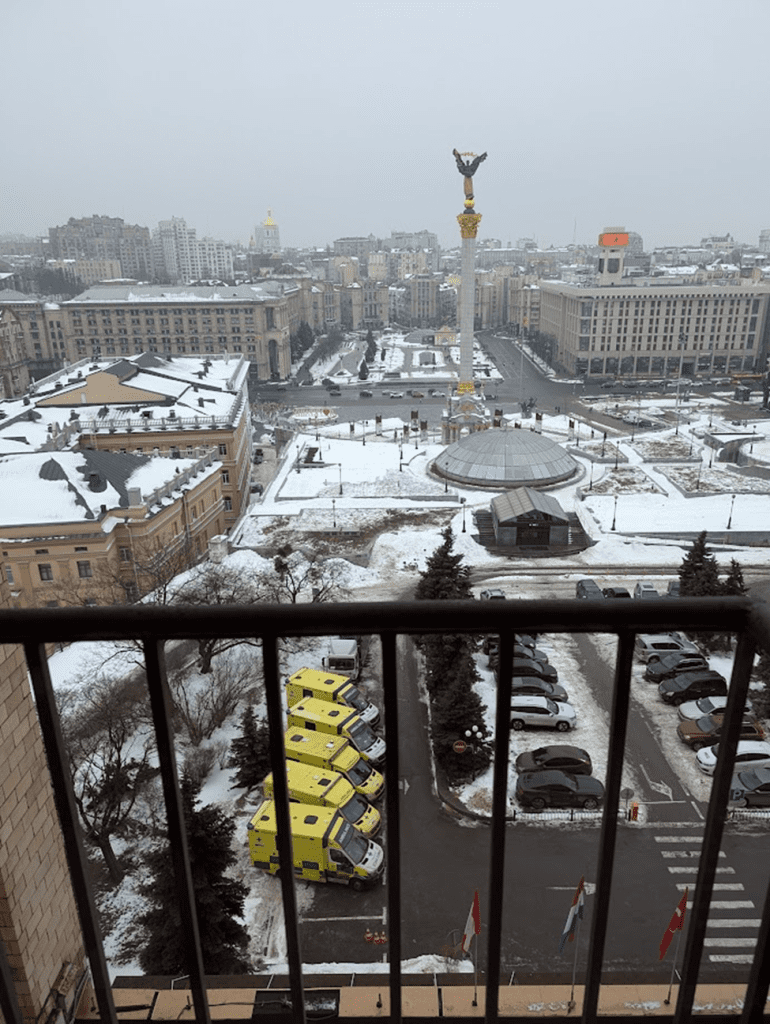
We stayed in Hotel Ukraine, right in the centre of Kyiv, overlooking Independence Square. It’s an area with many government buildings and good air defences. In this absolutely prime location, the rooms cost less than a Travelodge does in the UK. War hasn’t been good for Ukraine’s economy.

The view over Independence Square, with some of the vehicles we brought in the foreground.

Independence Square (Maidan Nezalezhnosti) is a national symbol of political activity and was the site where over 100 civilians were killed by snipers in anti-government protests in February 2014. The protests were originally prompted by President Yanukovych’s decision to refuse to sign an Association Agreement with the EU, instead opting for closer economic and political ties with Russia. The protesters are now known as the “Heavenly Hundred”.

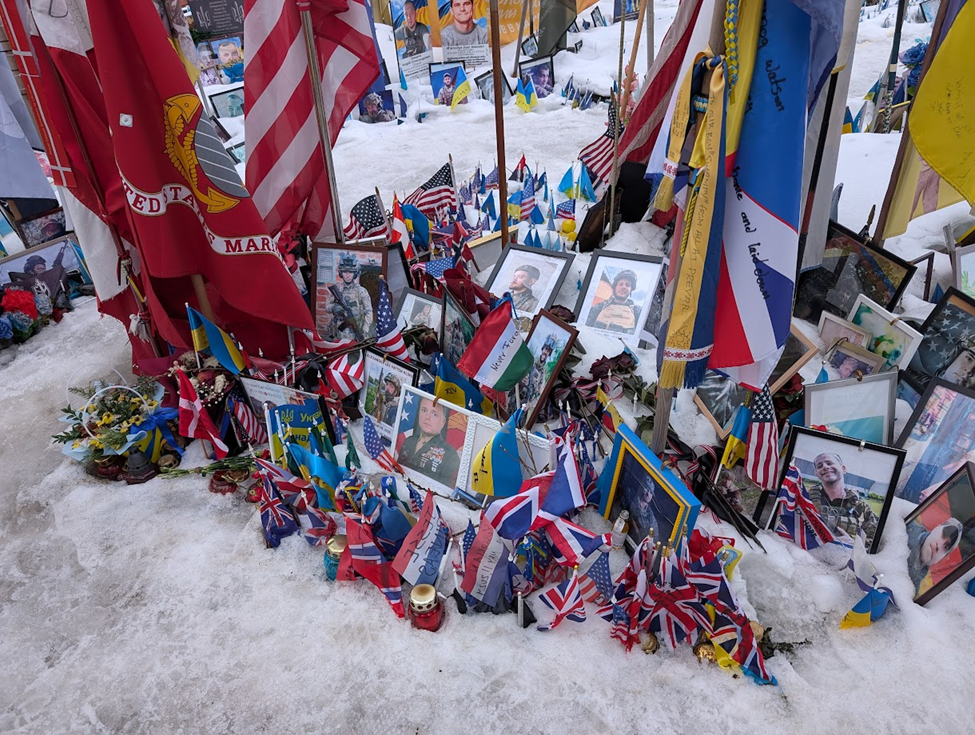
Today, the square also contains informal memorials to thousands of soldiers killed in the Russian invasion of Ukraine – not just Ukrainians but many other nationalities. Aequitas’s director showed us the section where many of his friends are commemorated, including his partner and the organisation’s original founder.

Flags and memorials in Independence Square. There are many for British, American, and international volunteers, alongside the majority of Ukrainian ones.

We took a minibus tour of the city on Monday, and had a meal together in the evening to celebrate bringing all the vehicles and aid safely to Kyiv.

Tuesday, 24 February marked the four-year anniversary of the full-scale invasion. Around 20 UK MPs were in Kyiv, along with many other European politicians and diplomats. Security was tight – we weren’t allowed to watch from the windows of the hotel, so we went outside and down towards the edge of the square for the 9am silence.

24 February was probably the safest day of the year in Kyiv, due to all the visiting dignitaries – killing one was too much of a risk for Putin. We were told by the head of a security firm that Friday would see heavy strikes. They actually began early Thursday morning, more than a day after we left.

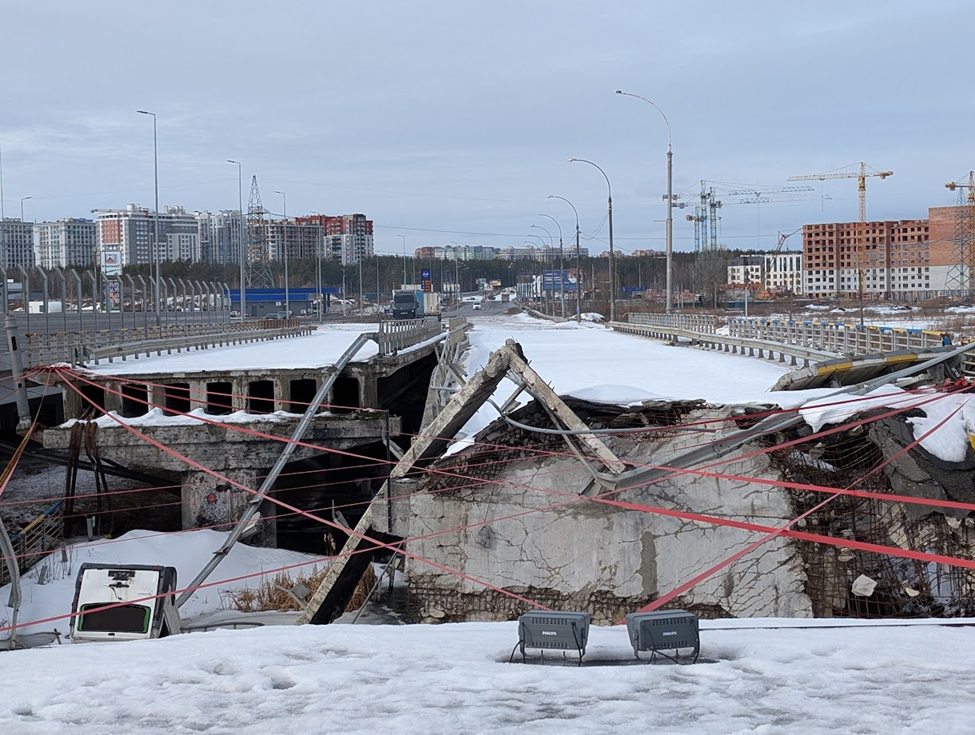
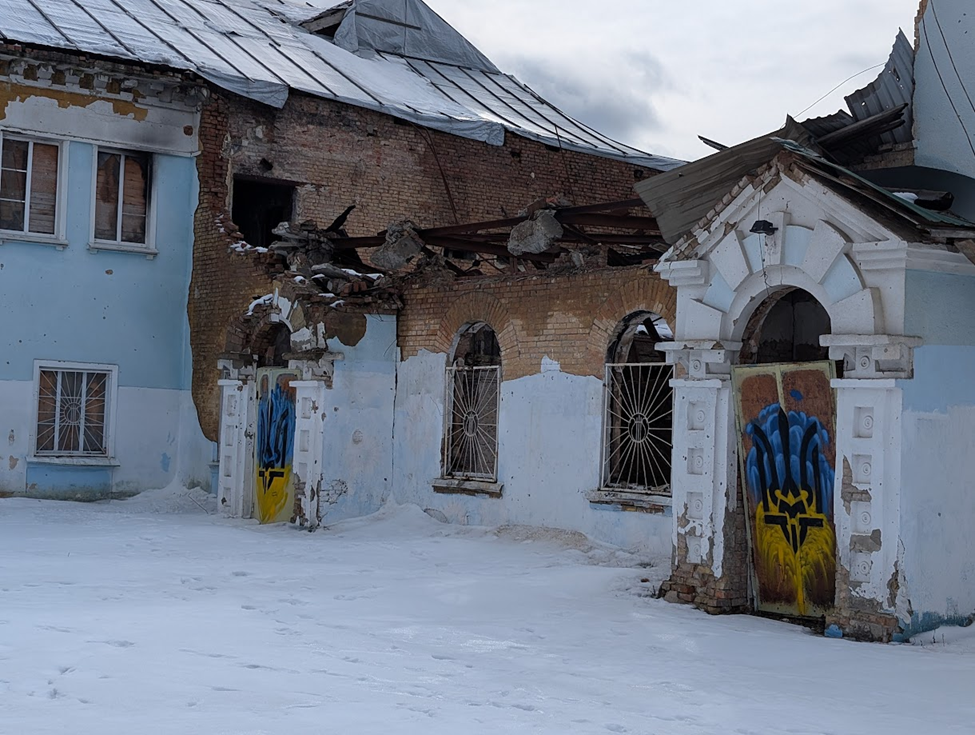
In the afternoon, a group of us went to Bucha and Irpin, a 40-minute drive from Kyiv and the sites of some of the worst atrocities of the war. These towns have since been liberated and partially rebuilt, but key locations have been left unchanged as memorials. There’s a sign with the words “Ne vidvod ochei”: “Don’t avert your eyes”.

The bridge in Irpin that was bombed to prevent Russian advances.

The Theatre in Bucha that was deliberately targeted, because Russian policy isn’t just to capture territory but to erase Ukrainian culture, language, and history.

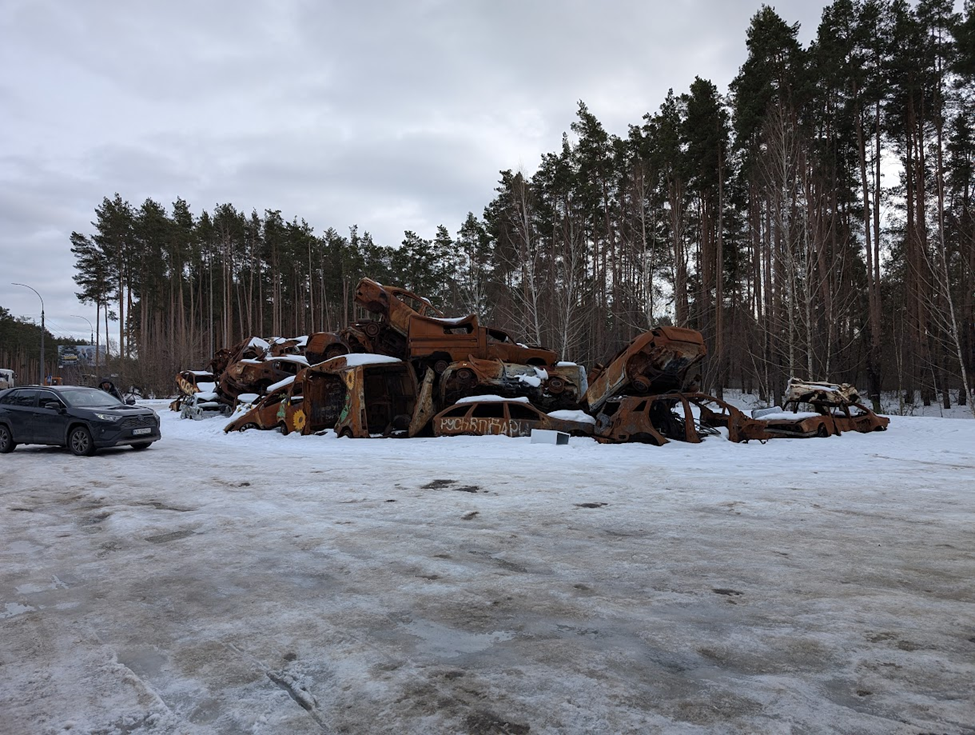
The art installation made from burned-out cars that belonged to families fleeing Bucha, which were picked off by Russian artillery from the woods on either side of the road.

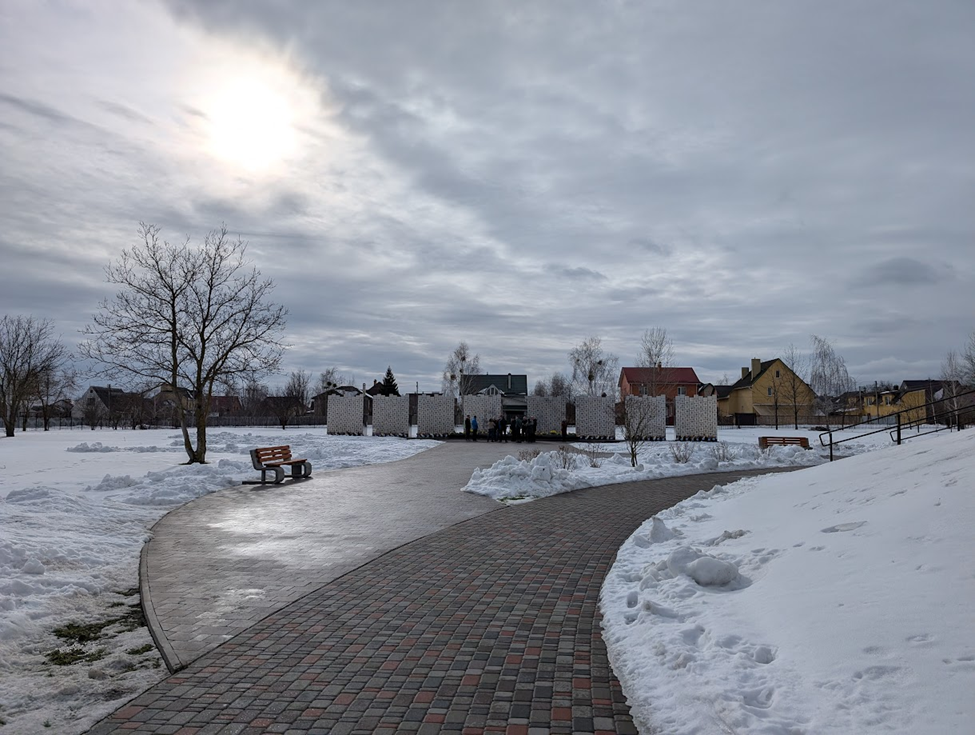
The memorial wall in Bucha for 501 people killed in the attacks.

In the evening, we caught the overnight train to Warsaw, and a flight home.

A huge “thank you” to the Aequitas team in Kyiv, the Convoy4Ukraine team, all the drivers and co-drivers, and everyone in the UK and around the world who supported us in many different ways.

Slava Ukraini.

February 2026

All forty-one of us have now safely returned from Ukraine having delivered twenty-three pickup trucks, a minibus and over £150,000 of aid to our contacts in Lviv, Kyiv, Poltava and Dnipro. Thanks to the huge generosity of you our supporters we have over our eleven trips to date to Ukraine raised just under £1,800,000. This has enabled us to deliver a total of 108 pickup trucks, an ambulance, two minibuses and an ATV together with specialist medical equipment to various hospitals and large volumes of medical and humanitarian aid. Our next convoy leaves mid-June 2026 and if you are interested in joining us do please contact me.

In June, as well as delivering trucks and aid, we will supply at a cost of 45,000 Euros one truly lifesaving fully equipped mobile ‘stabilisation container’ shown here which has already been funded by your donations. Thank you again for your generosity and support. Slava Ukraini!

Paul Parsons paul@convoy4ukraine.com

The Drivers

Nicholas Morse, Tim Morse, Michael Lee, Guy Sutton, Jonathan Baines , David Woodd, Paul Turner, Peter Gaskell, Philippe Lefevre, Monty Stuart-Monteith, Jim Yyoung, Michael Shipster, Paul Nevin, Storm Smith, Ian Wilson Young, Paris Back, Nigel Back, Paul Higham, Terry Gillett, Charlie Hastie Andrew Hudson, Matthew Atkin, Charles Prickett, Lois Prickett, Nick Taylor, Dominic Enderby, Anthony White, Thomas Buckle, Will Lewis , Rupert Douglas-Pennant, Richard Gladdle, Chris Moss, Gabrielle Liddy, Edward Allen, Andrew Post, Mary Aylmer, Hugh Ralli, Oleh Nayda, Archie Hainsworth, Nick Jacobs, Paul Parsons

Day 0 Prologue 12th February Towcester, Northamptonshire, UK

As the convoy team gathers, the fourth anniversary of the full-scale Russian invasion of Ukraine is looming. What an astonishing and awe-inspiring achievement by the Ukrainian people to have stood up to the might, ferocity and savagery of the world’s third superpower for four long summers and four bleak winters, and for Ukraine still to stand free and proud.

As we make our way that afternoon to Paul Parsons’ barns, where the vehicles are waiting, I think about the terrible price the Ukrainians are paying for their (and our) freedom as they endure the worst winter of the war. We know why they need the medical, humanitarian and rehabilitation equipment that we are going to be taking to Ukraine.

In recent months Ukraine has been pushed off the front pages and when we started raising funds for the Convoy we feared donor fatigue and wondered how hard it would be to persuade friends to give to Ukraine. But, astonishingly, our friends and colleagues are still digging deep into their pockets to support the work of Convoy4Ukraine. For this trip more than 1,500 supporters have donated more than £433,500 If you are one of those who has donated, huge thanks on our behalf and on behalf of the Ukrainian people.

This is the eleventh and largest convoy of aid to Ukraine that has been organised by Paul Parsons and Ant White. On the eve of our departure there are 22 vehicles and 41 drivers gathered as the dusk fell in Northamptonshire. A 23rd truck has already reached Ukraine. The trucks have been serviced and fitted with winter tyres ready for the journey, and they have been packed with aid. (There’s a full list of the equipment we bought in the appendix to this report.) We had no doubt that these tough vehicles would be up to the challenges they might face once in Ukraine. As for the drivers, maybe not so much?

I discovered that the 41 of us covered the full gamut, from experienced and eminently suitable for a trip like this, to rather the opposite. I am very much at the unqualified end of the spectrum. I am a recently retired barrister. I always anticipated a lot of travel in retirement. I just didn’t think it would be like this. Fortunately, my wife and co-driver Mary is better suited to this sort of thing: she’s a mechanical engineer and she drove a lorry load of aid to Poland in the 1990s.

I think all the newcomers feel apprehensive as we arrive. Nerves have been jangled a bit by messages about Air Raid Alert apps and Faraday pouches. But the veterans, reassuringly, seem calm. Talking to those veterans I realise why. Lots are ex-services, a couple are involved in racing driving, several are motorcyclists. One has flown a microlight from Bangalore to England. Another was with the Northern Alliance as they captured Kabul from the Taliban. I catch a moment with Mary: “Surrounded by all these alpha males, I’m feeling a bit beta”. “Maybe we’re the gamma bit of this convoy”.

Thursday’s task is easy, though. Testing out the trucks on the local roads. Ours is a sturdy, rugged Mitsubishi L200 with 120,000 miles on the clock, but it has been expertly serviced by Colin the dedicated mechanic and it drives and handles well. In the back is prosthetic equipment and a generator potent enough to power a mobile hospital.

After the test drive, the send-off. Speeches by Ukrainians temporarily living locally and by the Lord Lieutenant of Northamptonshire in full uniform, before retiring to bed to sleep fitfully and to worry about what was ahead.

Day 1 Rain 13th February
Start Towcester, Northamptonshire, finish Dortmund, Germany.
Distance: 733 km
Countries: Five
Time on the road: 8½ hours
Time spent at borders: 4½ hours
Fuel stops: One
Wrong turnings: Two: Calais (but that was French Customs’ fault) and Antwerp

An early start for the first day of the long drive to Ukraine. Breakfast at 5.15 am, departure
at 6.00 am ready to slog our way to the tunnel terminal
where the convoy regroups and by chance we meet a
Welsh government-backed convoy going to Ukraine too.
But crossing borders isn’t easy in a convoy of 22. As the
cheery security check man who flags us down for an
inspection says “Aren’t there a lot of you this time? And on
the busiest day of the year so far.” So, queues for security,
queues for passports and queues for the train. (But fellow
driver Paris from Norfolk takes the opportunity to recruit
another driver who she meets on the train). And then we
discover that the French customs authorities were not
playing ball: we are told to report to an office in Calais
after unloading.

Unfortunately opinions differ as to where this customs office actually is and in spite of expert remote shepherding over WhatsApp from Paul, Archie and Oleh, rather a lot of us miss the crucial turning and find ourselves scattered around the sodden Pas de Calais trying to navigate back to the office, which turns out to be hidden in a desolate freight terminal. Once reunited, we admire from a distance as Paul charms, cajoles and wrestles with the Douane bureaucracy before emerging
triumphantly with duplicate copies of a stamped manifest for every vehicle and its contents. Back on the road for an hour before a fuel stop and regroup just into Belgium. But after all the delays at and around the Shuttle it’s now late afternoon, and as we press on into Belgium we are also pressing on into Antwerp’s Friday rush hour.

Day 2 Fog (and rain and snow) 14th February
Start Dortmund, Germany, finish Gliwice, Poland.
Distance: 921 km
Countries: Two
Time on the road: 9 hours
Fuel stops: Three
Wrong turnings: Just a trifling scenic detour near Kassel

7.00 am breakfast, then trucks refuelled in time to set off at 8.00. It’s Valentine’s Day, but not as we know it. I try to make the best of it and ask what could be more romantic than an early start, a long drive and a rich variety of German and Polish motorway service areas? Capped off with provincial Polish food in a Silesian coal mining town. Perhaps I
will have to up my game next year.

Up into the wooded hills south of the Harz mountains, but also into cloud and fog shrouding what might have been fantastic views. Then down into the plains of Saxony and back into the rain, passing Leipzig, Colditz (“can’t we stop to go around the Castle?” “no, we’re literally on a mission”) and Dresden – just a glimpse in the distance of Florence on the Elbe, the jewel box of a city destroyed in the Allied firebombing raid of February 1945, and painstakingly reconstructed from Bellotto’s paintings. No time to see it on this trip, though.

Just after Dresden we cross the Polish frontier into the land of the unpronounceable ł and of excellent motorway service areas. We trundle for hours past the forests and across the vast wintry expanses of southern Poland. At some point the rain has turned to snow, and we arrive in Gliwice through snowfall in time to see the sights before dinner. Happily,
Gliwice turns out to be handsome and filled with mediaeval and baroque churches and Art Nouveau architecture. We lower the tone of the Valentine’s Day themed lobby of our Austro-Hungarian hotel for a while, and then head off for an architecture tour. We end by falling into a restaurant on the mediaeval Old Town Square. The rest of the clientele, loved
up Polish couples eating a deux, look a bit surprised to see we are choosing to celebrate our Valentine’s with 34 friends. The younger members of the convoy have found somewhere cooler to drink and dine and to celebrate Lois’ 20th birthday.
Some of the convoy are not so lucky. Archie and Oleh continue to work mechanical magic and resuscitate a ‘failing’ truck.

Day 3: Snow 15th February
Start: Gliwice, Poland, finish Lviv, Ukraine.
Distance: 432 km
Countries: Two
Time on the road: 8 hours
Time spent at borders: 2 hours
Fuel stops: One
Wrong turnings: None until the outskirts of Lviv

We wake to deep snow. Swift breakfast at 7.00 am and then time to scrape the snow off the vehicles. There are scrapers waiting for us, stuck into the snow on each bonnet – Archie and Oleh’s work as guardian angels is clearly a 24 hour operation.

I notice that the language of the WhatsApp messages is
getting more military as the border approaches: “don’t fill up: just muster. We get a pre-border briefing. Tight convoy now, and at the border we will switch to one Ukrainian
E-Sim per vehicle with other phones in a Faraday pouch and turned off. Then we’re given a short master class on convoy driving and a refresher on getting our loads through
Polish customs.

The convoy twists through dense, snowcovered forests and across icy steppe. The whole set-up could not be more cinematic: we all think of Cold War spy films and meetings at borders. Finally, the border post is in sight and
the line of 22 vehicles draws up in single file along the road. We are hugely fortunate that a visiting German border official takes charge and efficiently organises our arrival.

The magic of documents stamped by French customs
works. It is bitingly cold as we get out of the trucks to start to tackle the multiple hurdles of an old-style border. First task is cleaning the snow and ice off the number plates. Next is Polish Customs, which involves smashing the ice that has formed on the prow of the truck so we can open the bonnet to show the VIN. Then Polish passport control,
complete with registration for EU biometrics – but will my fingerprints be the same when it’s not many degrees below freezing? Next stage is to clean the ice that has reformed
during the last two checks off the numberplates so the camera can read them and open the barrier to Ukraine.

Ukraine’s formalities are quicker, but we still have time to read the Armed Forces of Ukraine’s border guard mission statement which includes treating us with ‘aimiability’ and, to be fair, they do, whilst Mary passes around candied pecans.

At last, all 22 vehicles and their drivers have been cleared; we are allowed out of the border compound and into Ukraine. We gather, excited and proud, for a group photo in front of the signboard marking the Ukrainian border. Then it’s a tight convoy through little villages, each with a magnificent onion-domed church in a different colour, and each with a graveyard with a fresh grave or two marked with National and Brigade flags, those of fallen soldiers. Village noticeboards are also covered with photographs honouring the dead or missing. As the convoy joins a main road the Ukrainian drivers hang back to let us pull onto the road as one unit.

By the time we’re into the suburbs of Lviv, convoy discipline has rather fallen apart and half a dozen trucks find themselves lost and in need of rescue by Oleh, our rearguard.

So it’s late by the time we laggards arrive at our secure parking, a trolley bus depot where Ihor, an old friend of the team and former mountain guide but now a wounded veteran, will guard them and their cargo. Central Lviv is disconcertingly normal: the shops, bars and restaurants are open (it is pre curfew) and there are lots of people out and about. Our hotel is stylish, and our dinner is a celebration of Lviv’s Austro-Hungarian heritage at the Vienna Coffee House complete with musicians playing waltzes and patriotic songs (the musicians an offering to us from the owners in thanks for our help to their country). Behind the scenes volunteer Ukrainian mechanics work to iron out a few niggles so that we are good to go in the morning.

Day 4 The point of it all 16th February In Lviv.

Hurried breakfast as ever, then minibuses to the trucks, to start our packed schedule of meetings with groups we support and handover of trucks and aid.

We’re on our way to the first appointment at 9am, when the entire city comes to a halt. Every pedestrian and car stops, every driver gets out, and all stand in silence for one minute as the daily act of solidarity with the armed forces of Ukraine and remembrance for all the victims of the war.

The need is vast. We are told that there are 250,000 patients in Ukraine in need of rehabilitation. We learn, too, that 30% of those fitted with prosthetics at the centre go back to fighting on the frontline.

We meet two of the surgeons who operate on the patients and hand over the equipment that they requested on the last visit both bought and generously donated: colonoscopes and gastroscopes, because many of the patients have gastro-intestinal injuries, and specialist skin grafting equipment. Unbroken hospital cares for the normal peacetime population of Lviv oblast but also the huge additional number of the internally displaced who have sought refuge in western Ukraine.

The next stop is the Field of Mars, the military cemetery for soldiers from Lviv from 2022 until the end of last year when it reached full capacity and the cemetry was closed. There are over one thousand graves, row upon row upon row. There’s always a photo of the fallen soldier and flags; often there are small mementos, flowers and candles and a little seat beside the grave; here and there across the vast cemetery a mother or wife is sweeping the snow off the grave. We wander along the lines of the dead looking at the photos. So many are so young – volunteers of 18. So many are so old – men in their sixties who had also been serving on the front line. There are men and women, young and old, some who look like soldiers, many who look like the teachers, clerks, farmers or whatever they were. There are tears in the eyes of every driver I pass. A new cemetery has been opened close by which in turn is filling. This scene is replicated in towns and villages across Ukraine.

On to Rizdva Presviatoyi Bohorodytsi Church where we meet the priests Frs Orest and Vasyl. All the vehicles are blessed by Fr Orest (as are we) and four are handed over to be driven by volunteers to distant parts of the country where the need is greatest.

We also meet Tetiana and Toma from the NGO ‘Ukraine Mother’ who provide support and equipment to the internally displaced, to those in need because of killing and maiming by the russians and to men and women serving their country. Tetiana and Toma are old friends, indefatigable in their voluntary work now undertaken without the help of their husbands who are serving.

We hand over a huge amount of equipment: generators, power banks, tourniquets, stretchers and so much else that has been requested. The gratitude and warmth of Tetiana and her team cannot be overstated. We feel humbled.

The beautiful icons in the church remain unfinished as the icon painter Sviatoslav whom we meet later is serving in the army.

Then to the City Hall to hear from Oleksandr from Unbroken and Andrii, the charismatic deputy mayor responsible for veterans’ affairs. The challenge involved in reintegrating veterans is vast. It is even worse for former prisoners of war who have been tortured by the russians.

Back at the hotel we hear from Adriana, a Professor of Medicine and head of the Lviv Volunteer Medical Battalion about the lifesaving first aid kits and medical backpacks they supply. We have brought them tourniquets, bandages and chest seals. Adriana is keen to tell us what else they needed by way of supplies, but keener still to get out the message about the threat that Ukraine and the West face: “the sooner the world realises how dangerous russia is, the better”.

Finally Olha and Oleksii from two rehabilitation NGOs, Nomad Live and Angar who provide therapy and activities for psychologically/psychiatrically injured veterans; we handed over equipment including canoes for use by amputees as part of their rehabilitation. They too were keener to get out Ukraine’s message than anything else: their aim is to “be resilient and remaining standing longer than russia”.

Everyone from each of the organisations C4U supports presses on to us their gratitude for what we had done, and for what all of our donors had done.

We’re emotionally shattered by the end of the day, but there are more emotions to come. 18 of us are going back to Poland from Lviv. The other 22 are pressing on east to deliver the rest of the aid and trucks. Jim Young will be writing the report on the second leg. We say farewell over dinner and wish the intrepid 22 the best of luck. Strangers four days ago are now comrades and friends.

Day 5 Coda 17th February

Lviv to Warsaw

Mary and I have decided to see a bit more of Lviv before heading to the border, so we are looking forward to a lie-in for a change. But the Russian Armed Forces have other ideas. Shortly after 6 am the air attack alarm sounds on our phones and throughout the hotel. Russia has launched 400 drones and 29 missiles against all parts of Ukraine, including Lviv. We scurry to the shelter, thoroughly aware that our shelter is a comfortable former wine cellar with electricity and heating. All over Ukraine families are stumbling through the dark to concrete basements, quite likely unheated. It’s -8° outside.

As we explore the city later, we realise how superficial the air of normality is. A convoy of vans full of wounded soldiers blares through the traffic. There’s a vast triple funeral at the Garison Church for three more men that Lviv has lost.

We count our blessings, and head for a city that’s at peace.

Conclusion

This has been an intense, and intensely moving, journey. We feel relieved to have done some good. We feel fortunate to have seen and heard what we have. We feel humbled by the fortitude and grace of the Ukrainian people. We feel grateful to all our co-drivers for their company and companionship and to Paul, Ant, Archie and Oleh for running the convoy so well. We thank all our generous donors.

We hope that in time Ukraine’s bravery will be rewarded by a just peace.

ANDREW POST

17th February

Our hotel was beautiful, the city of Lviv, entrancing. In fact, you could almost forget you were in a country at war. That is, until 6:09 a.m., when the air raid siren sounded on my phone and throughout the hotel. I walked quickly down five flights of stairs to the hotel’s basement bomb shelter, where I joined about ten fellow convoy drivers and a group of French businessmen and their Ukrainian escort. We made the best of it. Within half an hour, all my British colleagues had gone back upstairs and about their business, leaving the Frenchmen, the Ukrainian and me still waiting for the “all clear.” As the 7:30 deadline for our departure approached, I finally lost patience and went back upstairs only to find all my fellow travellers finishing their breakfasts. I ran up to my room finished dressing and packing and nearly missed the mini-bus back to the vehicles: lesson learned.

Our mission in Lviv having been fulfilled, the company split this morning according to plan, with 19 of the original drivers heading westward, going home and the rest of us, numbering 22, proceeding to central and eastern Ukraine. Five Ukrainians were brought in to supply the deficit of drivers to Poltava. We knew that the further east we went, the closer we were to hot zones. In his briefing that morning, Paul Parsons crystallized that perception by announcing that only one driver per vehicle should have an operating phone and we would generally avoid forming a cohesive convoy, all to reduce our digital signature for the russians to track and target.

We left Lviv heading toward Kyiv, a journey of about 600 km (370 miles). We passed through vast farmland areas and the signage indicated that most were owned by large, corporate farms. We saw what we believe was winter wheat emerging. We hit the Kyiv suburbs just before 5 p.m. The roads were in good shape. We began to see bomb damage in residential buildings, most of which had already been repaired.

It began getting dark, and everything on the roads that was wet began to freeze. We crossed the Dnipro River, which is massive. The snow and freezing rain were falling, it was dark, and our GPS stopped working. The snow built up on the roads. It was well below freezing. Then the windshield was icing up. We were struggling to see and were feeling quite lost, but the GPS resumed, and we made it to our hotel.

We made our first delivery right away, a battery backup
unit for a medical team and other equipment. It went to a
couple of Ukrainians named Andrii and Oleh, who had
driven from the East to which they were returning in their
own well-decorated van. Then, we had a dinner where a
small “orchestra” performed during dinner. This band
travels all along the front lines to entertain civilians and
soldiers – important for morale where conditions and life are tough. Tonight, they entertained us. What a privilege!
The moment that knocked me out, though, came when they replicated the daily nationwide moment of silence that we had experienced for the first time the day before
on a city street in Lviv. A chill ran down my spine as the drummer tapped out the slow cadence—tap, tap, tap, tap, tap, tap, tap, tap … thud—and it was over. Point made. With
the help of Yaroslav, a longtime friend of the organization, we delivered a mini-bus to replace one that had been blown up in a drone attack.

We gave a vehicle to Helena and Vitali, who were taking it to an organization they are involved with nearer the occupied territories in the East. In return, they gave us cheesecake and flags.

We delivered to an old friend Serhii, himself convalescing after injury, an electric wheelchair for use by a veteran well known to our organization from previous trips who had recently had three limbs amputated.

We returned to the hotel to sleep. In the wee hours of the morning, there was an air raid siren, but no one paid attention – including me.

Wednesday, 18th February

At 7:40 a.m., we began our journey to Poltava, a distance of about 210 miles. We made a fuel stop. Every petrol station had a convenience store, and we were always an oddity as we descended upon the locals. But these petrol stops gave us an opportunity to take the temperature. We meet an

Azov Brigade soldier on his return from visiting the Bundeswehr – his impressions of their readiness were not reassuring. At one such stop one of our number called out, “Who can speak Ukrainian? Nodding to a local who was sitting near him, he said, “I think he’s not too happy about us being here.” I speak a little bit of russian, so I went over and introduced myself to the man in that language.

“Who are you guys?” “Well, I’m an American, and there are two of us in this group, but the rest are British.”

“Why are you here?” he asked, a little suspiciously. “We’re here to deliver aid,”

“Aid for whom?” he asked, a little more suspiciously. “Why, for Ukrainians, of course!”

The man’s grizzled face split into a grin, and his eyes widened, and he said “Good – thank you!”

Our first destination, Poltava, where we would hand over three vehicles with equipment and supplies to medics. They joined us for lunch and conversation. One had been in the Seychelles when the war broke out and returned. He was 40, and his companion was 44. Both were named Volodymir. They talked about the high morale. One said he believed the russians would last only “one year more, no longer.” What would winning mean to them? “All our territories are rolled back, including Crimea, to the 1991 lines,” Volodymir said. “Reparations. Punishment for war crimes. Security guarantees.”

Anastasia, also a medic also came for lunch and a vehicle. Mikola, whom the convoy had met previously but could not come this day, sent a cake his wife had baked in thanks. The degree of affection with which these Ukrainian heroes greeted our organization’s leaders and its veteran members was truly remarkable, and this happened everywhere we went. As one Ukrainian wrote to Paul after our visit: “I understand how much effort it takes to organize such a team. What you are doing is a great mission, and we deeply appreciate it.”

After lunch, we left Poltava, trying to get to Dnipro, which is a relatively short distance: approximately 150 km. Our GPS dropped out because of air raids, and we got lost in the Ukrainian countryside. We eventually found our way to quite a traffic jam in Dnipro.

At dinner, we were joined by. Father Nicolai, a chaplain and a group of graduate student volunteers from the Ukrainian Students League, which undertakes humanitarian work in and around Dnipro. Zarya, 24, spoke at dinner: “You deliver to us not only trucks but inspiration, the greatest sign of humanity.” She acknowledged that there are doubts in the West about how Ukraine will maintain a democracy after the war. “I am sorry, guys, but this is our first time, and what we are going to do with it we don’t know,” she said with a helpless gesture to amusement of her audience. “The war started for us in 2014. We are a large country with a variety of views. We are really pretty exhausted, and we are sad about everything, but we will never be ashamed. We want to be heroes. We are just young Ukrainians who are trying to save our country. This is our work because this is our hope.” Applause replaced the laughter.

After dinner, we went to the dorm. The streets and sidewalks were sheets of ice. We parked our trucks on the street near the dorm. We arrived at our overnight barracks, where there was no electricity – but there was running water. As the temperature dropped, I added layers of clothing and socks. Eventually I achieved warmth and got a pretty good night’s sleep.

Thursday, 1Gth February

We started the morning with air raid sirens, to which no one appeared to pay attention. In only a few days, we had become accustomed to them, and you could easily see why Ukrainians looked as if normal life carried on. And for a little while, we had electricity.

There were 12 vehicles left at that point, so we all piled in and drove to our rendez-vous, a beautiful wooden church. When we arrived, another military funeral was being conducted. We watched as soldiers carried a coffin into the chapel. We waited.

Afterwards, we joined the Ukrainians who would soon take ownership of our remaining vehicles and the equipment and supplies they carried. Once again, we witnessed the deep affection and respect that Paul and his field leadership team – Anthony, Archie, and Oleh experienced wherever they went in Ukraine. At every stop, they were showered with plaques, certificates, and mementos. Newbies, too, were warmly welcomed to join this club of constant friends.

In the chapel, Father Vitaly conducted a service and blessed all of us and our missions. The priest giving the remaining vehicles a second blessing, this one Orthodox, of their own.

We gathered in the Sunday school hall for tea. Father Vitaly blessed us all and announced a blessing on Paul from the archbishop of this district for four years of faithful services to the Ukrainian cause.

Among the Ukrainians who stood out to me were another Volodymir, who left a successful business in Minnesota immediately after the full-scale invasion began, to join the struggle against Russian aggression, as did Anya, a Polish-born Belgian who came to Ukraine to work as a medic some years earlier.

Tears came to my eyes when I came across a medic named Svitlana and explained how her words, as quoted in a report on this organization’s September mission, had provided the last push to bring me to Ukraine all the way from America, and how I believed that my sharing of those words with many other Americans in my fundraising literature and speeches had generated a great deal of support for the Ukrainian cause. In the end, we both had tears in our eyes and smiles on our faces.

Svetlana with me

Wrapping Up: Thursday and Friday, 1Gth and 20th February

And, all of a sudden, we were done! We had to catch rides to the Dnipro train station with the new owners of the vehicles some of us had driven for the full 10 days and 3,600 km (2,400 miles) of this trip. We took a sleeper train from Dnipro to Lviv where the train arrived precisely on time. Our group began to disperse. Most of us continued on the same train to the Polish border, stopped there and then caught another train to Krakow.

Personal Observations

I came away from this trip with a respect for the courage, resilience and resourcefulness of Ukrainians that I had not fully understood from reading about it. They face their problems with clear eyes, and they find solutions. I also believe that the Ukrainians are gaining strength at the same time that the russians are losing strength, and now is the time for the West to apply maximum pressure on russia. Unfortunately, in the absence of a political miracle, the burden for applying such pressure will fall on Europe.

As the reader has perhaps noticed by now, I am an American. I live in a rural part of the southern state of South Carolina. Part of the urgency I felt in coming to Ukraine arose from my government’s failure to support Ukraine in its struggle against russian aggression. On this trip, I found myself saying over and over again that not all Americans support the current administration’s position. I will fight for that political miracle at home, but I can offer no hope that things will change in my country anytime soon. So, it is up to individual Americans to make a stand on their own—simply to do something. Based on my experience during this trip, I will urge other Americans to do likewise; I have seen in the eyes of Ukrainians that it does make a difference to see one of us because, as Svitlana wrote to Paul, “It’s not just a visit, it’s the feeling of a shoulder beside us.”

JIM YOUNG

APPENDIX

ProductQuantityPrice
Olympus colonoscope CF-Q260DL4£26,000.00
Olympus gastroscope GIF-XQ2601£8,000.00
ZIMER Dermatomes (Surgical instrument)2£9,200.00
Blades Original500£650.00
Blades Compatible200£350.00
Canoes (NOMAD rehabilitation)5£5,101.68
Power banks 30000mAh60£1,376.40
Power banks 60000mAh3£92.97
Könner C Söhnen KS 5500iEG Fuel Inverter generator3£3,567.00
EcoFlow DELTA 2 Portable Power Station29£13,771.20
EcoFlow GLACIER Classic Portable Fridge1£639.00
Generators 3.5kw2£569.98
Power banks 50000mAh10£329.22
Sleeping bags4£239.60
Vehicle tools4£375.80
Ecoflow Delta 2 Max (3 Max)10£11,690.00
Generators 2.3kw14£4,353.86
Generators 3.3kw13£5,068.95
EcoFlow DELTA Pro 3 Portable Power Station2£4,048.00
Ecoflow River 2 Max14£3,706.00
Vented Chest Seals1105£9,624.55
Celox Gauze240£5,253.60
Burn Gels200£290.00
Tourniquets CAT1135£24,348.30
Israli Bandages (Emergency Bandage 6”)190£1,060.20
Israli Bandages (Emergency Bandage 4”)300£1,347.00
SAM Junctional Tourniquets2£570.95
Generator Könner C Söhnen KS 3100iG S2£1,358.00
Abdominal Aortic Junctional Tourniquets5£1,898.25
Soft Stretchers30£938.89
Ecoflow Jackery Explorer 20001£899.00
Ecoflow Jackery Explorer 3000 v21£1,599.00
Diesel Heaters20£1,295.80
Disel Adapters20£579.80
EcoFlow DELTA 3 15003£1,647.00
UK to EU plug adapters (5 pack)18£161.82
EU to UK plug adapters (6 pack)46£735.27
Jackery SolarSaga 200W Solar Panel1£399.00
Jackery DC Extension Cable for Solar Panel1£32.99
Snugpak Special Forces Complete System8£2,526.75
Electric Winches2£899.90
Electric wheelchair with accessories1£1,104.98
 SUM:£157,700.71