
On the 16th of February, the Cambridge Convoy 4 Ukraine team embarked on their 22nd successful week-long convoy, where 41 volunteers delivered 21 aid-filled vehicles to Kyiv. Volunteer Guy Brandon has kindly written a piece about his experience and his reflections post-convoy.
Firstly, overall impressions. Ukraine is a beautiful country. At times and in some places you wouldn’t know it’s a country at war at all. Lviv could have been any other European city – until there’s a terrorist attack that killed a policewoman (one of the medics travelling with our group treated her partner and saved his life), or an air raid alert at 4am that sends you down to the shelter in the hotel basement. Life goes on with cafes and restaurants open, just like it did in Europe in the 1940s.
But there are signs of it everywhere. War has become part of the fabric of life. Part of the culture, even the fashion. That’s before you see the most obvious signs of it, like soldiers on the streets, dragons’ teeth scattered around, bomb-damaged buildings, or memorials like the one in the centre of Kyiv. Or the parts of the country that were captured and later liberated, where the evidence is clearest.
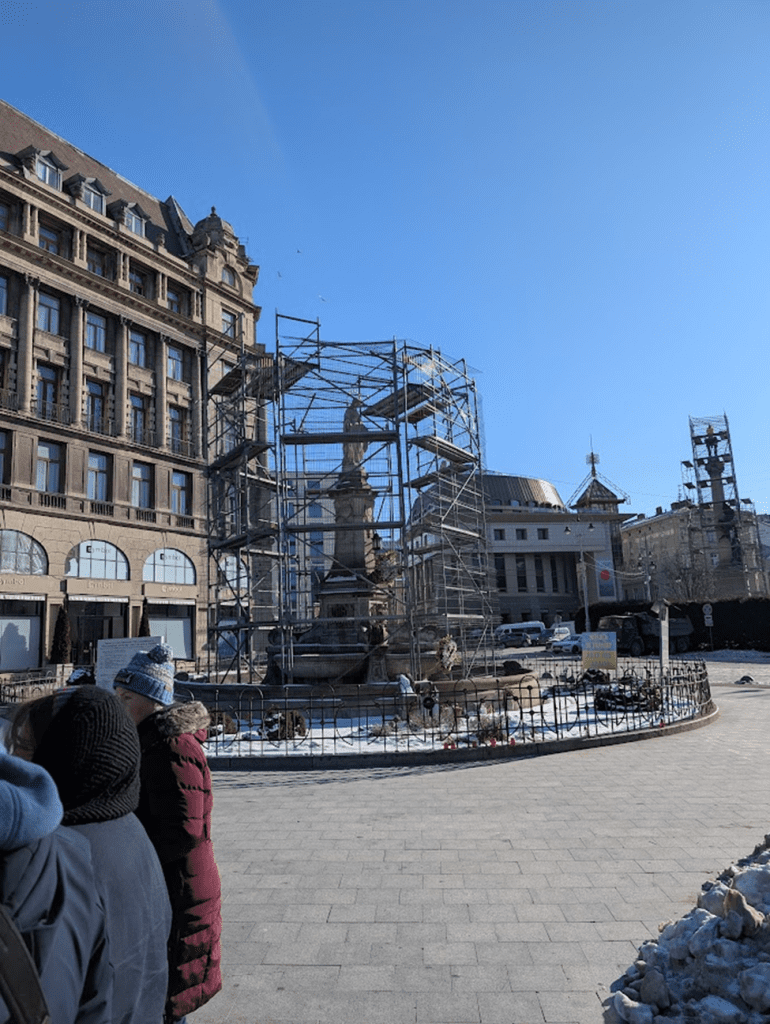
Protection around key statues in Lviv.
At 9am, much of the country stops for a minute’s silence. Loudspeakers announce the event in advance. Cars stop in the streets and everyone stands quietly. Then life goes back to “normal”. It’s worth saying that I never felt unsafe in the country, and I don’t believe we were ever at risk. Of course, we weren’t complacent, and we weren’t anywhere near the front line.
We were a group of around 40, driving seven Mercedes Sprinter ambulances, 13 4x4s, and a truck carrying a large generator. The vehicles were full of medical aid, including tourniquets and dressings, and over 20 smaller generators.
This was a trip of two halves. The first half was simply a long drive: Monday to Thursday, starting from various parts of the UK and ending on the border between Poland and Ukraine. It was relatively uneventful. The weather was good for the time of year, with little snow or ice – something that would have complicated the drive and made it far more dangerous.
The biggest glitch was one of the ambulances developing a major fault (a diesel injector blew out on the autobahn in Germany). It was almost catastrophic but the two specialist ambulance mechanics travelling with us did an incredible job with minimal resources and had it back on the road the next day. The drivers then did a 600-mile journey and were able to catch up with the rest of the group.
On Thursday evening we linked up with the team from Aequitas, our partner charity in Kyiv, who distribute the aid and vehicles to organisations on the ground. It’s run by a UK doctor who has been out in Ukraine since the beginning of the full-scale invasion in February 2022, with the help of a small team of Ukrainians and international volunteers.
Thanks to their work in the background, crossing the border was faster and easier than anyone had expected. Polish bureaucracy can be extensive, and it can take hours or even days sometimes. We were through in a little over an hour.
Our first stop was the Phoenix Centre, a home for internally-displaced people a little way from Lviv. Most of Convoy4Ukraine’s aid and vehicles are bound for Kyiv and further east, but we act as a delivery service to Phoenix for items donated to them from the UK. We were welcomed with a bowl of borsch and other Ukrainian food – very welcome when there’s still snow on the ground. A couple of hours later we said goodbye to some of the group, who were returning home, and left for Lviv, a journey of around an hour.
We stayed in Lviv for two nights, recovering after the long drive to Ukraine before our final leg to Kyiv, and seeing some of the city on a walking tour. Again, the war was often unnoticed but never far away: scaffolding and nets around monuments to protect them from missiles and drones; hundreds of pictures of fallen soldiers in the church; a military funeral; an underground restaurant designed like a bunker, where you could take potshots at Putin with a BB-rifle in between eating borsch and pirogi; shops with clothes themed around war, resistance, and independence. The tryzub, Ukraine’s national symbol, is everywhere.
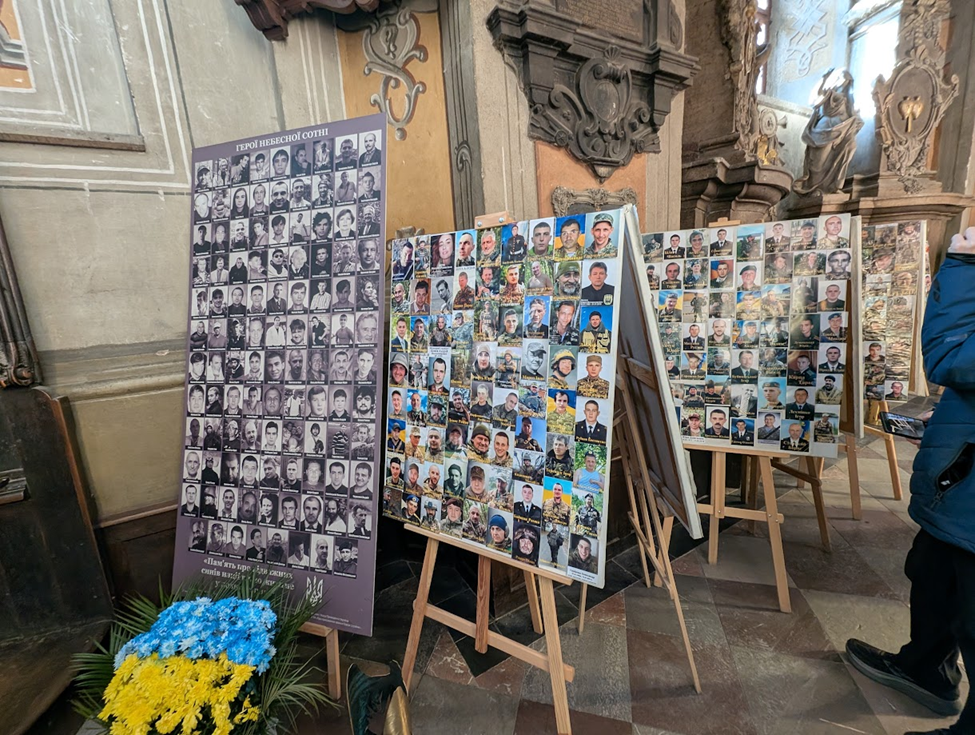
Memorials to soldiers from regiments in Lviv in the Saints Peter and Paul Garrison Church.
We formally handed over our vehicles that afternoon. While some of us would still be driving, they’d belong to Aequitas from that point onwards.
Shortly after midnight on Saturday, there was the first of three terrorist attacks targeting the police. A 23-year-old officer died. Her partner was treated in the lobby of our hotel by one of our medics and taken straight to hospital. He is expected to recover, though it will take weeks. Two more attacks occurred the next day in Dnipro and Mikolaiv. An air raid alert woke some of us at 4am and we went down to the bunker under the hotel.
There’s plenty of notice of attacks, and the alerts don’t necessarily mean a strike is imminent, only that there are missiles in the air heading in your general direction. Mobile phone apps warn you of incoming attacks anywhere in the country, and show you where the closest bunker is. Many people don’t bother going any more. They are tired.
The alert meant a very early start on the day we were due to leave for Kyiv, a distance of about 350 miles. The roads are terrible; filling potholes is not currently a national priority in the UK, let alone Ukraine. It gets worse the further east you go. You learn to check your left wing mirror constantly, so you know if it’s safe to change lanes or straddle the potholes at a moment’s notice. Of course, you don’t miss them all. My exhaust had already been shaken loose on the journey to Phoenix and was held on with cable ties. Fortunately there was no further damage.
Overall, the journey was remarkably easy, despite the state of the roads. Traffic wasn’t bad until we hit Kyiv, and there was no snow or ice – the thing I’d been most concerned about when driving an old ambulance with a long braking distance and half a ton of aid in the back. My passenger was a Ukrainian woman who worked with Aequitas. We spent a lot of the time trying to improve my limited Ukrainian, and discussing our favourite Ukrainian bands/songs (Zwyntar’s “Choven” is still my #1).
We stayed in Hotel Ukraine, right in the centre of Kyiv, overlooking Independence Square. It’s an area with many government buildings and good air defences. In this absolutely prime location, the rooms cost less than a Travelodge does in the UK. War hasn’t been good for Ukraine’s economy.
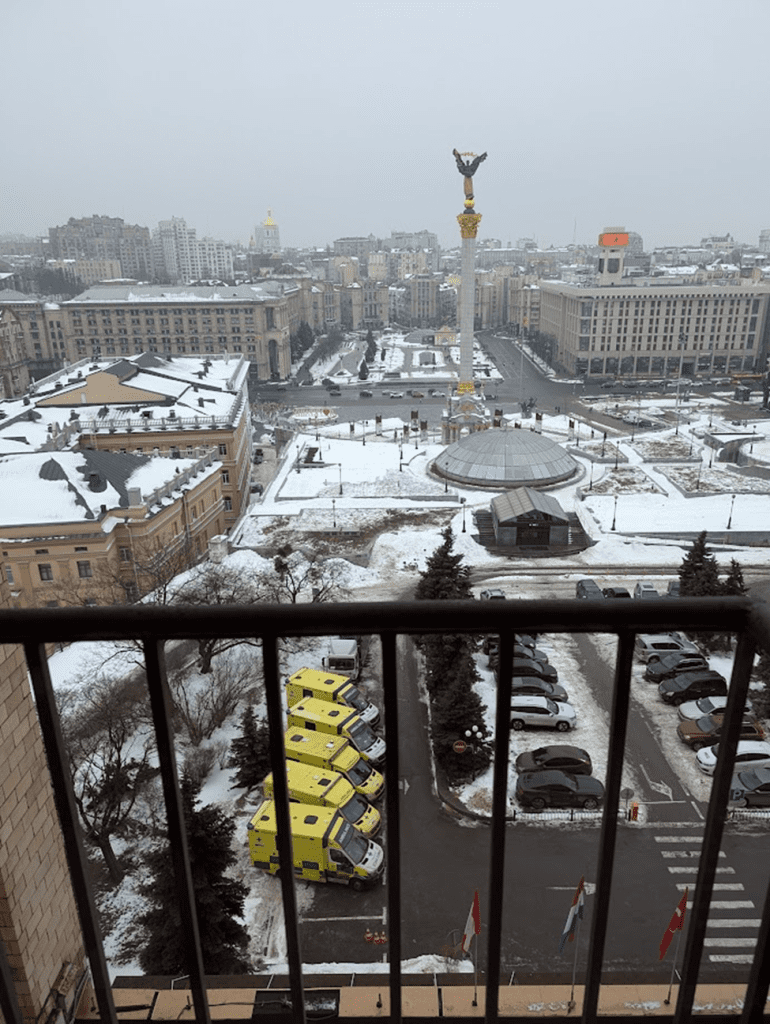
The view over Independence Square, with some of the vehicles we brought in the foreground.
Independence Square (Maidan Nezalezhnosti) is a national symbol of political activity and was the site where over 100 civilians were killed by snipers in anti-government protests in February 2014. The protests were originally prompted by President Yanukovych’s decision to refuse to sign an Association Agreement with the EU, instead opting for closer economic and political ties with Russia. The protesters are now known as the “Heavenly Hundred”.
Today, the square also contains informal memorials to thousands of soldiers killed in the Russian invasion of Ukraine – not just Ukrainians but many other nationalities. Aequitas’s director showed us the section where many of his friends are commemorated, including his partner and the organisation’s original founder.
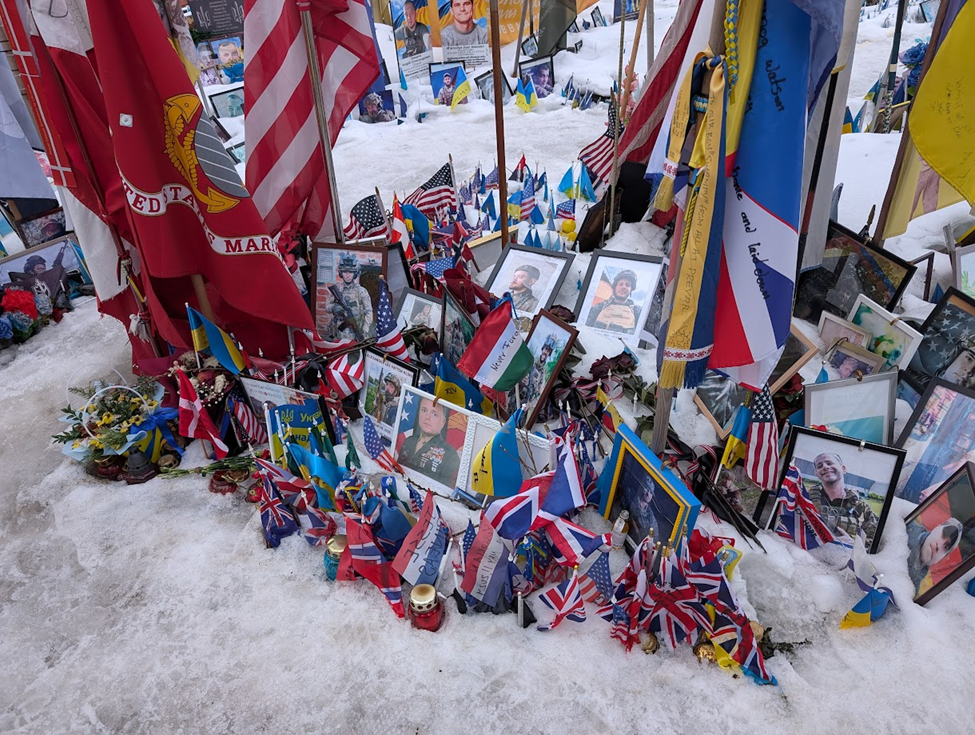
Flags and memorials in Independence Square. There are many for British, American, and international volunteers, alongside the majority of Ukrainian ones.
We took a minibus tour of the city on Monday, and had a meal together in the evening to celebrate bringing all the vehicles and aid safely to Kyiv.
Tuesday, 24 February marked the four-year anniversary of the full-scale invasion. Around 20 UK MPs were in Kyiv, along with many other European politicians and diplomats. Security was tight – we weren’t allowed to watch from the windows of the hotel, so we went outside and down towards the edge of the square for the 9am silence.
24 February was probably the safest day of the year in Kyiv, due to all the visiting dignitaries – killing one was too much of a risk for Putin. We were told by the head of a security firm that Friday would see heavy strikes. They actually began early Thursday morning, more than a day after we left.
In the afternoon, a group of us went to Bucha and Irpin, a 40-minute drive from Kyiv and the sites of some of the worst atrocities of the war. These towns have since been liberated and partially rebuilt, but key locations have been left unchanged as memorials. There’s a sign with the words “Ne vidvod ochei”: “Don’t avert your eyes”.
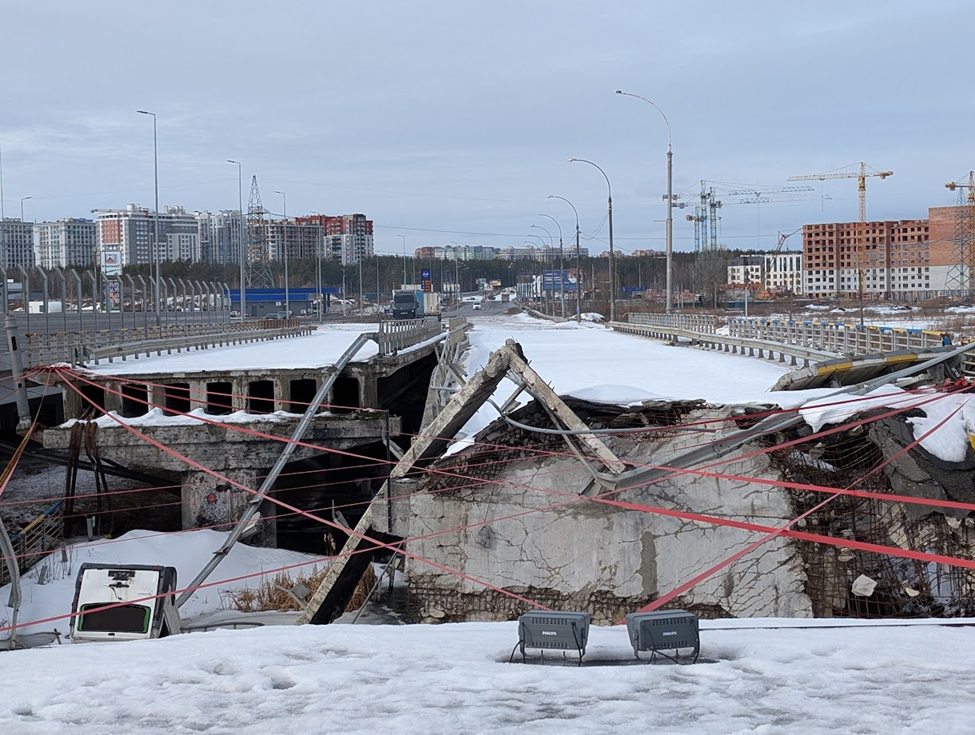
The bridge in Irpin that was bombed to prevent Russian advances.
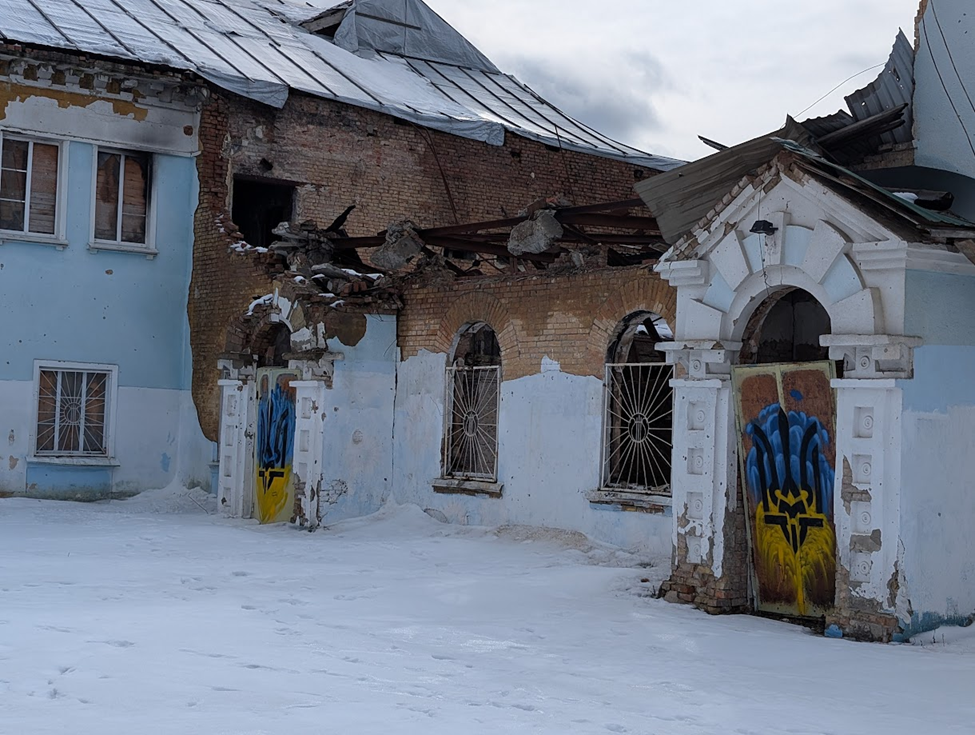
The Theatre in Bucha that was deliberately targeted, because Russian policy isn’t just to capture territory but to erase Ukrainian culture, language, and history.
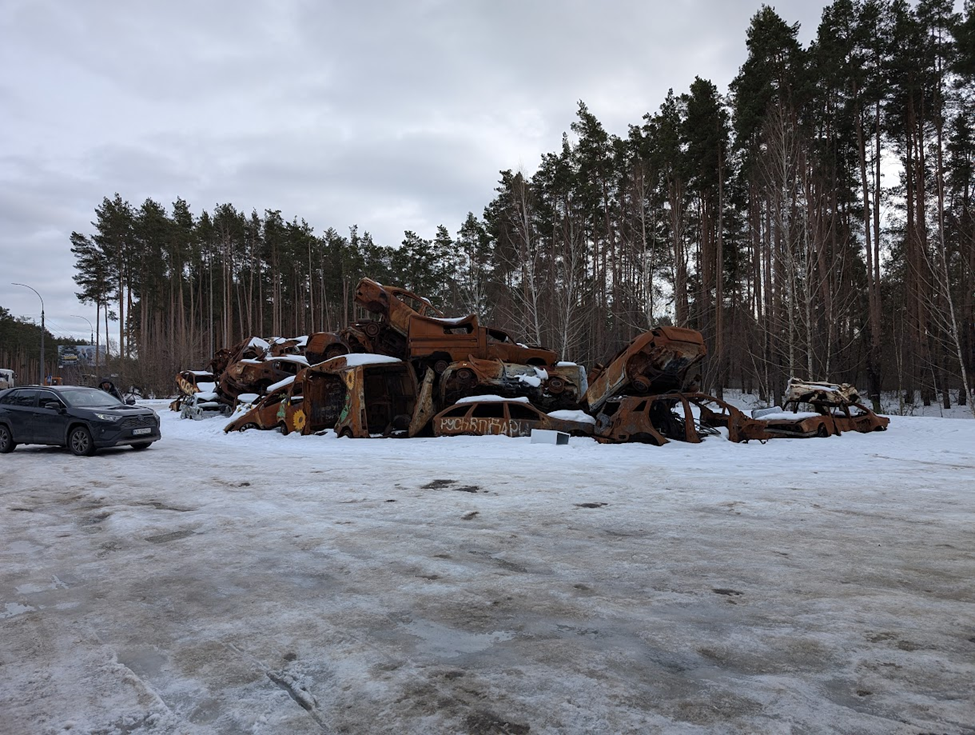
The art installation made from burned-out cars that belonged to families fleeing Bucha, which were picked off by Russian artillery from the woods on either side of the road.
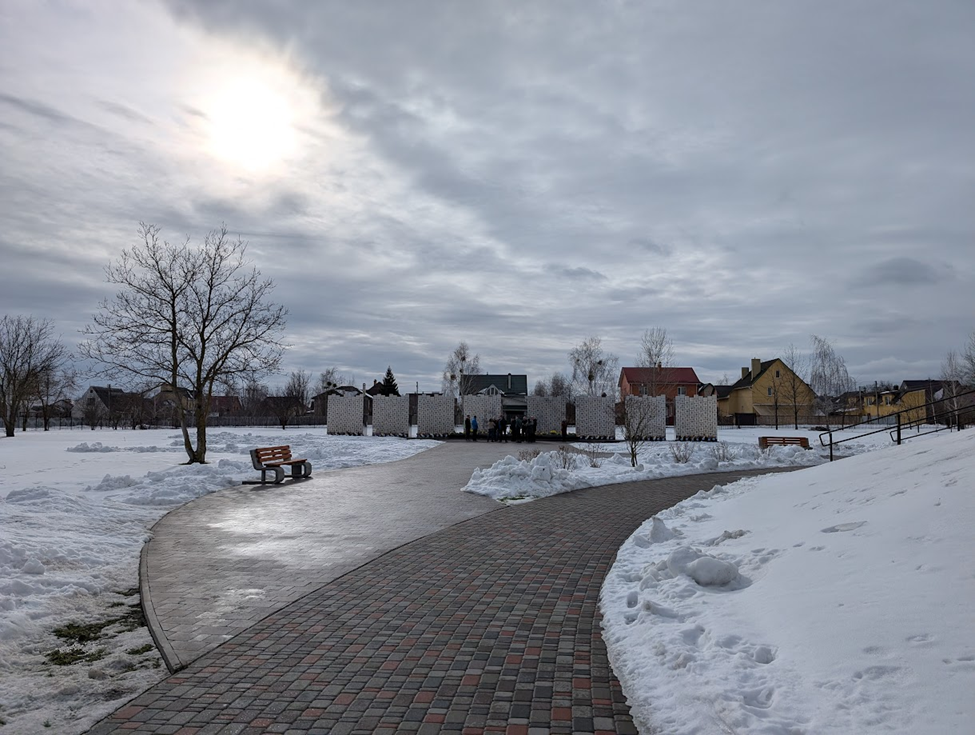
The memorial wall in Bucha for 501 people killed in the attacks.
In the evening, we caught the overnight train to Warsaw, and a flight home.
A huge “thank you” to the Aequitas team in Kyiv, the Convoy4Ukraine team, all the drivers and co-drivers, and everyone in the UK and around the world who supported us in many different ways.
Slava Ukraini.