All thirty-two of us have now safely returned from Ukraine having delivered: twenty pickup trucks (eighteen driven and two transported); over £107,000 of aid fully detailed at the end of this report; and two Stabnet Units (more on which below) to our contacts in Lviv, Poltava, Kharkiv and Barvinkove. Thanks to your huge generosity, we raised £343,802 for our June trip and have, over our twelve trips to date to Ukraine, raised in total over £2,100,000. This has enabled us to deliver 128 pickup trucks, an ambulance, two minibuses and an ATV together with specialist medical equipment to various hospitals and large volumes of medical and humanitarian aid and the two mobile operating theatres. Following our return to the UK, we received this message from one of our aid recipients, Svetlana who is a medic, which I thought worth reproducing in full:
“Thank you for these words.
Honestly, they mean no less to us than the vehicles, generators, or any other aid you bring.
Because war does not only exhaust the body. It exhausts faith. And sometimes, more than anything else, a person needs to know that somewhere far away there are people who genuinely care.
You come to a country where air raid sirens are part of daily life, where people have learned to plan their days between alerts, where every meeting could unexpectedly become the last. Yet each time, you choose to return.
And that is what we remember most. Not the vehicles. Not the boxes. Not the supplies. The people.
Those who could have stayed at home in warmth and safety yet chose to stand beside us.
There are thousands of kilometers between us, different languages, different flags flying above our homes. But for a long time now, we have shared the same cause. Freedom.
And the responsibility to defend it.
You wrote that you return home with a feeling that there is still unfinished work.
You know, most Ukrainians have lived with that same feeling for many years.
Perhaps that is why we understand each other so well.
Please pass on our deepest gratitude to your entire team.
Every driver. Every donor. Every volunteer who raises funds, repairs vehicles, loads supplies, and gives their time, energy, and heart to this cause.
They may never hear the explosions. But every day they help us withstand them.
To many of us, you are no longer simply partners or volunteers.
You have become part of the extended family that this war has created.
And when Ukrainians say, “Please tell them thank you,” believe me, those words carry far more than simple politeness.
They carry lives. Saved crews. Another day of resistance. Another chance for someone to make it home alive.
Take care of yourselves. And know that here in Ukraine, you will always have friends waiting for you.
With great respect, gratitude, and friendship, Svitlana and all of our Wild Pack
War has a strange way of creating families where, only yesterday, there were strangers.
And we are grateful that you have become part of ours. “
Our next convoy leaves October 2026 and if you are interested in joining us, do please contact me. Thank you again for your generosity and support. Slava Ukraini!
Paul Parsons paul@convoy4ukraine.com
The Drivers
John Foster, David Preston, Michael Middleton, Dick Bradford, Toby Chambers, Jacob Jenkins, Guy Fearon, Suzanna Stuart Monteith, Michael Baines, Squeeze Baines, Jonjo Wood, Matthew Horwood, Andrew Brash, Joe Brash, Charles Prickett, Fred Prickett, Tom Hughes, Andy Harrison, Charlie Pelling, Iain Willis, John Sinclair, Jeremey Owen, Charlie Hastie, Paolo Roncarati, Lisa Hainsworth, Andrew Cunningham, Nick Hoareau, Niall MacNaughton, Oleh Naida, Archie Hainsworth, Ant White, Paul Parsons
To Lviv
The success of this project depends upon two essential elements. First the volunteer drivers, some of whom are natural fund raisers and others to whom it does not come naturally. Secondly, those who are willing to put their trust in the charity and generously give their money to bring much needed aid to the brave people of Ukraine in their struggle against arguably the worst dictator since Hitler. This has been the twelfth Convoy4Ukraine organised and led by Paul Parsons and his outstanding team and, once again, the continuing generosity of donors has enabled them to return from the mission in the certain knowledge that they have helped to save Ukrainian lives and to aid the recovery of those who have suffered life changing damage to their physical and mental health caused by this cruel war.
Friday 12 June – Formation
We began to gather at Southfields near Towcester in the mid-afternoon and met by Archie, Paul’s trusted young lieutenant nursing a recently injured arm, who would guide and occasionally chivvy us on our journey and Paul whose welcome was warm and reassuring. Archie gave us our vehicle keys, all the paperwork necessary to get our vehicle into the EU and across the Poland / Ukraine border and off we went to find our previously loaded pickups lined up and waiting for us. Our Ford Ranger was not in the first flush of youth but it was comfortable and a test drive gave us confidence that it was up to the task ahead. By the time we returned most of the drivers had gathered. Some rather dazed looking newbies like us and other seasoned team members renewing friendships. While we were refreshed with Rosé or Peroni beer, Paul introduced us to his home team, Ukrainian and British, and those who were to shepherd us to Ukraine. We were told all we needed to know about how the convoy would operate and the all-important system of dropping pins on Google Maps to help us to complete each step of the drive. In amongst plenty of bravado and banter Solomonia gave us a moving reminder of how important it is to Ukrainians to feel that the peoples of the free world are actively supporting them in their struggle against evil and oppression. I would have loved our generous donors to have heard her express her thanks.
 It emerged that one experienced member of the team, who would be driving alone, was so keen that he had arrived at 6.00am on the previous day to find a deserted field from which he deduced that the convoy had already departed without telling him. Fortunately, there was no-one there to hear his reaction but his good humour was restored when he discovered the truth.
There was time for more wine and beer and more introductions and then we dispersed to the homes of those who would kindly host us for the night with the reminder that wheels would roll at 6.00 am the following morning whether we were ready or not.
Saturday 13 June – Towcester to Dortmund
I am sure that some slept well but I suspect that, for the first timers the anticipation of a long drive made sleep fitful – so it was a relief to start bang on 6.00am in a long convoy, armed with a pin on the Eurotunnel terminal at Folkestone. Rather disconcertingly the convoy split at the first roundabout outside Towcester and we found ourselves on our own but, with a delightfully clear M25 round the west side of London, the whole group completed the 164 miles comfortably in time to regroup for a cup of coffee and for Paul’s diplomatic skills to get us through French customs without requiring a detailed inspection of our vehicles in Calais which might have involved a delay of two or more hours. We drove on to the 10.20am shuttle on schedule without incident except for one nameless driver still in the manual gearbox familiarisation stage, who narrowly missed ramming the train which might have somewhat delayed dinner in Dortmund…
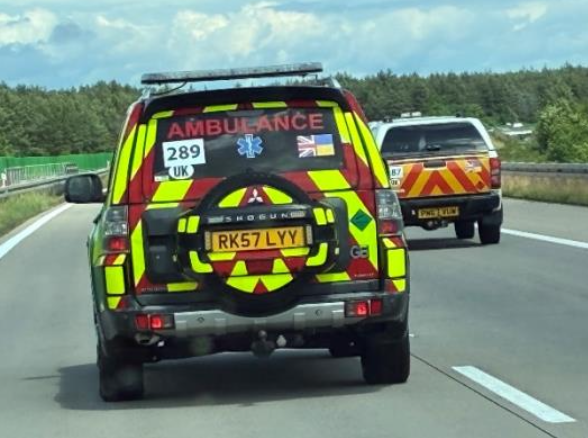
Once in the EU we travelled at a steady 80mph which our pickup managed comfortably. A WhatsApp message from Ant White, our highly efficient organiser of food and accommodation, brought some cheer by offering the choice of veal, salmon or chicken and wine or beer . My co-driver mistakenly thought this was for a gourmet continental lunch and responsibly declined the beer or wine. He should have been so lucky! At the next fuel stop in Belgium there was barely time to buy a bag of crisps but time for a warning from our leader (who spoke from bitter experience) to make sure that we filled with the correct fuel. And then we were on the road again.
The next 235 miles was through the flat and unexciting low countries studded with wind farms and leading to seemingly endless German industrial areas and the great rivers of the Rhine and Ruhr. At this stage of the journey one driver admitted to his companion a rather untimely phobia of bridges. We never learnt the effect that this phobia might have caused but they survived it… We all made it to our first Travelodge type hotel in Dortmund by 6.00pm with Archie and Oleh bringing up the rear for rescue and breakdowns. A quick drink to compare notes on the day led to dinner in a nearby restaurant and gave us more opportunities to get to know our travelling companions. I found a relatively early bed very welcome but some of the younger element had other ideas.
Sunday 14 June – Dortmund to Gliwice
The hotel gave us an excellent breakfast and after checking our oil and coolant levels and refueling we hit the road at 07.50 – ten minutes before schedule. The weather was grey and reasonably cool. This stage of the journey was much more scenic, still with forests of wind turbines (some enormous) but more hills and valleys and the occasional grand schloss in the distance. A number of us had served in the British Army of the Rhine during cold war years and this part of Germany brought back memories of our youth. On we went with the occasional warning from Paul reminding us that it was not a race and not to exceed 80mph. We never understood how he always seemed to arrive at our destinations first without breaking his own rule! The autobahns were in excellent condition and after Kassel we passed through the Meissner Kaufunger Wald, a vast forest, and on through Lower Saxony, south of the Harz mountains, to cross the former inner German border and what used to form the ‘Iron Curtain’. Travelling with a farmer I received regular mostly favourable assessments of the quality of German crops of rye, maize, wheat and potatoes. For this stage of the journey we formed mini convoys and it was sometimes a relief to tuck in behind another pickup.
After another flying fuel stop at Sangershausen, we passed a sign to Colditz crossing the Elbe at Dresden and the Spree at Bautzen near to the Czech border with its impressive church spire and onwards to the Polish border through large pine forests indicating poor land for agriculture. Once in Poland we stopped to refuel again at Kraśnik Dolny 409 miles after leaving Dortmund and I celebrated by having a slightly dodgy looking Polish sausage for lunch. Suddenly language and place names became unfamiliar and resulted in me making an inadvertent visit to the ladies’ lavatory to the consternation of some of the occupants.
Now firmly in Poland we passed big fields of arable in rolling country moving on to flatter land with potato fields between Wroclaw and Opole. High seats were positioned at woodland edges, presumably for shooting wild boar in the crops.
Our rapid progress looked too good to be true and it was – when Google told us that the A4 between us and our destination was closed due to an accident. After debating whether to risk the chance that it might not have opened again soon, we decided to leave the beaten track and followed a rather winding minor road through some quite scenic country and rather poor villages. Others took different routes and some sat it out. We lost about 30 minutes but all trucks were in Gliwice by about 6.00pm and we just had time to check into our hotel before going to a restaurant for a very splendid Polish dinner organised by our gourmet-in-chief, Ant.
Monday 15 June – Gliwice to Lviv
We gathered in the car park at 07.30 and were relieved to find that our Ford had lost no oil or coolant on the previous day. Archie and Oleh had to top up coolant and oil and make some running repairs to some other vehicles and, after issuing a group bollocking about the hazards of failing to replace coolant caps, we were off at 7.50am moving through pine and birch forest and poor scrubland to skirt round Kraków passing a beautiful hill top church. Crossing the river Wizla we were warned to take care for elk on the road and indeed a crossing elk resulted in a close shave for one of our number.
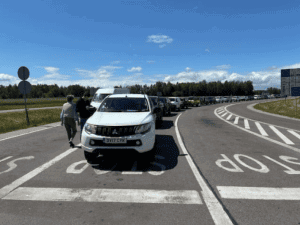 Our final filling station before reaching Ukraine was at Krzemienica and we were warned on pain of death not to leave there before we were given permission. Here we were briefed on the process of leaving Poland and entering Ukraine and the need to be ultra-cooperative with border guards through the tortuous process in order to avoid even longer delays.
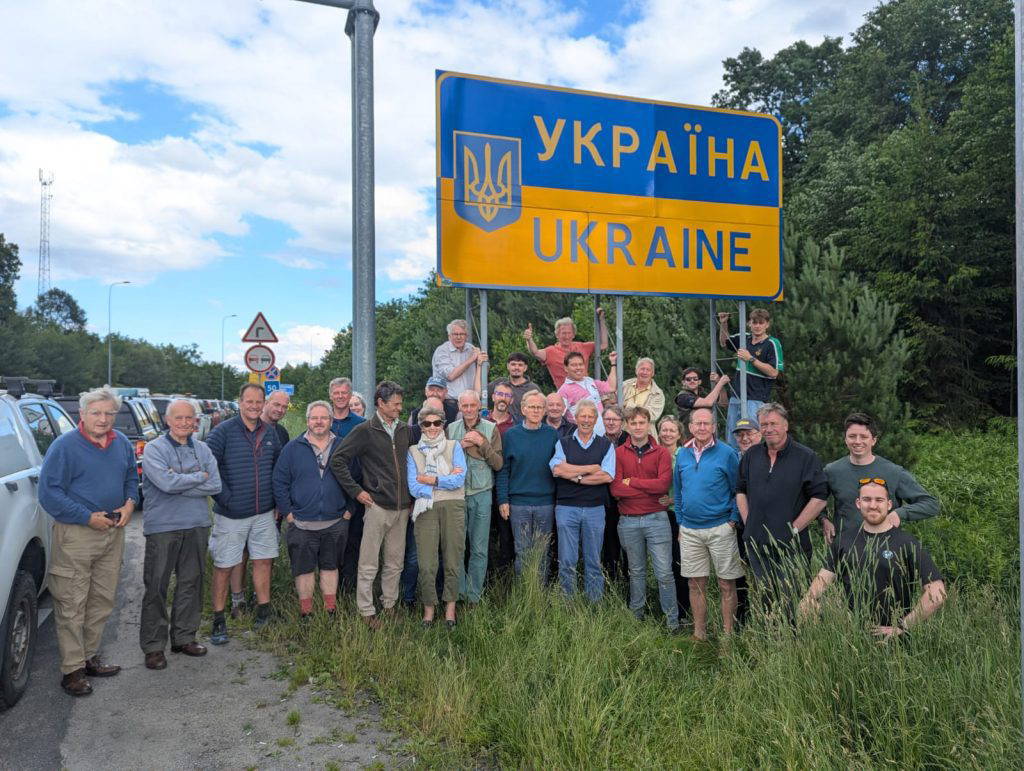
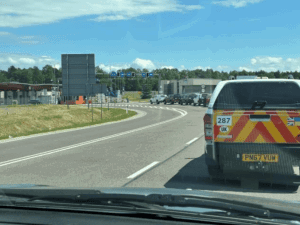 From this point we kept a tighter convoy at a slower pace on more minor and sometimes winding roads, passing through beech, birch and pine forest and poor strip farming including some crops that were difficult to identify. Loose dogs had to be avoided and stork nests on top of telegraph pole were a frequent feature. We reached the Polish border post at 1.00 pm. The process could have been worse, and we were all through by 4.00 pm and after a group photograph under the Ukraine sign we were on our way to Lviv, passing through small villages Ukrainian flags flying in cemeteries marking the graves of soldiers, forests and all kinds of subsistence farming. The outskirts of Lviv consisted of small factories and Soviet-style blocks of workers’ flats. We parked up in a secure yard outside the city centre and were taken by bus to the Leopolis hotel in the centre reaching it at 7.15pm.
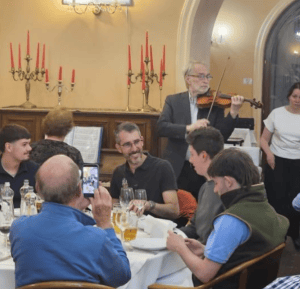
Dinner was laid on by Ant in a nearby restaurant for 7.45pm. Having sat on my bottom for three days with no exercise I had no appetite for food and opted out of dinner to explore the streets of Lviv. I was subsequently told that I had missed the best dinner yet and also some outstanding Ukrainian live music. I regretted this but enjoyed the only opportunity to explore the city centre on a lovely sunny evening. My initial impression was surprise that this did not feel like a city at war but soon the generators on every street, the small number of fighting age men except those in uniform and men on crutches with prosthetic limbs told a different story. A further reminder was the arrival of a flagged military funeral cortege arriving from the front.
 Lviv is a grand and beautiful city full of impressive baroque architecture including the Church of St Andrew in the Bernardine Monastery, a UNESCO world heritage site damaged by an Iranian built Shahed drone in March this year. I think we were all moved by the atmosphere of calm and reflection in the Saints Peter and Paul Garrison Church, completed in 1638 which was close to our hotel.
Tuesday 16 June – Lviv
This was the day in which we were to learn more about the effects of the war on those who are fighting and the extraordinary initiatives taken by those who are helping them to recover. It also helped us to see where some of the aid we had brought was to be used. After breakfast and coffee, if we were lucky (produced individually and painfully slowly by the barista) we were bussed back to our trucks.
En route to our first visit, we stopped and got out of our vehicles at 9.00am to stand in silence together with the whole city for the daily one minute pause to remember those who have given their lives for the freedom of their compatriots.
Our first visit was to the Unbroken Prosthetic and Orthotic Centre, one element of the Unbroken Charitable Foundation, which was founded by two veterans to help those who have been injured by the war by giving them the best professional medical care available to enable them to return to a full life. This centre was donated by the German Federal Government and the service is continuing to grow. We were taken round by Yulia who showed us how modern prosthetic limbs are made and fitted and the modern robotic equipment given by South Korea. 200 patients are currently undergoing treatment. Many of the staff are women who have lost relations. 25 year old Oksana, who teaches patients to use prosthetic limbs told us that she was an art restorer until she lost her brother in the war and she felt she ‘must do more’.
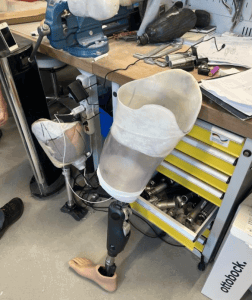
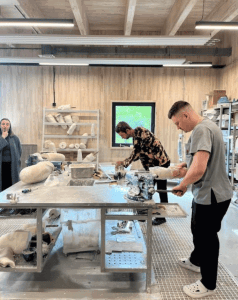
The organisation recognises that veterans undergoing treatment, many of whom are not from Lviv, need the close support of their families and are building social housing to fulfil this need. Convoy4Ukraine has supplied Unbroken with endoscopes, gastroscopes, colonoscopes, laryngoscopes and duodenoscopes and keeps in close touch to identify and source further needs. Oksana lightened the atmosphere by telling us the two most common questions she is asked by patients on what they will be able to do with their prosthetic hands: “Will I be able to use my trigger finger?’ and, holding up her middle finger, “Will I be able to do this at the Russians?”. Restoration of veterans’ physical and mental health is going to continue long after the war has ended and Unbroken will play a major part.
After another rather hairy drive through Lviv we reached the Lviv Centre for Services to Combatants. Since 2016 this organisation has delivered legal advice, psychological support, career advice and training to over 62,000 mentally and physically damaged veterans (compare this number to the 22,000 regular British Army troops in combat roles) and their families. The centre also encourages businesses to employ veterans. The staff, most of whom are women are invariably from veterans’ families. Convoy4Ukraine continues to offer and provide the Centre with aid.
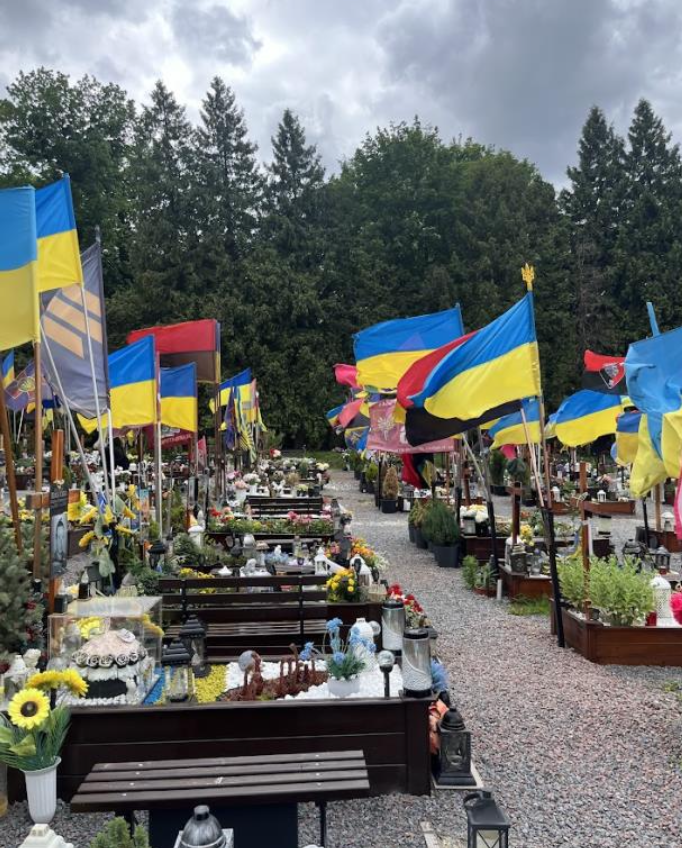
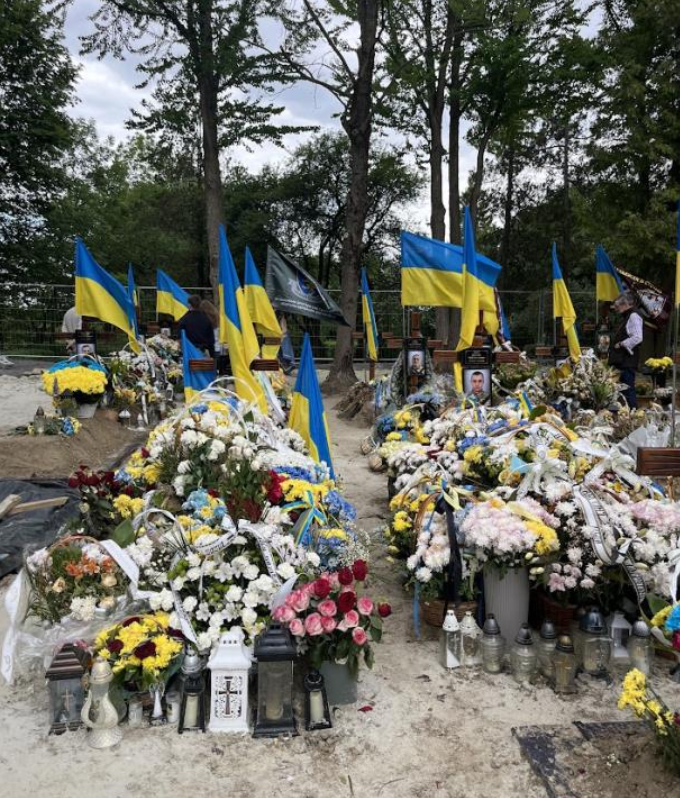
The largest military cemetery in Lviv, The Field of Mars where thousands of graves of men and women, combatants and medics of all ages fluttering with Ukrainian, nationalist and unit flags brought home to us the terrible human cost of the war. As mothers, fathers, husbands, wives, children and loved ones quietly came to the graves with fresh flowers it was impossible to not to feel moved by emotions of grief and anger. The Field of Mars has now reached capacity and has been replaced by a new cemetery called The Hill of Glory where we saw graves of those who had fallen in the previous two weeks. We were also acutely aware that cemeteries like this can be found throughout Ukraine. After the war the temporary grave surrounds will be replaced by permanent stone crosses.
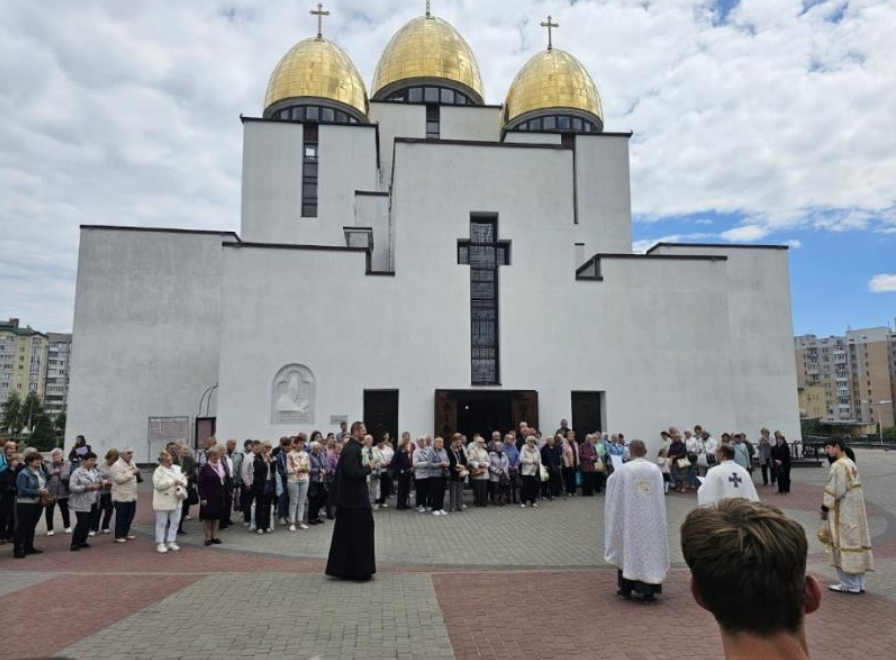
From there we moved to the impressive Church of The Nativity of The Blessed Virgin, built in 2008 following the collapse of the Soviet Union and dedicated to Pope John Paul II. After a mass, in front of a large part of the congregation, Fathers Orest and Vasil blessed the pickups and sprinkled them with holy water – not forgetting to give the drivers a good sprinkling too.
We were then entertained to lunch with a speech of thanks to Convoy4Ukraine by Father Vasil followed by a ceremony akin to school prize giving acknowledging the valiant work by Paul and his team of ‘permanent staff’. Amongst other presentations was a huge loaf of bread baked by ‘Mothers of Lviv’ who came in national dress. After lunch we handed over three vehicles and aid.
Back to the hotel by 5.00pm and we were already late for a talk by Alexei on Nomad Live, an organisation supported by Convoy4Ukraine which helps released prisoners of war with ‘peer to peer’ support to overcome the effect of their experiences and to reintegrate with society. It is easy for us to forget the long term trauma caused by war and this talk was a valuable eye-opener.
This talk was followed an on-screen presentation by Adriana Haydux on the invaluable role of the Lviv Volunteer Medical Battalion which reminded us that Ukraine is suffering not only its 5th, but also its 12th and 112th anniversaries of Russian invasions. Instant, correctly administered first aid saves lives that might otherwise be lost. The battalion supplies troops with advanced individual first aid kits, tactical medical backpacks and trains combat medics to a very high standard. It also provides first aid equipment and training for civilians living close to the front line. We were shown how to apply a tourniquet and provided with individual first aid kits.
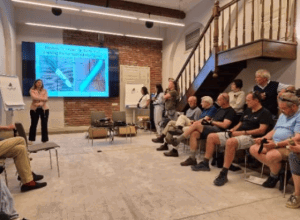
It was a long but unforgettable day and the whole team had dinner together for the final time before the following day when some would return home and others take the remaining vehicles further east.
Dick Bradford.
Beyond Lviv
Wednesday 17 June – Lviv to Poltava
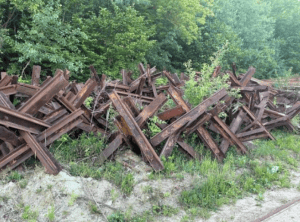
06.15. An early start and the normal bun fight to get breakfast in the Leopolis Hotel before we had to board the minibus and return to our vehicles, which had overnighted in an abandoned tram station. We noted the tank traps made from old tram rails piled up on the waste ground in front of the 4x4s. War time recycling at its best. It was going to be a long day on the road – approximately 900km, Lviv to Poltava via Kyiv.
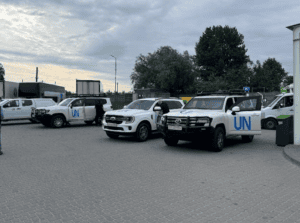
 We eased our way out of the city making our first stop at one of the ubiquitous OKKO service stations to refuel. Here, by coincidence, we met up with three UN Toyota Land Cruisers. They were crewed by a multi-national, mine clearing team heading for Kyiv. A former British Army Royal Engineer was part of their team. Nice to see fellow Brits on the road east, but we rather envied their high-spec vehicles with their armoured glass and doors.
We knew we had a lot of miles to cover so everyone had their foot down and missives were issued on the WhatsApp telling us to adhere to the speed limit and avoid trashing the engines of our old work horses. Truck 293 was belching black smoke periodically but we were informed it was less to do with excessive acceleration and more it lacked a DPF particle filter, whatever that is. You learn something new every day. Just east of Zhytomyr we stopped again to gather the convoy and refuel. We were about two thirds of the way to Kyiv on the E40. This was the arterial road that would take us most of the way to Poltava. It comprised dual carriageway, mixed in with two-way traffic and reminded me of the A303. Our drive throughout was punctuated by a stream of near suicidal Ukrainian drivers weaving in and out of traffic.
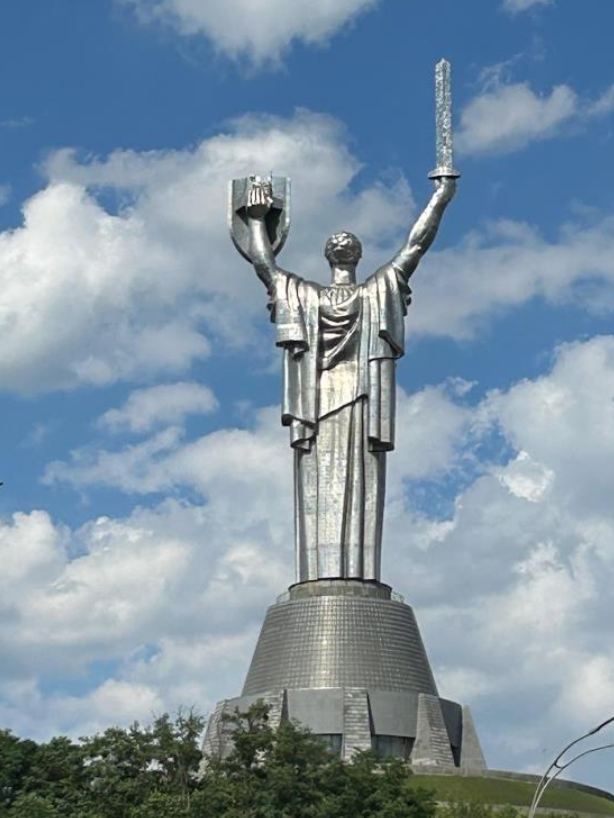
Nick my co-driver and I cut through Kyiv and had to utilise some London driving , i.e. aggressive and selfish, in order to get where wanted to and as a consequence of a series of last-minute changes of direction and lane. We stopped off briefly by the Dnipro River and grabbed a quick photo of the river with the statue of Mother Ukraine and the Kyiv skyline in the background.
On we pushed, following the signs for Kharkiv to the next stop, a WOG service station just east of Kyiv where we were meeting Oleg, the CEO of Stabnet from whom we had commissioned two Stabnet Units that had been manufactured in Kharkiv. These were Stabnets 64 and 65 of a hoped for production of 300 for which further funding was awaited .
Nick managed to drag a rare smile out of the service station staff while we were there. Most of us had been confused by what the system was for refueling. Pay first? Fill up first? Now we knew -fill up, pump number , fuel type-diesel, amount of fuel, type of payment – card. Nick then went on repeating it in his somewhat debatable grasp of Ukrainian.
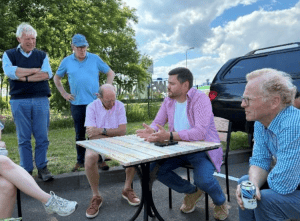
Andrew Brash’s white Ford Ranger was now leaking oil badly and there was some concern about whether it would make it to Poltava. Archie and Oleh were on the case. On towards Poltava past vast, beautifully groomed fields of wheat and potatoes, bathed in the soft early evening light. Bizarrely you rarely saw a heard of cows and never any sheep.
Whilst trying to relieve the boredom of the endless miles, Nick and I decided to check out the reviews of the Hotel Aristokrat in Poltava on Booking.com. This was to be our hotel for the night. It opened up with…
“Please review any travel advisories provided by your government to make an informed decision about your stay in this area, which may be considered conflict affected.”
This proved remarkably prescient given what followed in the early hours of the morning.
Booking.com reviewers had given the hotel an 8.5 rating and the status of Very Good, but there were few overseas reviewers! However, Victoria from Belgium gave it a 5.0 as the staff had locked her out of the hotel in January which we felt were reasonable grounds for a poor review.
Finally, we reached Poltava about 20.00 and after parking the vehicles in a pretty tight underground parking spot doubling up as the hotel air raid shelter, immediately began the handover of vehicles.
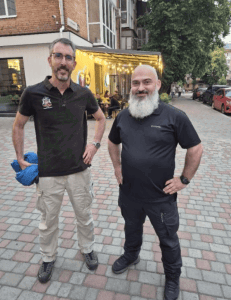
We met Michael, Archil and Alex. Archil was Georgian, a former maths teacher and sported an excellent ZZ Top style beard. He and his Georgian colleague had been in Ukraine since early 2023. We handed over some medical supplies to them and one vehicle to Sasha, JonJo doing the handover honours. Dimitrov and Alex who were heading towards Zaporizia and Lozza also picked up a vehicle. We handed over an ambulance to Misha a medic whose wife produced a cake for our dinner.
Michael and Squeeze Bains’ handover was briefly interrupted at around 21.00 by an air raid warning with the phone app telling us to go to the nearest shelter and reminding us that our “over-confidence was our weakness.” None of the locals took any notice so we followed suit and carried on. As the warning ended, some teenagers who had been mooching around in the courtyard in front of the hotel headed past us. One long-haired, scruffy youngster wandered up and asked, in good English, who we were and why we were in Poltava. We explained and he thanked us for helping Ukraine and then sauntered off to join his friends. We were rather touched by his words. We then headed in for a belated dinner.
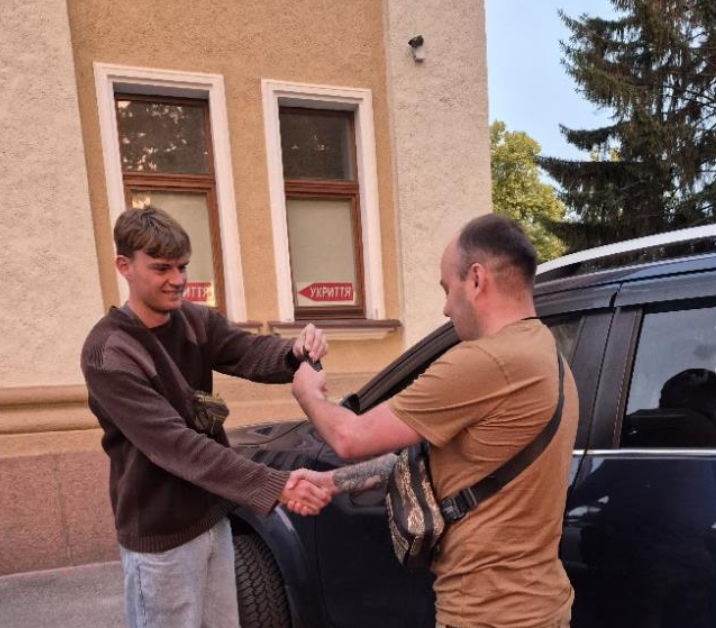
Thursday 18 June – Poltava to Barvinkove
01.20. I was awakened abruptly by a loud explosion followed by some more distant crumps and accompanied by the air raid siren. I had to decide – bed or shelter? Bed won, but sleep followed slowly as the adrenaline that had fired through my system took time to fade. An hour later, the air raid warning wails me awake again, but this time no explosions and sleep follows more quickly. I awake more gently at around 06.30 to a beautiful sunny morning, slightly fuzzy headed from the interrupted sleep and the rather potent beers sunk at dinner the previous evening. It transpired that an electrical substation had been hit, or so the hotel receptionist informed one of our party and the Kyiv Post confirmed Poltava had been hit by six ballistic missiles.
I glance at my hotel receipt and imagine it to be a Soviet travel document, all in Cyrillic script with its official looking blue stamp. Your brain behaves in peculiar ways sometimes.
My colleague Charlie Pelling calls to say Iain, his co-driver, is feeling better after his previous day’s stomach upset and informs me that he and Iain managed to sleep through the explosions. How is that possible? Perhaps the white wine at dinner was a better anesthetic than my beer. England have beaten Croatia.
I climb out onto my room’s balcony and life in Poltava goes on. The buses are running and people are going about their business. A feature we have noted in all the cities we have passed through. The country may be at war but life goes on.
Breakfast and refuel. On the way to the next pin our GPS goes down and we get complete nonsense on the satnav, at one point telling us to take a left turn into a field and then we are informed we are in Lima in Peru! We are not sure who is spoofing the GPS, but it is very effective. We revert to our rather large-scale, paper map. We eventually get to the pin drop where we are due to RV with the Stabnets and are rather puzzled there is no sign of them as we wend our way up a dusty track with four other vehicles. We hang around for half an hour and then Charlie Hastie decides to go for coffee at a nearby service station and by chance discovers the Stabnet and crew we are looking for are about 400m away on the opposite side of the road. We all gather and the second Stabnet arrives. We get a chance to look inside the two units we had named Nightingale and Lister. These are fantastic mini hospitals that we know save lives and this technical information explains why.
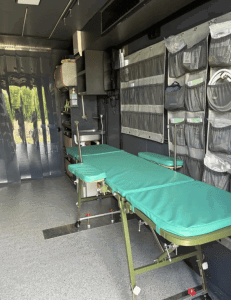 The stabilization container is 2.5 meters wide by 6 meters long and weighs only 2.4 tons. It is specially designed for stabilization of injured soldiers and is the only mobile structure able of caring for the wounded directly at the front line. It offers mobility (thanks to the light weight); discretion (the compact size allows it to be hidden as close as possible to the contact zone besides, advanced thermal acoustic insulation has been developed to avoid enemy detection; and autonomy (the container can function independently thanks to supply of equipment on board (inverter generator, water tank, bacterial decontamination system and washing system).
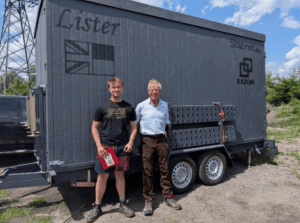 The medical equipment each unit carries includes: an operating table; a multiparameter heart monitor; infrared coagulator; manual /automatic defibrillator; secretion aspiration system; portable ultrasound scanner; oxygen concentrator; intensive care ventilator; blood bags refrigerator; hot-air sterilizer.
We then make a short drive to drop off the next vehicles. It is off the E40 on some waste ground edged with trees. We park up in the shade and under cover and meet up with some old friends Svitlana the larger-than-life medic and Yura, both of whom I had met in an abandoned house east of Sumy the previous February and her team of medics.
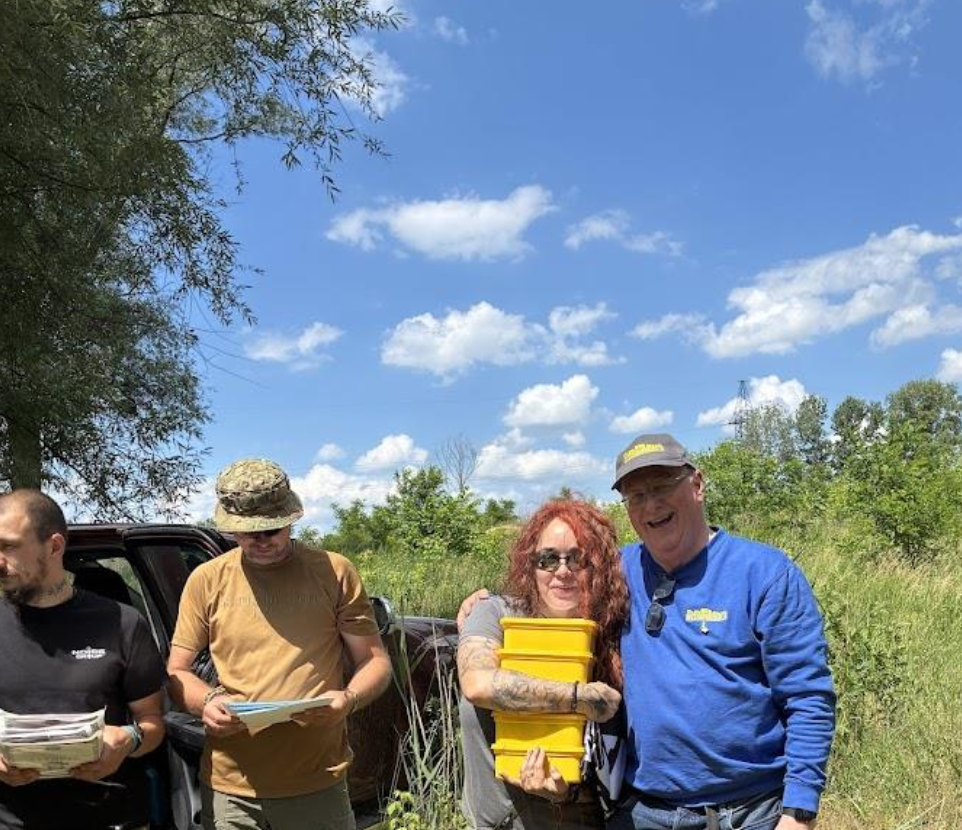
They had moved south to Kharkiv Oblast in May 2025. Vlodamir a young tough looking Ukrainian/ American had come from the US to assist leaving his wife in the US to run their business. We hand over the designated vehicles and collect more certificates of appreciation. Paul, Anthony and Archie’s hauls will probably cost them an extra baggage charge on the flight home. The engraved 0.50 shell case, key ring may also cause a few problems when we pass through airport security. We say good-bye to old friends and to some new ones.
To the last pin north of Izium. We have intermittent GPS and note drone nets now shroud most of the roads. This is all liberated territory with omnipresent signs of damage caused prior to and during the Ukrainian counteroffensive.
There is also increased military traffic on the roads. We get to the final pin which is in the town square in Barvinkove. Billboards depicting pictures of local deceased soldiers line the park.
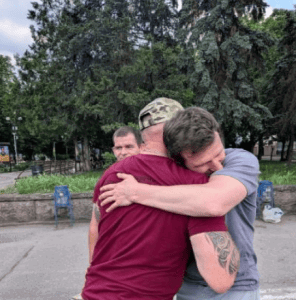
Here we meet Serhii, a great bear of a man and his colleagues, including Rita a young psychologist. We never quite worked out how she applied her skills.
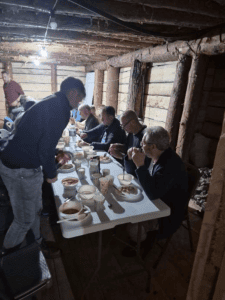
They are incredibly generous with gifts and their words. We leave the square, now bereft of vehicles and all board an old, yellow, school bus made by Leyland (worrying) which takes us to a camp, which is to be our base for the night. Ihor, our host, gives us a guided tour of the facility . There is a wonderful smell of freshly sawn wood and we are all impressed by the quality of the camp’s construction.
A delicious borscht and a mix of salmon, pork, potatoes, and salad. The night is spent in an underground dorm that resembles a prison of war camp with its wooden bunk beds. Sleep follows for some, although our leader Paul, a light sleeper, eventually gives up trying to sleep through the snoring and opts for a sofa in the dining hall.
Friday 19 June – Barvinkove to Lviv
Breakfast is cup of coffee and a piece of last night’s cake. We are on our way to Kharkiv station by 08.15. We are back on the school bus again, which unfortunately and to the driver’s irritation, is limited to 75 kph. It is a slow journey, under endless drone nets and alleviated briefly when Ihor stopped to buy us a mountain of strawberries from a babushka at the roadside. They are delicious. Two and half hours later we arrive at Kharkiv station, a wonderful Soviet style building that opens out onto a wide square.
We grab a quick bite and board the train, only to be told to get off again as there is an air raid warning. We reboard five minutes later. It is four hours to Kyiv and I am struck again by how normal everything feels, particularly as we are only 20 miles or so from the Russian border. A group of school children join us in the carriage, seemingly on a school trip to the capital.
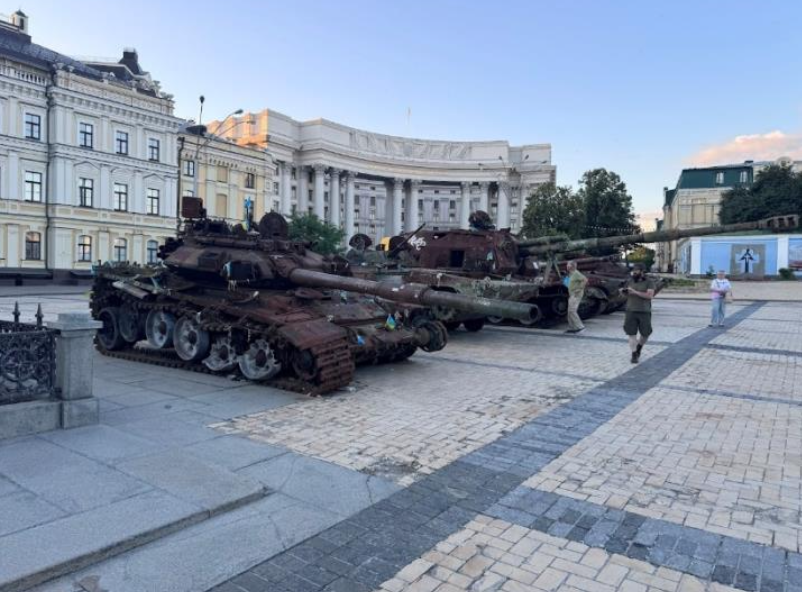
On arrival in Kyiv, precisely on time, Yaroslav, an old friend of Paul’s, meets us and we board a minibus for a quick tour of some of Kyiv’s sights. We have an eclectic dinner of modern and traditional Ukrainian food, washed down with a rather nice red – Odessa Black. After dinner we continue the whistle stop tour taking in a few more sights. St Michael’s church with its wall of remembrance, thousands of faces of those who have lost their lives since 2014. As always, very sobering. The hulks of burnt-out Russian vehicles sit in the square in front of the church and are a grim reminder of the cost of war to everyone. There is then a headlong dash to Kyiv station to catch our sleeper west to Lviv. A little bit of confusion, as the 22.17 is not listed initially, but it eventually appears and we head to Platform 6 and hopefully a decent night’s sleep. The two berth cabins are comfortable and we bed down for the night, having persuaded Iain not to crack open the bottle of whisky he was carrying.
Saturday 20 June – Lviv to Poland
We wake and receive our tea from the carriage guard, somewhat frustrated as she had also been trying to fix both loos, which had packed up overnight. We arrive in Lviv just before 07.00 again on time. Here we say goodbye to Paul, Oleh and Archie who are staying on in Lviv and the remainder of us board a minibus to the border crossing point some 13 km east of Przemysl. I note the road signs encouraging enlistment in the army. We are then stopped by a Ukrainian guard at a check-point short of the border post. He checks our passports and questions Toby if he is in the army given his military-looking gear. Perhaps checking for draft dodgers and deserters? We speed through Ukrainian passport control only to see a rather long queue to get through to the Polish side. Anthony White took the initiative and confirmed we could go through the EU lane. We move past waiting families, hot and bothered by their long wait in the strong morning sun. We edge between two women who are having a very intense argument about what we surmise is one’s attempt at queue-jumping. We make slow passage through Polish border control and then head for the taxis waiting on the main road. I had travelled with three friends who I had served with in the 4th Royal Tank Regiment decades before and we enjoyed a very nice afternoon and evening in Krakow Old Town, with Iain’s wife Clare joining us later.
In summary, it was a fantastic week being part of what is essentially a road trip with a serious element and common purpose to provide needed aid and trucks, but which also provided the full range of emotions; sadness at seeing the waste of life that accompanies war; the frisson of excitement that accompanies a bit of danger and lots of laughs. We met some wonderful people, the tough, resilient and determined Ukrainians and our fellow travelers.
A huge thank-you to all those who made it possible, Paul, Oleh, Anthony and Archie along with Tisha and the UK team and of course to all those that donated so generously to fund the 12th convoy and make it happen. Best of luck to convoy 13 in October 2026.
Niall MacNaughton
Product | Quantity | Price |
OMRON M1 Blood Pressure Monitor | 10 | £196.50 |
EcoFlow DELTA 2 Portable Power Station | 25 | £10,895.00 |
Sleeping bags | 25 | £1,593.50 |
Generators 3.5kw | 2 | £440.00 |
Generators 2.3kw | 8 | £2,487.92 |
Power banks | 45 | £955.80 |
Generators 3.3kw | 19 | £7,855.96 |
Tourniquets CAT | 1550 | £33,288.25 |
Ecoflow Delta 2 Max | 8 | £7,147.00 |
Power banks 60000mAh | 15 | £471.60 |
Power banks 50000mAh | 10 | £369.90 |
Emergency bandages 6″ | 345 | £1,894.80 |
Emergency bandages 4″ | 30 | £167.40 |
Rescue eye shields | 100 | £537.13 |
EcoFlow DELTA 3 Max Plus / DELTA 3 Max Plus Smart Extra Battery | 3 | £6,594.00 |
EcoFlow DELTA 3 Max | 3 | £3,242.00 |
Vented Chest Seals | 1110 | £10,489.50 |
XShear Trauma Shears | 165 | £5,443.35 |
Celox Gauze | 290 | £7,972.10 |
Haemostatic Dressing | 100 | £899.00 |
Burn gels | 80 | £175.20 |
Hyundai 3.3kW Petrol Open Frame Inverter Generator | 4 | £1,199.96 |
Plug converters | 59 | £829.84 |
Poly – EncorePro 520 QD headset | 2 | £192.00 |
Diesel generator KS 9200HDES-1/3 ATSR | 1 | £1,444.00 |
Foam mattresses | 20 | £405.79 |
Storage Cases | 3 | £339.98 |
SUM: | £107,527.48 |